
Social Media Management Services to Offer: 5 That Sell to Local Businesses
October 19, 2026 · 10 min read · by Jan Oršula
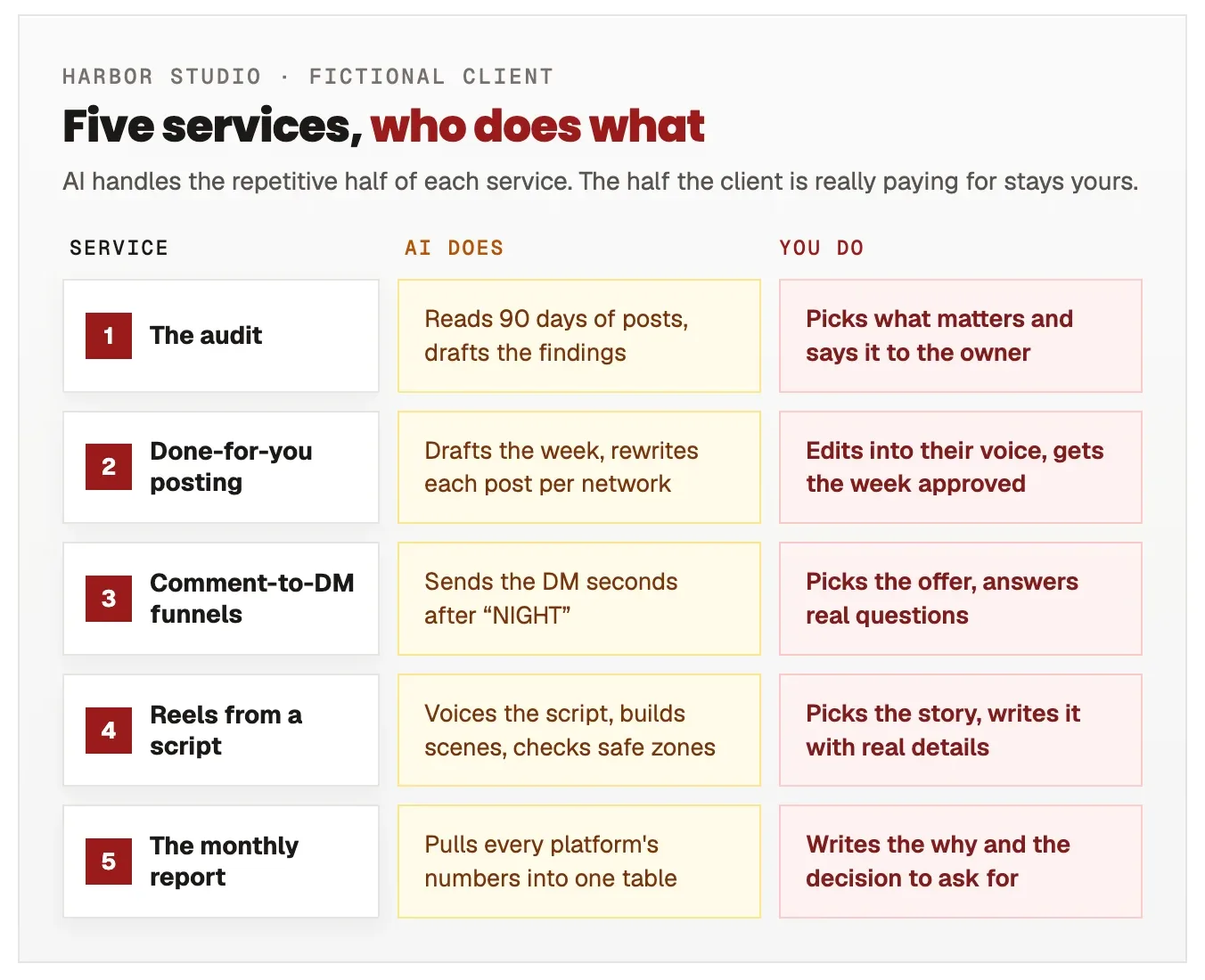
The social media services a local business will pay for are the ones tied to a result the owner can see: an audit, done-for-you posting, comment-to-DM funnels, short videos made from a script, and a monthly report. Strategy, content creation, scheduling and community management all live inside those five; ads and influencer work come later. What changed is the workload. AI now drafts the posts, voices the videos and pulls the numbers, so one person can run these services for several clients at once. Your part is the judgment: what to say, what to fix, and what the client should decide next.
This guide walks through each service with one example client, shows which half AI handles and which half stays yours, then packages and prices the five from your actual hours. The free kit below has the four documents you need to sell and deliver them.
The client kit (4 files, about 73 KB in total)
Word and Excel files that also open in Google Docs, Google Sheets, Pages and Numbers. No sign-up.
What services does a social media manager offer?
Ask ten agencies and you'll get ten lists, but they all draw from the same menu:
- Strategy: goals, audience, which platforms, what to post about.
- Account setup and optimization: bios, links, access, profile details.
- Content creation: captions, graphics, carousels, short video.
- Scheduling and publishing: getting each post out at the right time, on each network, in that network's format.
- Community management: replying to comments and messages.
- Reporting: what happened, why, and what it earned.
- Audits and consulting: a one-off review with recommendations.
- Paid social: running ads on Meta, TikTok or LinkedIn.
- Influencer outreach and training: less common for small clients.
The trouble with selling that menu as-is is that a café owner doesn't buy "community management." They buy "every comment gets an answer." A task list makes them guess what they're paying for, so the five services below are the menu regrouped into things a local business can picture, each one ending in something they can point at.
The five services, with one client running through them
To keep this concrete, every service below uses the same client: Harbor Studio, a small music venue that runs open studio nights every Thursday. The owner knows Instagram matters, posted four times in the last 90 days, and has no time to do more.
1. The audit: the service that gets you the retainer
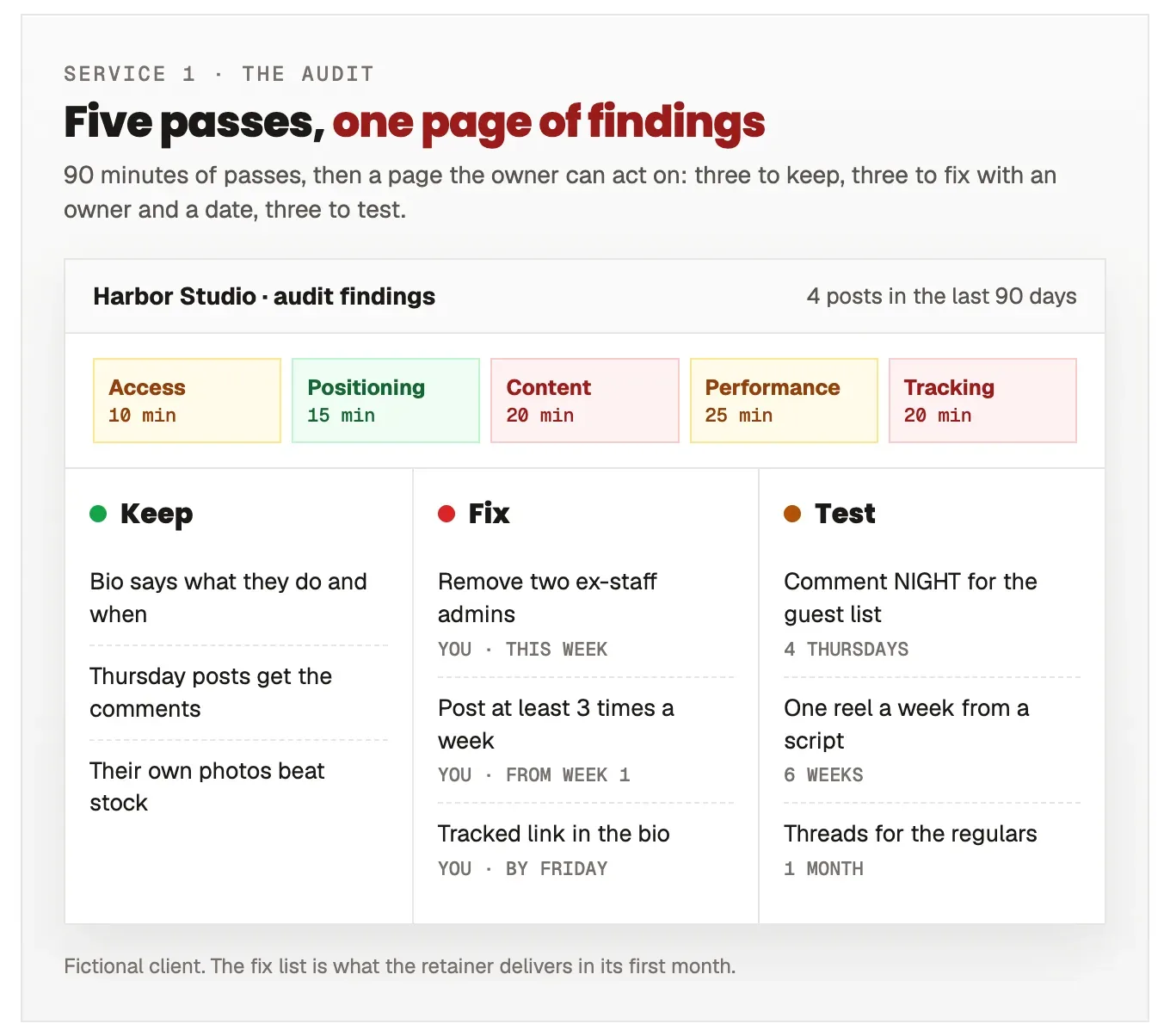
What the client gets: a review of every account in five passes (access and hygiene, positioning, content and mix, performance against their own baseline, tracking and funnel) and a one-page findings doc. Three things to keep, three to fix with an owner and a date, three to test.
What AI does: pulls the last 90 days of posts, counts how the content splits across topics, compares this quarter with the last, and drafts the findings in plain language.
What you do: decide which findings matter for this business and say them to the owner's face. AI can tell Harbor Studio that two former staff members still have admin access. You're the one who explains why that matters the week a disgruntled ex-employee posts from the venue's account.
Time: about 90 minutes to run, plus a 30-minute call to walk through it. The full five-pass procedure times each pass and the audit template in the kit gives each pass its own tab.
The audit sells first because it's small, priced as a one-off, and it ends in a fix list. Harbor Studio's audit said: four posts in 90 days, no tracked links anywhere, reach falling since spring. Nobody reads that list and decides to fix it alone. They ask who could do it for them, and you're already in the room.
2. Done-for-you posting: the core of the retainer
What the client gets: a week of posts, written for each network, published on schedule, without the owner thinking about it. For Harbor Studio that's nine posts a week across Instagram, TikTok, Facebook and Threads: lineup announcements, rehearsal clips, a question for the regulars, a thank-you after Thursday.
What AI does: drafts the whole week in one sitting from the client's content pillars and the events coming up, then rewrites each idea for each network. That rewrite step is the one people skip, and it's why copy-pasting one caption everywhere underperforms: every app cuts your caption off at a different length, and what works as a LinkedIn opener reads stiff on Threads. A scheduler then publishes each post at its time.
What you do: edit every draft into the client's voice (Harbor Studio says "come through," never "join us"), pick the photos, send the week for approval, and fix anything that's off before it goes out. The approval step is the service. The client is paying to see a finished week once, say yes, and stop thinking about posting.
Time: the planning session, editing and approvals are most of the 22 hours a month in the pricing example further down.
3. Comment-to-DM funnels: community management that runs itself
What the client gets: posts that turn comments into conversations. Harbor Studio's Thursday post says "Comment NIGHT for the guest list." Everyone who comments gets a private message a few seconds later with the time, the address and a link, and the venue sees who's coming before the doors open.
What AI does: nothing clever, and that's the point. An automation watches for the keyword and sends the reply. Instagram lets a business send one private reply to a comment within seven days of it being posted (more only if the person writes back), which is the mechanism these automations use (Meta's private replies documentation). Any comment-to-DM tool built on the official messaging API works; the section on running all five services below covers the one we use.
What you do: choose the keyword and the offer worth commenting for, write the DM so it reads like the venue and not like a bot, and answer the real questions that come back ("can I bring my own amp?"). The automation only sends the first message; everything after it is you.
Time: an hour or two to set up per campaign, then minutes a week to watch the replies. This one is easy to sell as a setup fee plus a monthly line, because the client can count the DMs.
4. Reels from a script: video without a shoot
What the client gets: short vertical videos, posted weekly, without anyone holding a camera. Most local businesses never post video because filming feels like an event. A script removes the event.
What AI does: turns a short script into a voiced video. A text-to-speech voice reads it, the timing of the voice sets the cut points, scenes are built from the client's own photos and clips, and a final check makes sure no text sits under the parts of the screen Instagram and TikTok cover with buttons. None of it needs a camera crew, only the client's photos and a script.
What you do: pick the story worth 25 seconds (the night a regular played their first set beats "we have a stage"), write the script with real details, and approve the cut. Some owners will want their own voice or face; mix their phone clips in and use the AI voice only where they'd rather not record.
Time: once the pipeline is set up, a script and a review are under an hour per video.
5. The monthly report: the reason they renew
What the client gets: one page that answers five questions. What were we trying to do? What happened? Why did it happen? What did it earn? What's next, and what do we need from you? Harbor Studio's October report reads: fill Thursday nights; reach 41,000 at 4.8% engagement; the guest-list reels beat photo posts; 212 guest-list DMs and three full Thursdays; and the question of whether to add a second night, with a yes needed by the 5th.
What AI does: pulls the numbers from each platform into the same table every month and drafts the first pass of the "what happened" section.
What you do: write the "why," which needs you to know the business, and the ask at the end. Ending on a decision is what gets the report read.
Time: about 30 minutes once the numbers are in one place. The monthly report guide has the full structure and a worked example, and the report template in the kit is laid out in the order of the five questions.
What about ads, influencers and training?
They're real services, and other lists put them near the top. For a first local client, they come later:
- Paid social needs a budget the client may not have yet, a different skill set, and a clear way to measure return. Add it once posting is steady and the report shows which posts are worth paying to push. Price it as a separate line, not folded into the retainer.
- Influencer outreach suits brands with a product to send out. A music venue is better served by featuring the artists who play there, which is content, not outreach.
- Training works when the owner wants to do it themselves. Offer it as a one-off session after the audit for clients who say no to the retainer. It keeps the relationship warm.
- Account setup doesn't need its own line: fixing bios, links and access is what the audit's fix list turns into in the first week.
How to package social media services
Five services make a natural ladder. Most clients climb it in this order:
| Package | What's in it | Billed |
|---|---|---|
| Starter | The audit and findings call | Once |
| Core | Done-for-you posting and the monthly report | Monthly retainer |
| Growth | Core, plus comment-to-DM funnels and reels | Monthly retainer, higher tier |
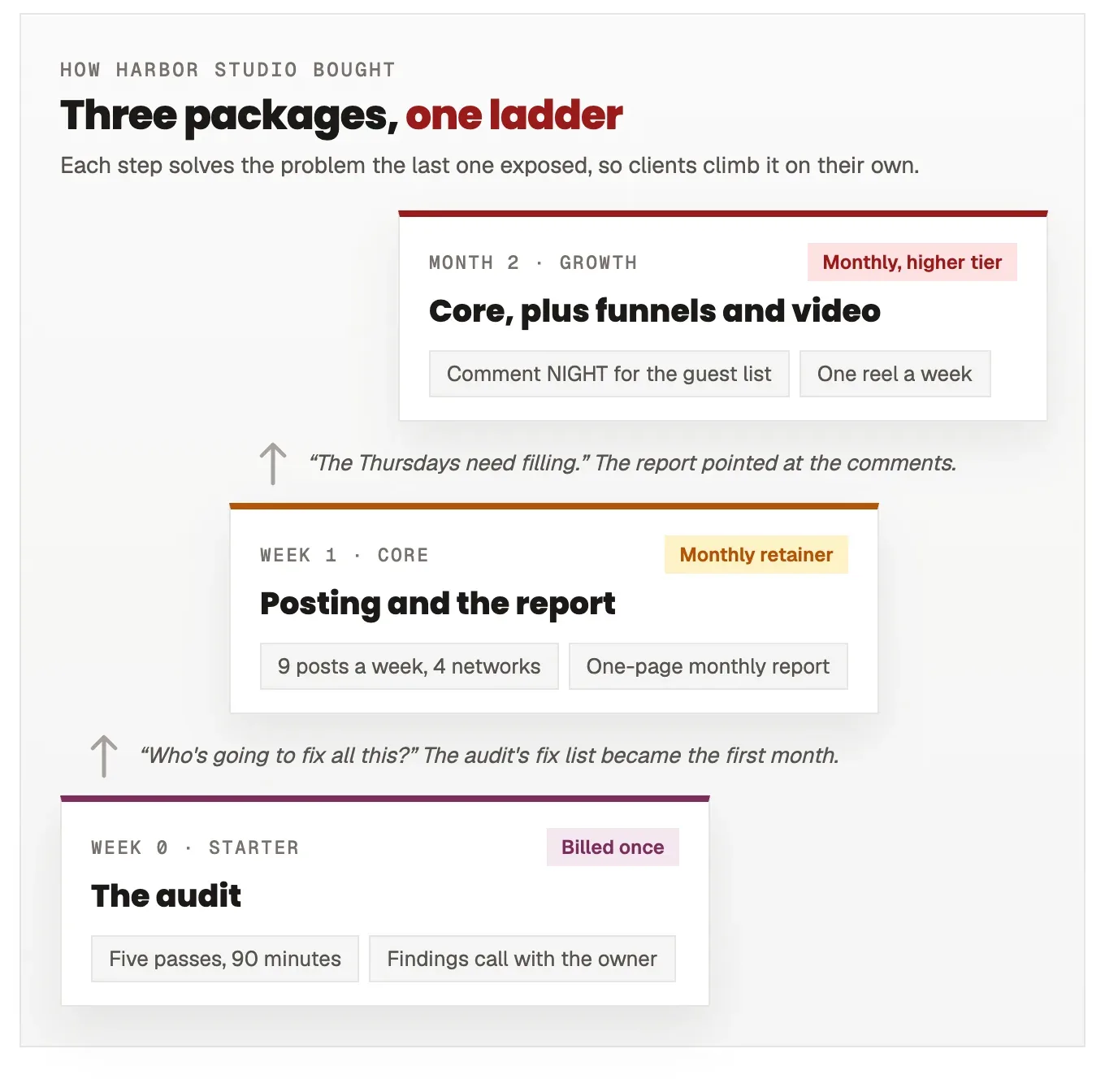
Harbor Studio bought the audit, signed for Core a week later, and added a DM funnel in month two when the Thursday nights needed filling. That path is typical because each step solves the problem the last one exposed. The proposal template in the kit is written to present these as options rather than one take-it-or-leave-it price, and the contract template covers scope, approvals and what happens to the accounts if the client leaves.
How to price social media services from your hours
Don't start from what other people charge. Start from how long the work really takes you, then multiply.
A Core retainer for Harbor Studio comes to about 22 hours a month once planning, editing, approvals, messages and the report are counted. If your effective rate (what you need to earn, plus overhead, divided by the hours you can actually bill) is $90, that's 22 × $90 = $1,980. Add a margin for the month something goes wrong and round up: $2,200 is the floor for that client. Three clients at the floor is $6,600 a month, about 66 hours of work.
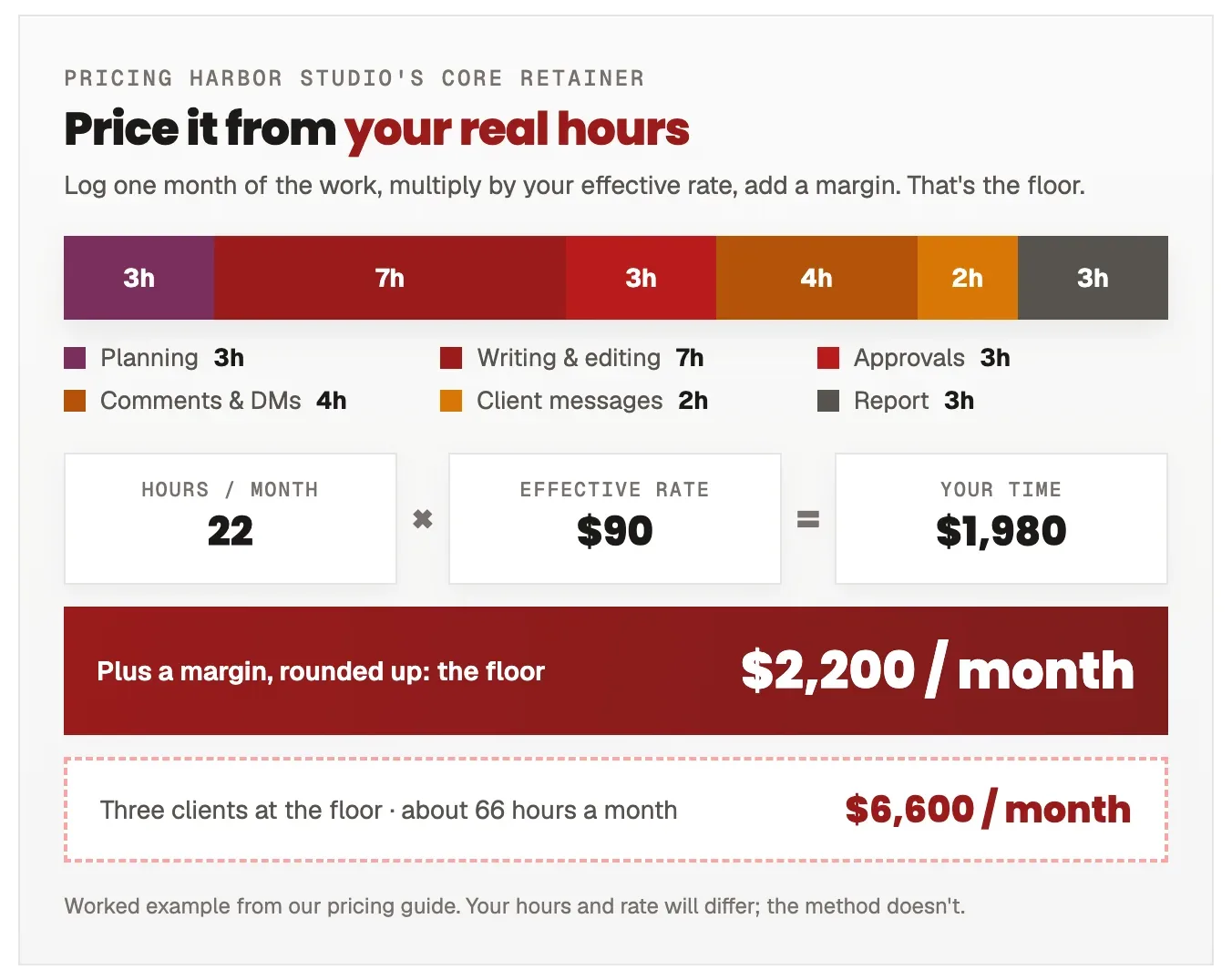
AI shortens some of those hours. That doesn't mean you charge less: the client is paying for nine posts a week and three full Thursdays, not for your minutes. Price the result, and use the hours you save to take on the next client or to do the part only you can do better. The pricing guide shows how to work out your effective rate and when to quote above the floor.
How to find your first social media client
Look for businesses that clearly need the audit. Open the Instagram accounts of ten places you'd walk into anyway: the venue down the street, a gym, a dentist, a bakery. The ones whose last post is from months ago, whose bio link is dead, or who post the same flyer everywhere are your list.
Then lead with something useful. Run the first two audit passes on their public profile (it takes about 25 minutes), write three specific findings in an email, and offer the full audit. Three findings about their account beat any pitch about your services. When they say yes, the client onboarding questionnaire gets you the voice, goals and logins in one pass.
Can AI do social media management on its own?
No, and a client wouldn't want it to. AI drafts, edits, voices and schedules, and tools that post for you deliberately stop and ask before anything goes live. What it can't do is know that the venue's sound engineer just left, that the owner hates exclamation marks, or that a comment is a regular's joke and not a complaint. Those calls are the job.
Running all five services for several clients from one place
Five services for three clients is fifteen things to keep straight, across twelve or more accounts. The tools matter less than keeping each client's work separate and the approvals in one place. Here's how the services map onto Kadenzo, which is what we built for exactly this:
- Each client gets a profile. Harbor Studio's Instagram, TikTok, Facebook and Threads belong to Harbor Studio, so a post can't land on the wrong venue, and the owner can review and approve only their own posts.
- Done-for-you posting goes out to up to 11 networks from one composer, each post in that network's format, at the time you set. On the Professional plan you can also draft and schedule from a chat in Claude or ChatGPT, as in our guide to scheduling posts with Claude.
- Comment-to-DM funnels run on Instagram and Facebook's official messaging API: someone comments NIGHT, gets a DM with a button, taps it, and gets the guest list link. See DM automation.
- The monthly report starts from analytics filtered to one client, and on the Professional plan becomes a branded report the owner opens from a link.
What it doesn't do: run the audit for you or make the reels. The audit is your judgment, and the video pipeline sits upstream; Kadenzo schedules the finished reel like any other post.
Kadenzo for freelancers and agencies
Run your clients from one dashboard
Client profiles, scheduling to 11 networks, comment-to-DM automation and branded reports. Compare what each plan includes.
See plans and pricing
Frequently asked questions
What should a social media management package include?
At minimum: a set number of posts per week on named networks, who writes and approves them, how fast comments and messages get answered, and a monthly report. Write each as a deliverable the client can check (nine posts a week on Instagram, TikTok, Facebook and Threads) rather than an activity like content creation.
How many social media clients can one person manage?
Work it out from hours, not from a rule of thumb. If a retainer takes about 22 hours a month, three clients is roughly 66 hours, a comfortable part-time load, and five fills most of a working month once you add sales and admin. AI drafting moves that number up, but approvals and client messages don't shrink much.
Should I offer a free social media audit?
Offer a free sample, not the full audit. Two passes and three findings by email show you know what you're doing; the full five-pass audit with a findings call is real work and should be paid. Paid audits also attract clients who act on the findings.
Do I need a contract for a small local client?
Yes, and small clients are where it matters most, because informal deals drift. A short contract should cover the scope, how approvals work, the notice period, and who owns the accounts and the content if the work ends. The contract template in the free kit covers all four.
What tools do I need to start selling social media services?
Less than you think: an AI assistant for drafting, a scheduler that publishes to each client's networks, a way to automate comment replies if you sell DM funnels, and a document for each client's report. Keep each client's accounts separate inside your tools so a post never goes to the wrong venue.