
Social Media Audit Checklist and Template: The 90-Minute Version
October 4, 2026 · 8 min read · by Jan Oršula
A social media audit is a periodic, structured review of everything your accounts are doing (access, positioning, content mix, performance, and tracking) that ends in decisions. The version that works is not the 40-point scorecard template: those get filled in once, graded generously, and filed. What works is five timed passes, 90 minutes total, producing a one-page findings doc with three things to keep, three to fix (with owners and dates), and three to test. This guide is that procedure, pass by pass, and the free template below gives each pass its own tab.
Social media audit template (.xlsx, 33 KB)
Excel, Google Sheets (File, then Import) and Numbers. No macros, no sign-up.
Download the template
What's in the template
Six tabs: one per pass, timed in the tab name, and a findings page. It isn't a scorecard. Each tab asks only for what that pass needs, and the formulas do the counting:
- Access turns an account's status red the moment two-factor is off, a former employee still has a login, or the bio link is dead.
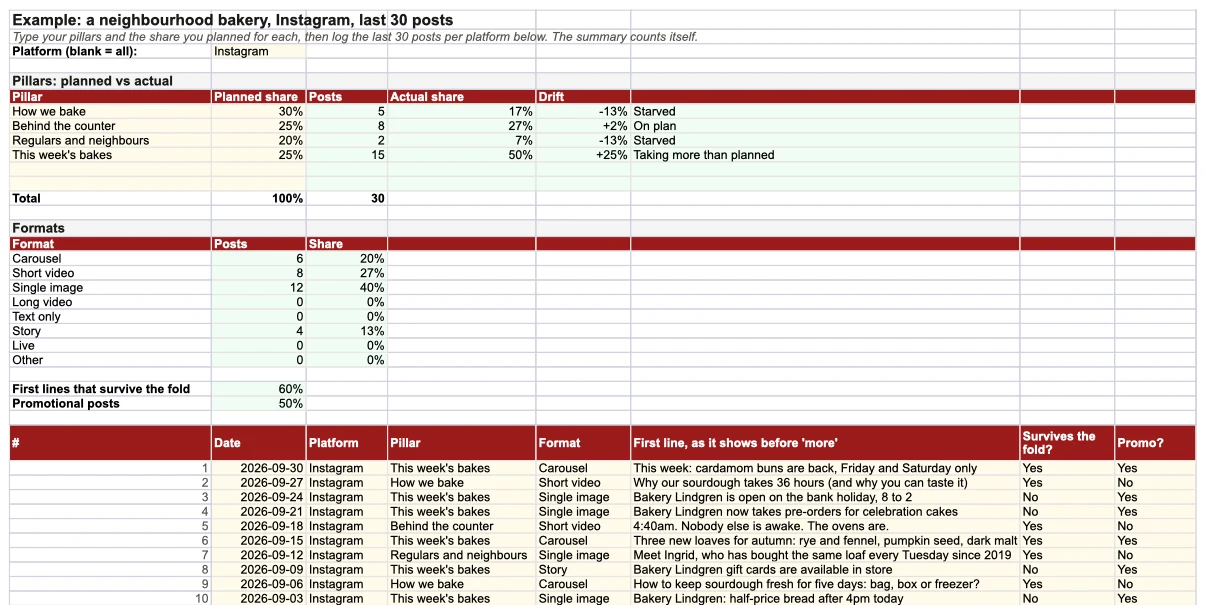
- Content mix is where the time goes. List your pillars with the share you planned for each, log your last 30 posts, and it shows the actual share per pillar, flags any that drifted ten points or more, and counts how many first lines survive the fold.
- Performance compares this quarter with your baseline per platform and names the pattern that matters most: engagement rate rising while reach falls.
- Findings pulls in what the passes flagged, then gives you three rows each for keep, fix (with owner and due date) and test.
Where the audit fits
Three instruments, three jobs. Your baseline tells you what normal looks like for your account. Your monthly report tells you what happened against that normal. The audit is the quarterly (or new-client) deep look at the system itself, the things a monthly report assumes are fine: who has the passwords, whether the bio still says what you do, whether the content mix drifted, whether the tracking still works. Reports catch performance problems; audits catch structural ones.
Pass 1: access & hygiene (10 minutes)
The unglamorous pass that saves careers. Inventory every account: who has admin access, whether two-factor is on, where the passwords live, and which former employee or agency still has a key. Then sweep the edges: abandoned accounts still discoverable in search, an old handle squatting on your brand name, bio links pointing at a campaign that ended in March. Bad looks like: a single shared password in someone's notes app, or an account whose only admin left the company. Every finding here is a fix-now item by definition.
Pass 2: positioning (15 minutes)
Open each profile as a stranger and give it five seconds: can you tell who this account is for and what they get from following it? Check the bio's claim against the last month of content (accounts drift; bios don't), the link destination, the pinned post or highlights, and whether name, handle, and avatar are consistent enough across platforms that a searcher knows they found the same brand. Bad looks like: a bio written for the company ("Innovating synergy since 2019") instead of the follower, or a pinned post from a previous strategy.
Pass 3: content & mix (20 minutes)
Pull the last 30 posts per platform into a quick list and label each with its pillar and format. Now count. The intended mix was a ratio; the actual mix is a confession. Most audits find promotion ate a quarter more share than planned and one pillar quietly starved. Scan first lines only across the 30: how many would survive the feed's fold? Finally, look for repurposing leaks, strong posts that lived once on one platform and were never translated to the others. Bad looks like: nine promos and one useful post, or thirty openers that all start with the company name.
Pass 4: performance vs. baseline (25 minutes)
The longest pass, and the one your existing discipline pays for. Refresh the trailing baseline per platform: engagement rate per post (the calculator does the per-post math and prints the methodology), median reach, high-intent interactions. Then pull the five best and five worst posts of the quarter and read them against their pillar's job, not against each other: education should out-save the baseline, community should out-comment it, product will underperform on everything and that's its job. Bad looks like: a rising rate on collapsing reach, or every top post coming from one pillar while the calendar still funds five.
Pass 5: tracking & funnel (20 minutes)
Click your own links like a customer. Bio link → landing page → the thing you actually want people to do: does the path work on a phone, and does each step get recorded? Check that outbound links carry consistent UTM tags, that social sessions land in the right GA4 channel instead of Unassigned (the GA4 setup guide covers the 30-minute fix if not), and that at least one key event is defined and firing. Bad looks like: a quarter of "social media drove no revenue" that turns out to be a quarter of untagged links.
The findings doc
One page, three lists, written in the last ten minutes while the details are fresh:
- Keep (3): what's working and must survive the next strategy conversation, with the number that proves it.
- Fix (3): the highest-leverage problems, each with an owner and a date. Three, not eleven; an audit that produces eleven fixes produces zero.
- Test (3): hypotheses for next quarter, each tied to something the audit surfaced ("education out-saves everything, so test doubling its share").
Findings without owners are observations. The doc is the audit; the 90 minutes are just how you write it.
Cadence
Quarterly for accounts you run continuously. The system drifts slower than performance, so monthly auditing just re-reads the same page. The exception is inheritance: every new client or newly adopted account gets the full 90 minutes in week one, because you're not auditing your own assumptions yet, you're discovering someone else's. Between audits, the monthly report carries the load, and if a report ever surprises you structurally, that's the signal to pull the audit forward. No monthly report yet? The social media report generator builds one from the numbers you already collect.
Frequently asked questions
Is there a free social media audit template?
Yes, the template on this page is a free .xlsx file with no sign-up. It opens in Excel, Google Sheets and Numbers, and has a tab for each of the five passes plus a findings page. The formulas count your content mix against plan and flag access and tracking problems for you.
How long should a social media audit take?
Ninety minutes if you time it. Five passes (access, positioning, content mix, performance, and tracking) run 10 to 25 minutes each, and the last ten go to writing the findings doc. The 40-point scorecard takes longer and gets filed unread; the timed version ends in decisions.
How often should you do a social media audit?
Quarterly for accounts you run continuously, since the system drifts slower than performance and monthly auditing just re-reads the same page. The exception is inheritance: every new client or adopted account gets the full audit in week one, because you're discovering someone else's assumptions, not checking your own.
What should a social media audit include?
Five things, in order: who has access and whether security is sane; whether the positioning still reads clearly to a stranger; whether the content mix drifted from its intended pillar ratio; how performance tracks against your own baseline; and whether links and tracking actually fire end to end. Each pass produces fix-now items the monthly report would never catch.
What is the difference between an audit and a monthly report?
A report tells you what happened against your baseline; an audit checks the system that produced it. Reports catch performance problems, like a soft month or a weak post. Audits catch structural ones the report assumes are fine: stale passwords, a bio that no longer matches the content, untagged links quietly hiding every conversion.
What makes an audit actually get acted on?
Cutting the fix list to three. An audit that produces eleven fixes produces zero, because nobody owns eleven things. End on a one-page doc (three things to keep, three to fix with an owner and a date each, three to test) and the findings turn into changes instead of a filed document.