
Content Pillars for Social Media: Ratios, Not Vibes
July 4, 2026 · 7 min read · by Jan Oršula
Content pillars are the three to five recurring themes an account commits to. The reason most pillar exercises fail is that teams stop at the naming part. A list of themes taped to a strategy doc changes nothing. A pillar only does work when it's a ratio enforced in the calendar: education gets two slots a week, social proof gets one, and the mix is decided before the week gets busy, not after promotion has quietly eaten it. This guide covers picking the pillars, setting the ratios, wiring them into actual slots, and auditing the drift monthly.
A pillar is a promise with a ratio
A useful pillar names a value the audience receives, repeatedly. That's what separates it from two things it gets confused with: a topic (a subject you happen to post about once) and a format (carousel, Reel, thread: the container, not the content). "Education" is a pillar; "our April webinar" is a topic; "carousels" is a format. Pillars stay stable for quarters, topics rotate weekly, formats get chosen per post.
The ratio is what gives the pillar teeth. "We do educational content" commits you to nothing. "Two of our five weekly posts are educational" is checkable, schedulable, and noticeable when it slips. If you can't attach a number of slots to a pillar, it isn't a pillar yet. It's a mood.
The five-pillar default, and how to make it yours
A general-purpose starting set (the same one our content calendar generator ships with) covers most accounts:
- Education: teach the thing your audience is trying to get better at. Earns saves, builds authority.
- Behind-the-scenes: the process, the tools, the misses. Earns trust; cheapest to produce because the material already exists.
- Social proof: results, testimonials, customer stories. Converts the audience the other pillars assembled.
- Product: what you sell, framed by the problem it removes. The pillar everything else buys permission for.
- Community: questions, polls, spotlights. Earns the comments that feed distribution.
Make it yours by renaming pillars in your audience's language and re-weighting for your model. A B2B consultancy might run education-heavy (say 40% education, 20% proof, 20% behind-the-scenes, 10% product, 10% community) because authority is the product. A local fitness studio inverts toward community and proof: member spotlights and transformation stories are the marketing, so education drops to a supporting role. Both keep product at a disciplined minority share, because the audience tolerates promotion in proportion to the value around it.
Three to five is the working range. Two pillars make a repetitive feed; six make a ratio nobody can hold in their head, which means nobody will.
The pillars stay the same across channels, but a pillar wears a different costume on each one: an education pillar becomes a Reel on Instagram, a thread on X, and a document post on LinkedIn. Same value, native format. The mix can shift per platform too, since each audience shows up for something different: behind-the-scenes might carry your Instagram while education leads on LinkedIn. Weight the ratio to the channel rather than copy-pasting one split everywhere.
Enforce the mix in slots, not in intentions
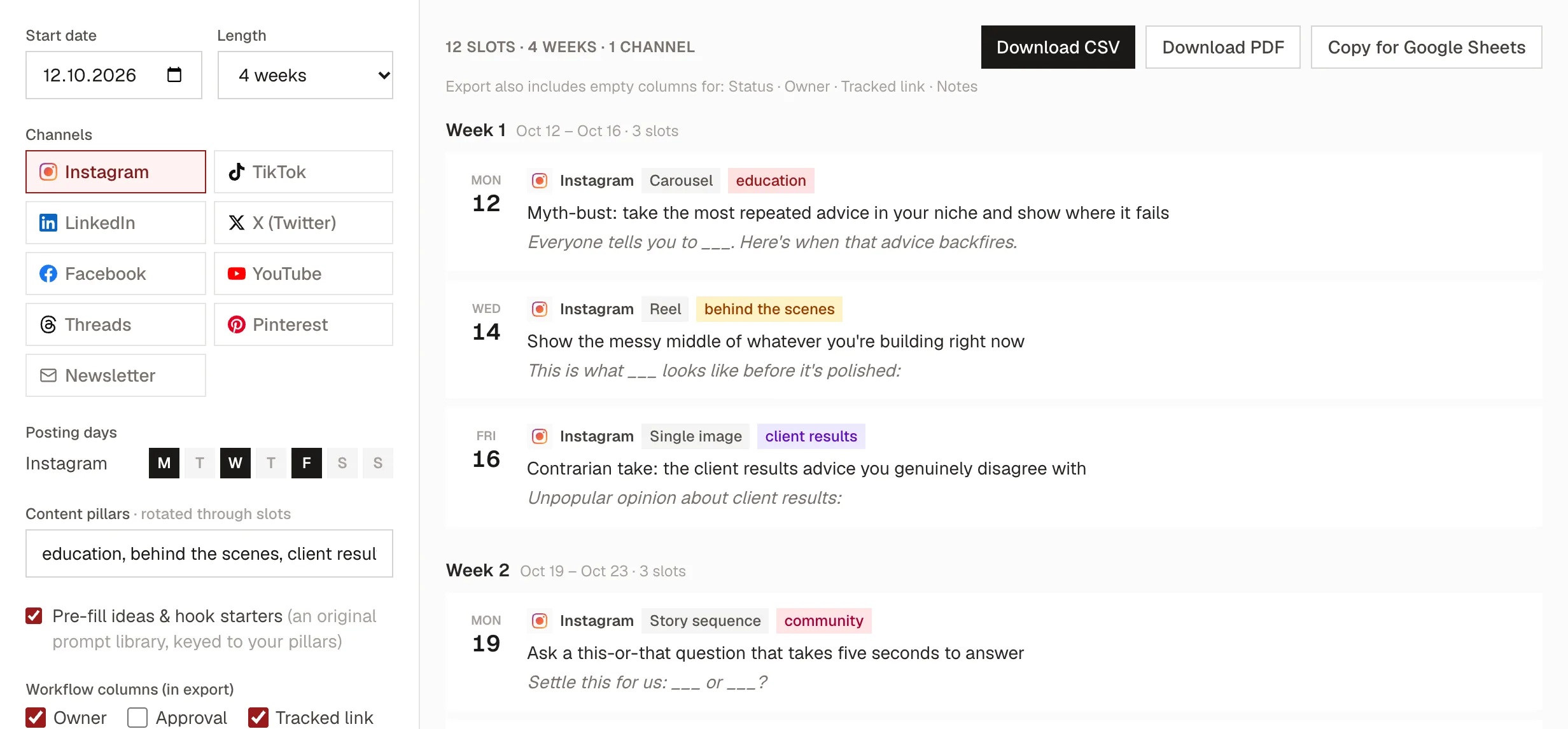
The failure mode of every pillar strategy is the busy week. Nobody decides to abandon the mix. There's just a launch, and suddenly the month was 70% promotion. The fix is mechanical: assign a pillar to every calendar slot before the content is written, so the mix is a property of the schedule instead of a daily act of willpower. (The calendar generator rotates your pillars through the slots automatically; adjusting a week means consciously swapping a labeled slot, which is exactly the speed bump you want.) Pillar-first planning also kills the blank-page problem, because "write Tuesday's education post" is a workable brief in a way "post something Tuesday" never is. And it's the natural place to plan the opening line, since each pillar tends toward its own hook patterns.
Audit the drift monthly
Pillars are bets, and bets get settled. Once a month, two checks, both of which slot straight into the content pass of your quarterly audit when it comes around:
Mix drift. Count last month's posts per pillar and compare against the intended ratio. A drift of one or two posts is noise; a pillar that got half its intended share for two straight months is a planning problem, or a sign the team quietly hates producing it, which is worth knowing.
Pillar performance. Compare each pillar's engagement against your account's own trailing baseline, not against the other pillars, because they have different jobs. Education should beat your baseline on saves; community on comments; product will run below baseline on everything, which is fine, because its job is conversion, not applause. A pillar that underperforms its own job for a quarter gets reworked or merged. Kill it only after you've checked whether the execution, not the theme, was the problem. Most "dead" pillars are really one tired format wearing the pillar's name.
Run the ratios for a quarter and the feed develops the quality audiences actually follow accounts for: a rhythm. People can't name your pillar split, but they can feel that following you is predictably worth it, and predictably worth it is the whole game.
Frequently asked questions
How many content pillars should you have?
Three to five. Two pillars make a repetitive feed; six make a ratio nobody can hold in their head, which means nobody holds it. Start at five general-purpose pillars, then merge or rename until you land in the working range.
What is the difference between a content pillar and a topic?
A pillar names a value the audience receives, repeatedly, and stays stable for quarters. A topic is a subject you happen to post about once and rotates weekly. 'Education' is a pillar; 'our April webinar' is a topic; 'carousels' is a format, which is the container, not the content.
What is a good ratio for content pillars?
There's no universal split. It depends on your model. A B2B consultancy might run education-heavy because authority is the product; a local fitness studio inverts toward community and proof. The one constant is keeping product a disciplined minority share, because audiences tolerate promotion only in proportion to the value around it.
How often should you audit your content pillars?
Monthly, with two checks. Count last month's posts per pillar against the intended ratio to catch mix drift, and compare each pillar's engagement against your own trailing baseline rather than against the other pillars, since they have different jobs. A pillar that underperforms its own job for a quarter gets reworked or merged.
Why do most content pillar exercises fail?
Because teams stop at naming the themes and never attach a number to them. A list taped to a strategy doc changes nothing; a pillar only does work when it's a ratio enforced in the calendar before the week gets busy. If you can't assign a pillar a number of slots, it isn't a pillar yet; it's a mood.