
How to Become a Social Media Manager (Even With No Experience)
October 30, 2026 · 13 min read · by Jan Oršula
To become a social media manager, you need three things more than a degree: the core skills (writing, planning, reading the numbers), one account you've run long enough to show a result, and a portfolio that proves you can do the job for someone else. The usual advice stops at "build a portfolio", which is the hard part when nobody has hired you yet. This guide fills that gap with a concrete method: audit three real local businesses' public profiles, turn each audit into a short document with numbers and fixes, and use one of them to win your first client. It also covers free certifications, entry-level job titles, pay, and how long the whole thing realistically takes.
What a social media manager actually does
The job title covers a lot, but a typical week for someone managing a small business's accounts looks like this:
- Planning: deciding what to post over the next few weeks, built around the business's goals and a few recurring themes.
- Making the posts: writing captions, taking or editing photos and short videos, or briefing someone who does.
- Scheduling and publishing across two or three platforms.
- Replying: comments, DMs, reviews, and questions that need passing to the right person.
- Measuring: checking what worked, and turning that into a short monthly report the client actually reads.
- Talking to the client: getting approvals, chasing photos, explaining why a post did well or didn't.
Junior roles lean toward the middle of that list (making, scheduling, replying). Senior roles own the top and bottom: the plan and the numbers.
Do you need a degree or experience?
Not strictly. In the US, the Bureau of Labor Statistics doesn't track social media managers as their own occupation; it counts them under public relations specialists, where the typical entry route is a bachelor's degree in communications, marketing, journalism or similar. In-house jobs at larger companies often list a degree. Small businesses and freelance clients almost never ask: they want to see work that looks like what they need.
Experience is the bigger hurdle, and it's a circular one (you need a job to get experience, and experience to get a job). The way out is to produce the same kind of evidence a job would have given you, which is what steps 2 to 4 below are for.
The skills that matter, and how to practise each
| Skill | What it looks like on the job | How to practise without a client |
|---|---|---|
| Writing | Captions that stop the scroll and sound like the brand | Rewrite five captions from a business you like, in their voice |
| Planning | A month of posts tied to a goal | Plan four weeks for a business you know, around three themes |
| Basic visuals | Clean photos, simple graphics, short edited clips | Shoot and edit one short video a week on your phone |
| Reading the numbers | Knowing which posts worked and why | Calculate engagement rate for 10 posts on a public profile |
| Community | Replies that help, defuse or convert | Draft replies to real (public) complaints and questions |
| Client communication | Clear updates, approvals, saying no to scope creep | Write the one-page audit in step 3 as if a client will read it |
You don't need all six at an expert level to start. You need enough of each to do a small business's accounts well, and one or two you're noticeably good at.
How to become a social media manager, step by step
1. Learn the basics (free)
Three free or cheap options are worth your time, mostly for what you learn, less for the badge:
- HubSpot Academy's social media course: free, and a solid overview of strategy, content and measurement.
- Google Analytics certification: free through Google's Skillshop. Most social media managers can't explain where their traffic goes once someone clicks, so this is a real advantage. Our guide to GA4 for social media teams covers the social-specific setup.
- Meta Blueprint: the training is free; the Meta Certified Digital Marketing Associate exam costs money. Take the free courses first and only pay for the exam if job ads you're applying to mention it.
Don't let certifications become the project. A few weeks of learning is enough to start step 2; you'll learn faster from running an account than from another course.
2. Run one account for real
Pick one account and run it properly for about three months: your own project, a friend's small business, a local club or a charity that would welcome the help. "Properly" means a plan, a regular schedule, replies to every comment, and a number you track from the start (followers, engagement rate, or clicks to a website).
The result doesn't have to be dramatic. "Grew a running club's Instagram from 300 to 900 followers and filled two beginner sessions from posts" is a better portfolio piece than a big number you can't explain. Write down what you tried each month and what changed, because that's the case study.
A free content calendar template is enough to plan it. Our guide to content pillars helps you choose the three themes to rotate.
3. Build a portfolio from three practice audits
This is the step most guides skip. A practice audit is a short, honest review of a real business's public social media, with numbers, what's working, and specific fixes. It shows exactly what a client is paying for: the ability to look at an account and know what to do next.
Pick three local businesses that already post but clearly could do better: active, but inconsistent, with weak captions or a messy bio. Choose three different types so your portfolio shows range. For this guide, take a florist, a physiotherapy clinic and a climbing gym. Here's how the florist's audit comes together.
Measure the last few posts. You can't see a business's reach from the outside, but you can see likes, comments and follower count. Note them for ten recent posts and calculate the engagement rate against followers. The free engagement rate calculator does the averaging and gives you a methodology line to paste into the audit:
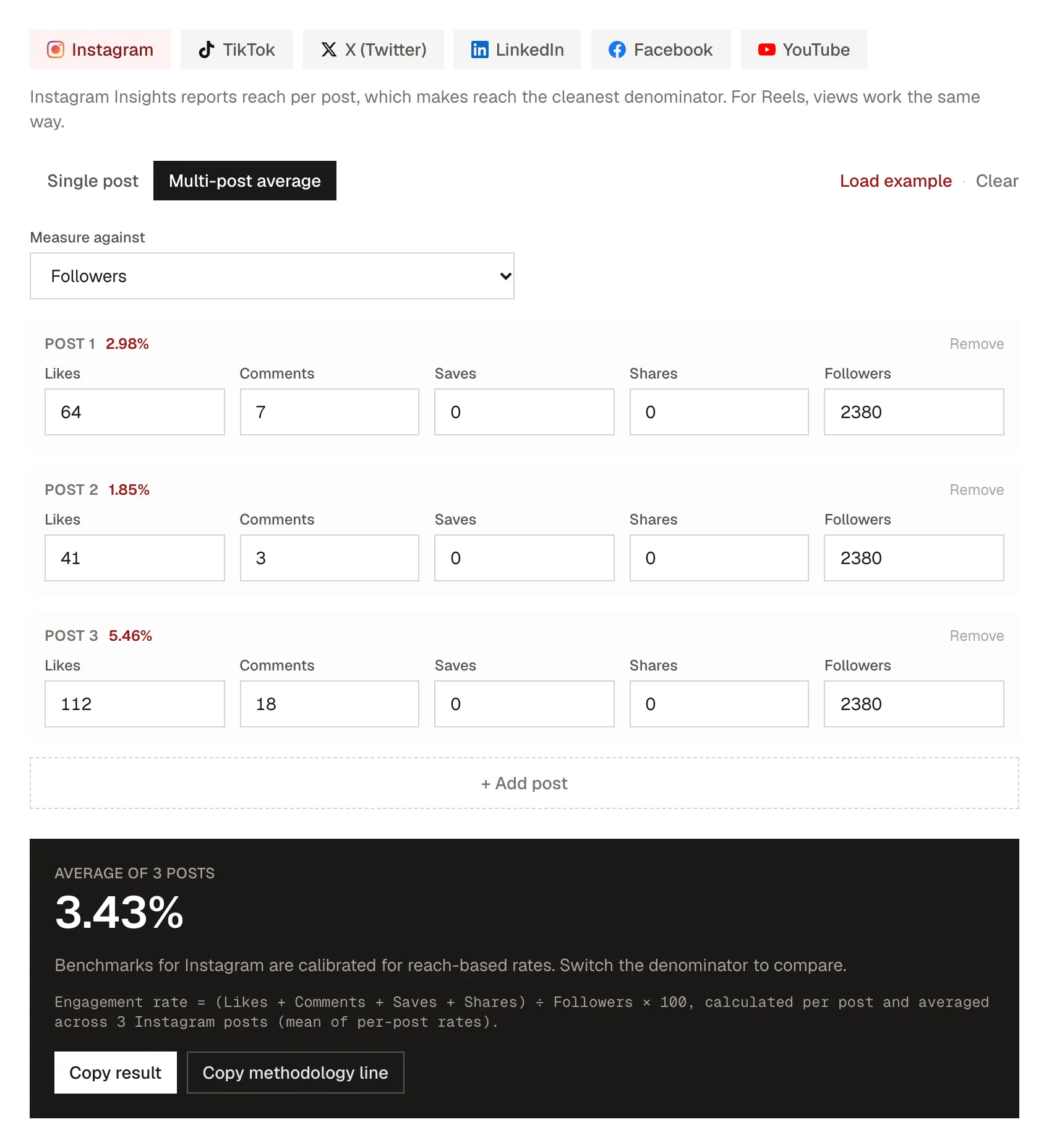
The number on its own says little. What matters is the pattern: in our florist's case, the behind-the-scenes posts consistently beat the product photos, roughly twice over. That's the first line of the audit.
Write down what's working and what isn't. Keep it to three of each, and make every point specific. "Posting is inconsistent" is vague. "Eleven posts in March, two in April, none in the first three weeks of May" is a finding. The full social media audit checklist covers what else to look at.
Suggest three quick wins. Fixes the business could make this week, each one shown rather than described. The florist's bio said only "Flowers for all occasions", with no location, no mention of delivery and no reason to tap. The free bio generator gives you alternatives to put side by side with the original:
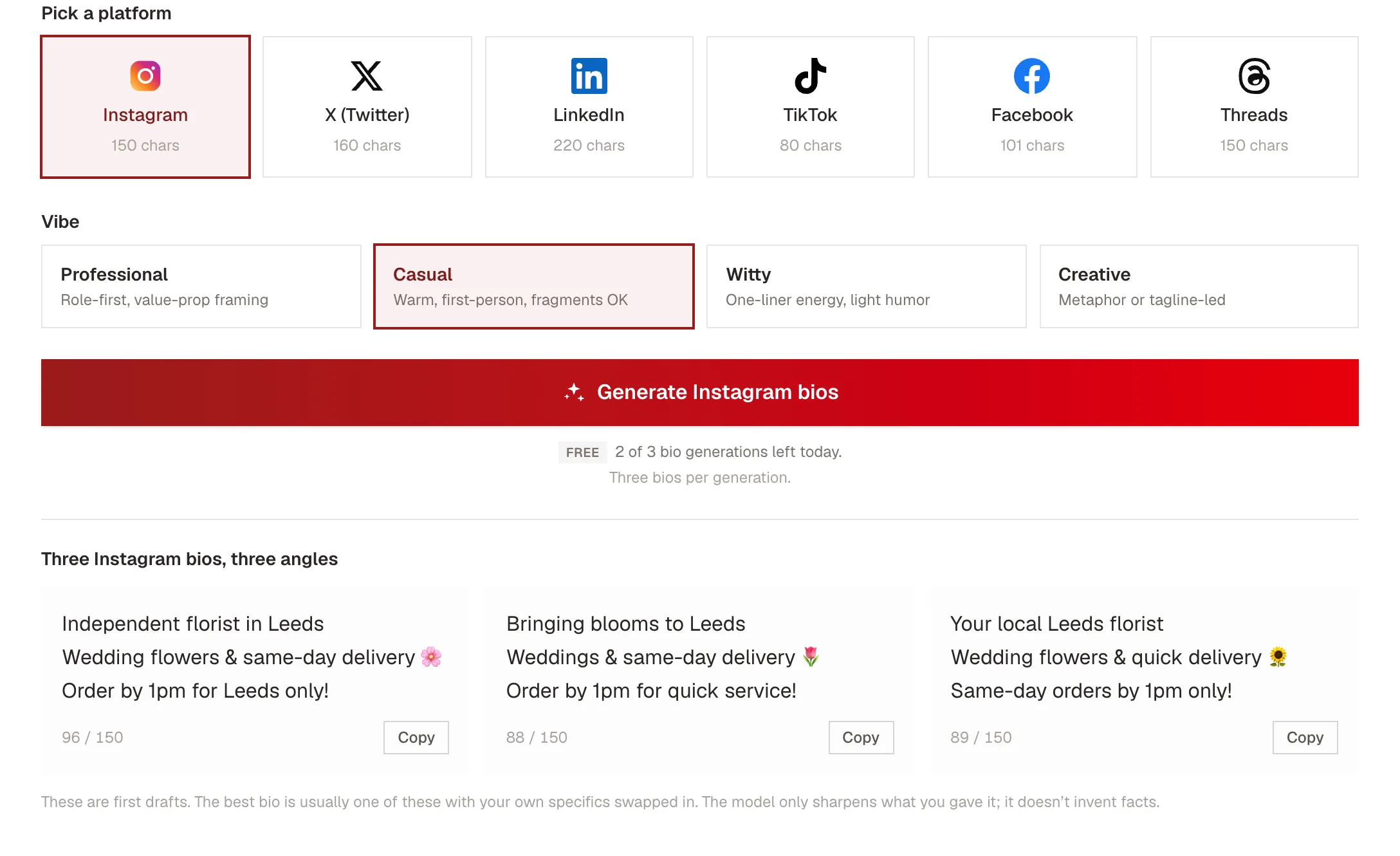
Treat generated drafts as raw material. Pick one, tighten it in your own words, and say why it's better (it names the city and gives a reason to order today). That reasoning is what the client is buying.
Add a sample two weeks. Six to eight post ideas, with a one-line caption each, built around what the numbers showed. For the florist: more behind-the-scenes videos, one wedding post a week, and a weekly "order by 1pm" reminder.
Put it on one or two pages. Numbers, three things working, three things to fix, three quick wins, two weeks of ideas. That's one portfolio piece. Do it three times and you have a portfolio that shows how you think, which is more persuasive than a gallery of pretty posts.
One rule: these are real businesses, so don't publish an audit that criticizes one without its permission. Keep them in a private portfolio you send on request, or remove the business's name.
4. Turn an audit into your first client
Your practice audits are also your best pitch. Pick the business whose audit showed the clearest wins, and send it to them, short and specific:
Hi, I'm a social media manager starting out in Leeds. I put together a short review of your Instagram, including three changes you could make this week. Your behind-the-scenes videos get about twice the engagement of your product photos, which is worth building on. Happy to send it over, no strings attached.
Some won't reply. Some will read it and make the changes themselves, which is fine: it was practice anyway. The ones who reply are your warmest leads, because they've already seen what you'd do.
When someone wants to go further, make it easy to say yes:
- Offer a paid first month with a small, clear scope (for example, 12 posts, replies on weekdays, and a short report at the end). A small paid month beats free work: it's taken seriously, and it gives you a real testimonial.
- Price it properly from the start. Our guide to social media management pricing covers how freelancers set monthly rates.
- Put it in writing. A one-page proposal and a simple contract protect both of you, especially on revisions and who supplies the photos.
- Start with an onboarding questionnaire so you're not guessing at the brand's voice. Our client onboarding guide has the questions.
At the end of the month, send a short report with the numbers and what you'd do next. The free report generator turns the numbers into a structure a client reads in two minutes.
5. Or apply for an entry-level job
If you'd rather be employed than freelance, the same portfolio works for job applications. Search for the titles where most people start, not only "social media manager":
- social media coordinator, executive or assistant
- community manager or community coordinator
- content assistant or marketing assistant
- junior roles at a marketing or social media agency
Agencies are worth a look in particular: you'll work on several clients at once and learn quickly. Send your account case study and one practice audit with the application, and in the interview, walk through the audit. Being able to explain what you'd change, and why, is exactly what the hiring manager is trying to find out.
Freelance or in-house?
| Freelance | In-house or agency | |
|---|---|---|
| Getting started | You can start this month with one client | Needs a hiring process, often a degree at larger companies |
| Income | Uneven at first, set by your rates and client count | Steady salary and benefits |
| What you learn | Sales, pricing and client management, fast | Process, specialist colleagues, bigger budgets |
| The hard part | Finding clients, chasing invoices | Less choice over what you work on |
Plenty of people do both: a junior job for stability and one or two freelance clients on the side, then move to whichever suits them.
How much social media managers make
Because the BLS counts social media roles under public relations specialists, that's the closest official figure: a median of $74,750 a year in the US as of May 2025, with the lowest tenth earning under about $44,000. Entry-level social media roles usually sit toward the lower end of that range, and pay varies a lot by city, company size and whether you're freelance. Our social media manager salary guide breaks it down by level, region and employment type.
How long does it take?
There's no official answer, but the steps above give a realistic shape. A few weeks of learning, about three months running one account, and two or three weeks for the practice audits (they overlap with the account work). So roughly three to four months to a portfolio you can pitch with, if you put in a few hours a week. The first client can come from the first pitch or the twentieth, which is why the audits double as pitches: none of the work is wasted.
Is social media management still a good career?
It's a crowded field, and it's changing. The BLS projects slow growth for public relations specialists overall, and notes that AI may reduce demand for some of the data-heavy tasks. In practice, AI is making the routine parts (first-draft captions, resizing, basic reports) faster, so the work that's valued shifts toward judgment: knowing what a business should post, spotting what the numbers mean, and handling customers and clients well. That's the skill the audit method trains, so a portfolio built on audits shows the part of the job that AI doesn't do for you.
Frequently asked questions
Can I become a social media manager with no experience?
Yes, but you need something that stands in for experience. Run one account properly for a few months so you have a result to show, then write short audits of real businesses' public profiles with numbers and specific fixes. That gives a client or hiring manager evidence of how you work, which is what experience would have shown.
Do social media managers need a degree?
Not to freelance or to work for most small businesses, which care about your work rather than your qualifications. Larger companies often list a degree in marketing, communications or a related field for in-house roles, and the US government's closest occupational category typically expects one. A strong portfolio can still get you interviews without it.
Which social media certification is worth getting?
The free ones are worth it mainly for what you learn: HubSpot Academy's social media course for the overall picture, and Google's free Analytics certification because few social media managers understand what happens after the click. Meta's paid associate exam only makes sense if the jobs you're applying for ask for it.
How do I get my first social media client?
Send a local business a short, specific review of its social media with a few changes it could make this week, and offer to do more. If it wants help, propose a paid first month with a small, clear scope, a written agreement, and a short report at the end. A good first month usually brings a testimonial and often a referral.
What should be in a social media manager portfolio?
One case study from an account you've run, with the starting point, what you did, and what changed; two or three audits of real businesses showing numbers, findings and specific fixes; and a few sample posts or a sample content plan. Keep it short: a client should be able to read it in five minutes.