
Social Media Proposal Template, and How to Write One That Wins
July 28, 2026 · 6 min read · by Jan Oršula
A social media proposal isn't a price list with a cover page. It's an argument that you understand the client's problem and can solve it. The proposals that win lead with the client's situation, not your service menu, and they close with a specific scope tied to an outcome, not a vague "social media management" line. Most losing proposals get this backwards: they're all about the agency's process and price, and say almost nothing about the client. This guide covers the structure that wins (their problem first, then the strategy, then a concrete scope and the results it drives) and the one mistake, a vague scope, that sinks more deals than price ever does. The free template below follows the same structure, section by section.
Social media proposal template (.docx, 13 KB)
Opens in Word, Google Docs (File, then Open, then Upload) and Pages. No sign-up.
Download the template
What's in the template
Eight sections, in the order that wins: where the client is now, what you'd do, the scope, goals and how you'll report them, a 30/60/90-day timeline, the investment, one proof point, and a single next step with a place to sign. Every placeholder sits in square brackets, and grey notes under each heading explain what goes there; delete them before you send it.
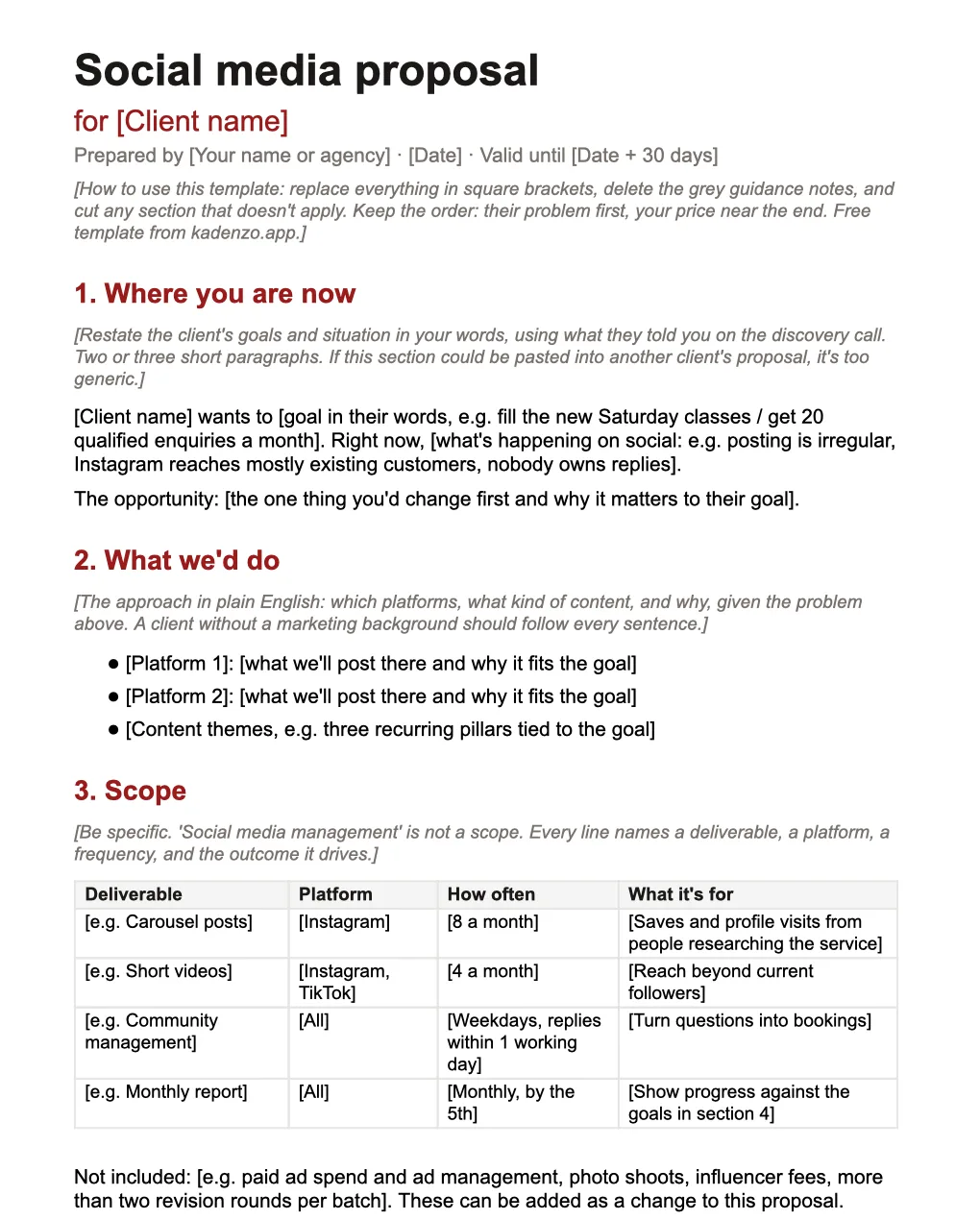
The rest of this guide explains each section, so you know what to write in it.
Lead with their problem, not your services
Open by restating the client's goals and situation in your own words. That does two things at once: it proves you actually listened on the discovery call, and it frames everything after it as a solution to their problem rather than a pitch for your services. A short strategic read covering what's holding their social back, who they're trying to reach, and where the opportunity is makes the whole document feel built for them, because it was. You're gathering this at the same discovery stage as client onboarding; a proposal and an onboarding questionnaire draw from the same conversation.
Then the strategy, in plain English
Lay out the big-picture approach: which platforms, whether you're focused on organic engagement, paid reach, or partnerships, and why, given the problem you just named. Keep it plain enough that a client without a marketing background can follow it. This section is where you show you have a plan, not just hours to sell. A client can't tell good execution from bad in advance, but they can tell whether you have a coherent idea of what you'd do and why.
Make the scope specific: this is where proposals win or lose
Here's the mistake that sinks more proposals than price: a vague scope. "Social media management" is not a scope. Break the work into concrete, modular deliverables: which platforms, how many posts of what type, how often, what's included (community management? reporting? paid ads?) and what explicitly isn't. Specificity does two jobs: it protects you from scope creep once the work starts, and it gives the client a clear sense of exactly what they're buying.
Then tie each deliverable back to the outcome it drives. The client doesn't care that you'll post twelve carousels a month; they care about reach, engagement, and growth. "Twelve carousels" is a cost. "Twelve carousels built around your three highest-intent topics, to grow saves and profile visits" is a reason to say yes.
Set measurable goals and how you'll prove them
Name a few SMART goals tied to their business rather than to vanity. Pick from the metrics that actually matter, like engagement rate, reach trend, click-throughs, or conversions, and say exactly how you'll report on them. Committing up front to a monthly report signals that you'll stay accountable, which is quietly reassuring to a client who's been burned before by an agency that took the retainer and went silent.
Timeline, price, and proof
Give a timeline for what happens in the first 30, 60, and 90 days, so the client can picture the work starting. Present the price with the value behind each part, not as a bare number: what each line buys them. And price it from the bottom up so the figure is defensible the moment they push on it. If you have it, include one piece of proof, a short case study or a concrete result from similar work, because a single real outcome closes harder than any adjective.
End with one clear next step
Close with a single, obvious action: book the kickoff call, sign the agreement, reply to get started. A proposal that trails off into ambiguity earns a "we'll think about it"; one that ends with a clear step earns a decision. That's the whole shape that wins: their problem first, a specific scope, provable outcomes, one next step. None of it depends on being the cheapest option in the running.
Frequently asked questions
What should a social media proposal include?
The client's problem restated in your words, your strategy in plain English, a specific modular scope (platforms, deliverables, frequency, what's excluded), measurable goals with how you'll report them, a timeline and price with the value behind each part, one proof point, and a single clear next step.
What's the most common mistake in a social media proposal?
A vague scope. 'Social media management' isn't a scope. You have to specify platforms, deliverables, and frequency, and tie each to the outcome it drives. Vagueness loses more deals than price, because it leaves the client unsure what they're actually buying.
How long should a social media proposal be?
Long enough to make the argument and no longer. Lead with their problem, be specific about scope, and cut anything that's about you rather than them. A tight, client-focused proposal beats a long template padded with boilerplate about your agency.
Is there a free social media proposal template for Word?
Yes, the template on this page is a free .docx file with no sign-up. It opens in Microsoft Word, Google Docs and Apple Pages, and has eight sections with placeholders and short notes explaining what to write in each one.
How do you price a social media proposal?
Build it bottom-up from the deliverables and the true hours they take, then present the price with the value behind each part rather than a lone number. Tie the figure to the outcomes the scope drives, so it reads as an investment with a return rather than a cost to negotiate down.