
Social Media Management Contract: Free Template and the Clauses That Matter
August 27, 2026 · 6 min read · by Jan Oršula
Most social media management contracts fail the same way: they list deliverables and a price, then go quiet on the five things clients and managers actually argue about. A contract that prevents disputes nails down a scope boundary (what triggers a new fee), who owns the content and accounts, what a client pays if they kill approved work, how either side exits, and when money is due. This guide covers those five clauses with a worked scope-creep boundary you can adapt. It's the signed-agreement piece that sits after your proposal, pricing, and client onboarding. It's general guidance for structuring an agreement, not legal advice, so have a lawyer review anything you sign. The free template below puts all five clauses into a working agreement.
Social media management contract template (.docx, 15 KB)
Opens in Word, Google Docs (File, then Open, then Upload) and Pages. No sign-up.
Download the template
What's in the template
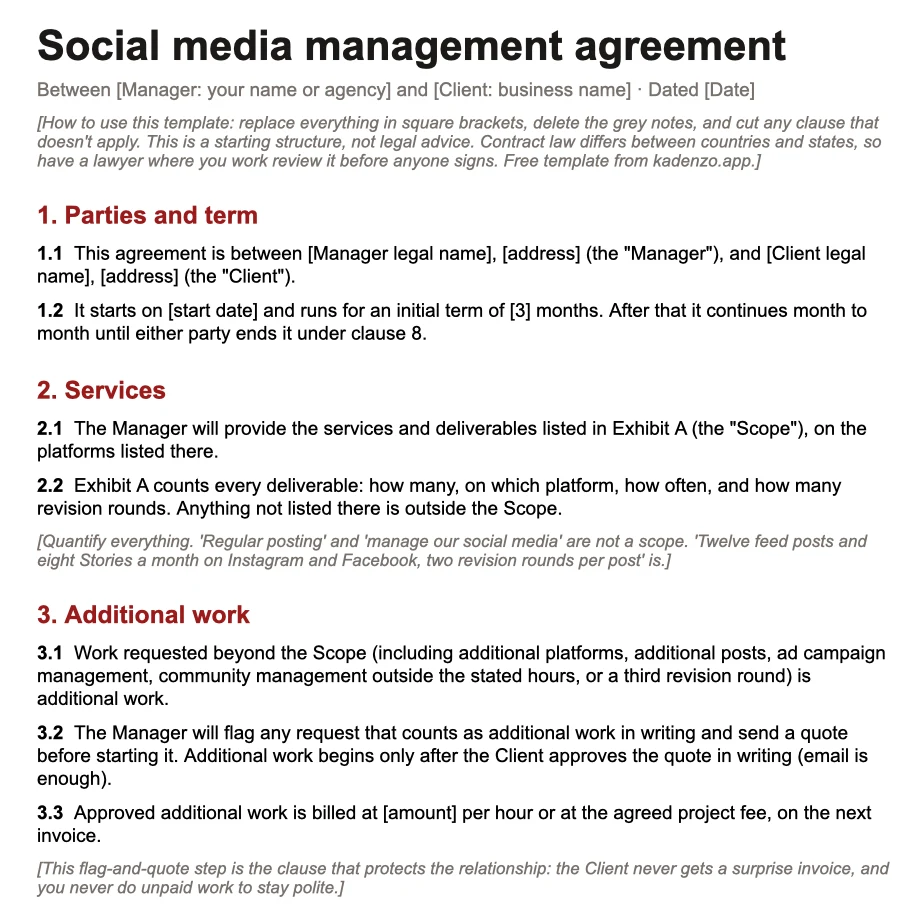
Twelve short clauses in plain English and an Exhibit A for the scope. The five clauses this guide explains are all there: additional work with the flag-and-quote step, ownership split three ways (accounts, paid deliverables, your own methods), a kill fee, notice and handoff, and payment with a late fee and a right to pause. Around them sit the supporting clauses most agreements need: approvals with an agreed rule for unanswered posts, confidentiality and password handling, a line that results aren't guaranteed, liability, and governing law.
Placeholders sit in square brackets, and grey notes explain the clauses people most often get wrong. Delete the notes before you send it.
A contract's real job: settle the argument before it happens
A boilerplate template makes people feel covered without being covered, because the disputes that end retainers aren't about whether a contract existed. They're about the specifics it left vague. "Manage our social media" is not a scope; it's an invitation for the client to keep adding. "We'll create content" doesn't say who owns it when the relationship ends. Each of the five clauses below exists to convert one predictable fight into a line both sides already agreed to. Write them plainly, in language a non-lawyer client will actually read, and the contract does its job: it makes the answer boring instead of contested.
1. The scope-creep boundary (the clause most templates skip)
Scope creep is the number-one reason a profitable retainer turns into a resentful one. The fix isn't listing everything you'll do. It's defining the line where "included" stops and "billable" starts, and naming what happens when a request crosses it.
Do it in two parts. First, quantify the deliverable so "more" is measurable: not "regular posts" but "twelve feed posts and eight Stories per month across two platforms, two rounds of revisions per post." Second, add the boundary clause that catches everything beyond it.
A worked version you can adapt:
Scope and additional work. The monthly fee covers the deliverables listed in Exhibit A. Work requested beyond those deliverables (including additional platforms, additional posts, ad-campaign management, community management outside stated hours, or a third revision round) is out of scope. The Manager will flag out-of-scope requests in writing and provide a quote before starting; such work proceeds only on written approval and is billed at $[rate]/hour or an agreed project fee.
That "flag it in writing before starting" mechanic is what saves the relationship. The client isn't surprised by an invoice, and you're not swallowing free labor to stay polite. Counting deliverables precisely is a habit worth carrying into the work itself. A shared content calendar makes "twelve posts, two platforms" visible so nobody has to argue about what shipped.
2. Content and account ownership (IP)
Decide, in writing, two separate questions people conflate: who owns the accounts, and who owns the content.
Accounts: the client owns their brand's social accounts. Say so, and specify that on termination you'll return admin access and remove yourself. Those exit mechanics keep a handoff from turning hostile.
Content and deliverables: this is where managers lose money by default. If you deliver strategy docs, prompt libraries, templates, or a content calendar and say nothing, a client can assume they own it all and reuse or resell it. Carve out what transfers and what you retain: final posts and assets created for the client transfer to them on full payment; your underlying methods, templates, and reusable frameworks stay yours and are licensed for their use, not sold. Add that ownership of paid deliverables transfers on payment, so unpaid work stays yours until the invoice clears.
3. The kill fee
A kill fee covers work a client approves and then cancels: the campaign that got built and shot before the client changed direction. Without it, "we're not going to run that after all" means you ate the hours.
State a trigger and an amount: if the client cancels approved work already in production, they pay a percentage of the fee for that work (commonly 25–50%), scaled to how far it progressed. For retainers, pair this with the notice clause below so a mid-cycle cancellation still pays out the current period. The kill fee isn't punitive. It prices the reality that your capacity was reserved and the work was real.
4. Termination and notice
Every retainer needs a clean exit for both sides, or a souring relationship drags because nobody wrote down how to leave. Cover four things: a notice period (30 days is standard, so neither side is stranded), what's owed on the way out (the current period plus any approved out-of-scope work), an immediate-termination trigger for serious breach (non-payment, or a client demanding something that breaks platform rules or the law), and the handoff obligations: return of access, final deliverables paid for, and a clean transfer. Tie the money to the notice: fees are due through the end of the notice period regardless of whether the client keeps assigning work.
5. Payment terms
Vague payment terms cause slow payment, and slow payment strains everything else. Nail down the amount and cadence (monthly retainer billed on the 1st, due on receipt or net 15), a deposit or first-month-upfront so you're never a full cycle in the red, and a late clause with teeth: a late fee after a set number of days and a right to pause work until the account is current. Naming the pause right is what makes it real. A client who knows posting stops on non-payment pays on time.
The clauses in one place
A workable contract answers these five before the work starts:
- Scope boundary: deliverables quantified, plus the flag-and-quote clause for anything beyond them.
- Ownership/IP: client owns their accounts; paid deliverables transfer on payment; your reusable methods stay yours.
- Kill fee: a percentage owed on cancelled approved work.
- Termination: notice period, what's owed, a breach trigger, handoff duties.
- Payment: amount, cadence, deposit, late fee, and the right to pause.
Get these in plain language both parties actually read, and the contract stops being a formality you file and starts being the thing that keeps the retainer healthy. For the internal side of running these agreements at scale (approvals, roles, who can post), see how team workflows keep the execution as tidy as the paperwork.
This is general information, not legal advice. Contract law varies by jurisdiction; have a qualified lawyer review your agreement before you use it.
Frequently asked questions
Is there a free social media management contract template?
Yes, the template on this page is a free .docx file with no sign-up. It opens in Word, Google Docs and Pages, and covers scope with an Exhibit A table, additional work, approvals, payment, ownership, a kill fee, termination and handoff, confidentiality and liability. It's a starting structure, so have a lawyer where you work review it before you sign.
What clauses should a social media management contract include?
At minimum: a scope boundary that quantifies deliverables and defines what triggers extra fees, content and account ownership (IP), a kill fee for cancelled approved work, termination and notice terms, and payment terms with a deposit and late clause. Those five cover the disputes that actually end retainers. Add confidentiality and a basic liability clause on top.
Who owns the content in a social media management contract?
Decide it explicitly. The client owns their brand accounts. Final posts and assets you create typically transfer to the client on full payment, while your reusable templates, frameworks, and methods stay yours and are licensed for their use rather than sold. Saying nothing usually defaults ownership to the client, so carve out what you keep.
What is a kill fee in a social media contract?
A kill fee is what a client pays when they approve work, you put it into production, and they then cancel it. It compensates you for reserved capacity and completed hours, commonly set at 25 to 50 percent of the fee for that work and scaled to how far it progressed. It keeps a change of direction from becoming free labor.
How do you handle scope creep in a contract?
Quantify the deliverables so more is measurable, then add a clause requiring out-of-scope requests to be flagged in writing with a quote before any work starts. Extra work proceeds only on written approval and is billed hourly or as a project fee. The flag-and-quote step prevents surprise invoices and stops you absorbing unpaid work to stay polite.