
Why Are My Tweets Not Getting Impressions? What X's Own Code Says
October 17, 2026 · 8 min read · by Jan Oršula
Tweets stop getting impressions for one of a handful of reasons, and X's published ranking code shows which ones are real. The For You feed predicts how likely each viewer is to like, reply, repost, stay on the post or click through, and also how likely they are to mute you, block you, report the post or say they're not interested. It adds those up with negative actions counted against you, drops posts older than 48 hours, and spreads each viewer's feed across many authors. So low impressions usually mean people scroll past your posts, react badly to them, see too many of them at once, or that your followers have stopped being active. An account restriction is possible but rarer. Below are the seven causes, each matched to what the code does, and how to tell a real drop from a normal week.
How a post reaches people on X
X open-sourced the system behind the For You feed in its x-algorithm repository. In short, every time someone opens the app:
- It gathers candidates from two places: recent posts from accounts the viewer follows, and posts from accounts they don't follow that a model thinks they'll like.
- It filters some out: duplicates, posts older than 48 hours, posts the viewer has already seen, and anything from accounts or keywords the viewer has muted or blocked.
- It scores the rest by predicting a long list of reactions. Positive ones include likes, replies, reposts, quotes, shares, time spent reading and profile visits. Negative ones are "not interested", mute, block, report and scrolling straight past. The score is a weighted sum, with the negative ones subtracting.
- It adjusts the ranking: a decay so one author doesn't fill the feed, a discount for accounts the viewer doesn't follow, and a boost for new authors.
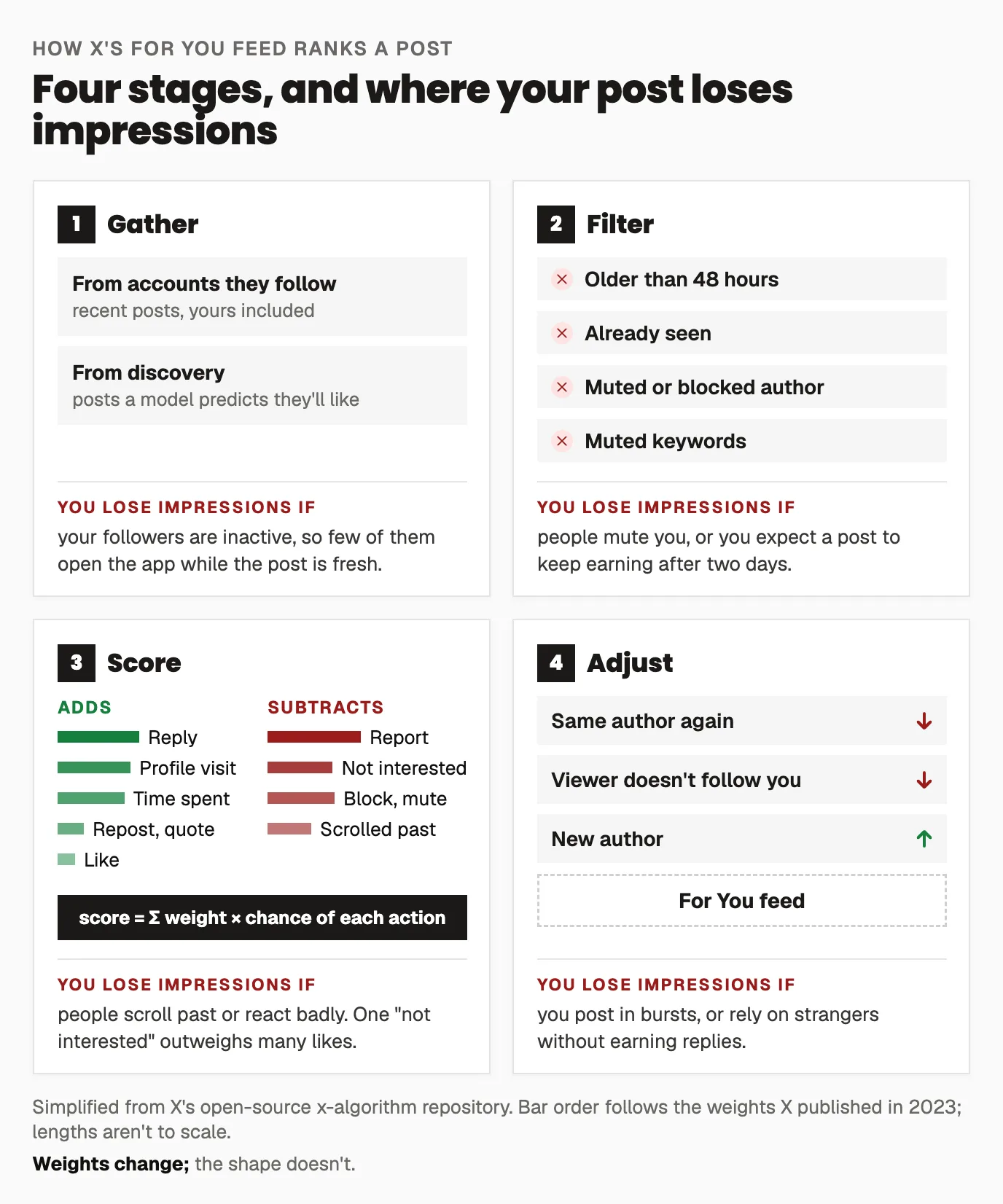
The weights themselves change and aren't something to optimize by hand, but the version X published in 2023 listed them, and the proportions are instructive: a like was worth 0.5, a reply 13.5, a reply the author went on to engage with 75, negative feedback −74 and a report −369. One person hitting "not interested" outweighed well over a hundred likes.
The seven causes, from most to least likely
1. People scroll past without stopping
The model predicts whether a viewer will spend time on the post or scroll straight past it, and scrolling past counts against you. Posts that open with context ("Quick thread on…", "Some thoughts about…") or with the conclusion buried in line three give people nothing to stop for.
Fix: put the most specific thing first. Read only your first line and ask whether a stranger would stop. The hook writing guide has a method, and the hook tester gives a quick second opinion.
2. Your posts get negative reactions
Mutes, blocks, reports and "not interested" taps carry large negative weights. They come from posts that feel like bait ("Like if you agree"), repetitive self-promotion, replies dropped under big accounts that don't relate to the conversation, and topics far outside what your followers followed you for. A handful of these on each post is enough to keep it out of most feeds.
Fix: look at your last 20 posts and cut the formats that read as asking for engagement rather than earning it. Stay close to the topics your followers chose you for.
3. You post in bursts
The ranking applies a decay per author so no one fills a viewer's feed. If you post five times in an hour, your posts compete with each other for the same few slots in each follower's feed, and the later ones lose. It's one reason a thread can do better than the same points posted separately.
Fix: space posts out across the day, or combine related points into one thread. The thread splitter breaks a draft into numbered posts that fit the limit.
4. Your followers aren't active anymore
The first audience for any post is the people who follow you. If a large part of your following is inactive accounts, bought followers or people who followed years ago for a different topic, your follower count says nothing about how many people the post can reach. A post only reaches followers who open the app in the day or two it's eligible, and only if it beats everything else they follow.
Fix: stop judging posts against follower count. Compare each post with your own recent median instead (more on that below).
5. You're asking strangers to care
Posts shown to people who don't follow you are discounted compared with posts from accounts they do follow. To travel beyond your followers, a post has to earn enough predicted engagement from strangers to overcome that discount. Replies and real conversation do the most here: in the 2023 weights, a reply the author went on to answer was worth 150 times a like.
Fix: answer the replies you get, quickly and properly. A post where the author is in the conversation is a different post, in ranking terms, from one the author left alone.
6. Your post sends people away without giving them a reason to stay
X has said links aren't penalized as such, but the feed is built around predicting whether people engage and spend time on a post. A bare link with a one-line caption gives viewers little to read and nothing to reply to.
Fix: make the post complete on its own (the point, the number, the takeaway) and offer the link as the follow-up rather than the whole post. Then compare your link posts with your non-link posts over a month instead of judging from one.
7. The account is actually limited
X can temporarily limit an account so that only its followers see its activity, typically after behavior that looks automated (many follows, likes or replies in a short time) or after rule violations. X's help page on locked and limited accounts covers what applies and how to resolve it. This is real, but it's the least likely cause of a gradual drop, and it usually comes with a notice. The shadowban guide walks through how to check without paying for a "shadowban test".
Is it a real drop, or a normal week?
Impressions count every time a post appears on a screen, including the same person seeing it twice, so they swing a lot from post to post. Before changing anything:
- Compare with your own median, not your best post. Take the impressions of your last 20 posts, find the middle value, and judge new posts against that. A post at half your median is a signal; one viral post resetting your expectations is not.
- Look at a week, not a day. Posts stop getting new impressions once they're filtered out after 48 hours, so a quiet day after a busy one is the normal shape of the feed.
- Check replies and profile visits, not just impressions. If those hold steady while impressions fall, fewer strangers are seeing you but your audience is still engaged, which points to causes 4 and 5 rather than 1 or 2.
The benchmarks guide covers building your own baseline, and the engagement rate calculator does the per-post maths.
Frequently asked questions
Why did my impressions on X suddenly drop?
Most sudden drops come from a few posts that got negative reactions (mutes, "not interested" taps) or from posting more often than before, so your posts compete with each other in followers' feeds. Compare the last two weeks against your own median before assuming a penalty. If only your followers can see your posts and you got a notice from X, the account may be temporarily limited.
Does X limit the reach of posts with links?
X has said links aren't penalized as such, and the published ranking code doesn't contain a link rule. But the feed predicts whether people will engage and spend time on a post, and a bare link gives them little to do. Posts that are complete on their own, with the link as an extra, tend to do better.
How long do tweets keep getting impressions?
Not long. X's ranking code filters out posts older than 48 hours from the For You feed, so most impressions arrive in the first day or two. Replies, quotes and reposts can extend that a little, but a post that's quiet after two days won't recover through the feed.
Do X Premium accounts get more impressions?
X has said Premium replies are prioritized in conversations, which can mean more visibility in reply threads. It doesn't change the core of ranking: posts still need predicted engagement from viewers, and negative reactions still count against them.
What counts as an impression on X?
An impression is counted each time your post is shown on a screen, in a feed, a profile, search or a conversation. The same person can produce several impressions, and an impression doesn't mean they read it. That's why replies, profile visits and link clicks say more about whether a post worked.