
How to Write a Twitter Thread People Actually Finish
July 12, 2026 · 6 min read · by Jan Oršula
A thread is a series of connected posts on X, and the mistake that quietly kills most of them is treating it like one long article chopped into tweets. It isn't. Readers drop off at every break, so each tweet has to earn the tap to the next one. A thread is really a chain of small hooks: the first tweet wins the open, and every tweet after it has a single job: make you want the one below it. This guide covers the structure that holds readers, the per-tweet discipline that keeps them, and the character math that decides where your lines actually break.
The first tweet is the whole ballgame
The opening tweet is the only one most people will ever see. It's what shows in the feed, and the rest stays hidden until someone taps. So it has to do two jobs at once: stand alone as a hook that stops the scroll, and promise that the thread pays off. "A thread on content strategy 🧵" does neither. "I rewrote our content strategy and doubled reply rates in a month. Here's the exact change 🧵" makes a specific promise and opens a gap.
That's the same promise–gap–truth logic behind any strong hook, and it's worth more here than anywhere, because a weak first tweet means the other nine never get read. Draft a few openers and pressure-test them with the viral hook tester, which scores an opening line against engagement signals, before you write the body.
One idea per tweet
Inside the thread, the unit is the tweet, not the paragraph, and every tweet is a fresh decision to keep going or bail. So give each one a single, complete idea that's satisfying on its own and points forward. When you cram two thoughts into one tweet, the second gets skimmed; when you split one thought across two, the first reads as a non-sequitur. One idea, one tweet, each ending in a reason to continue.
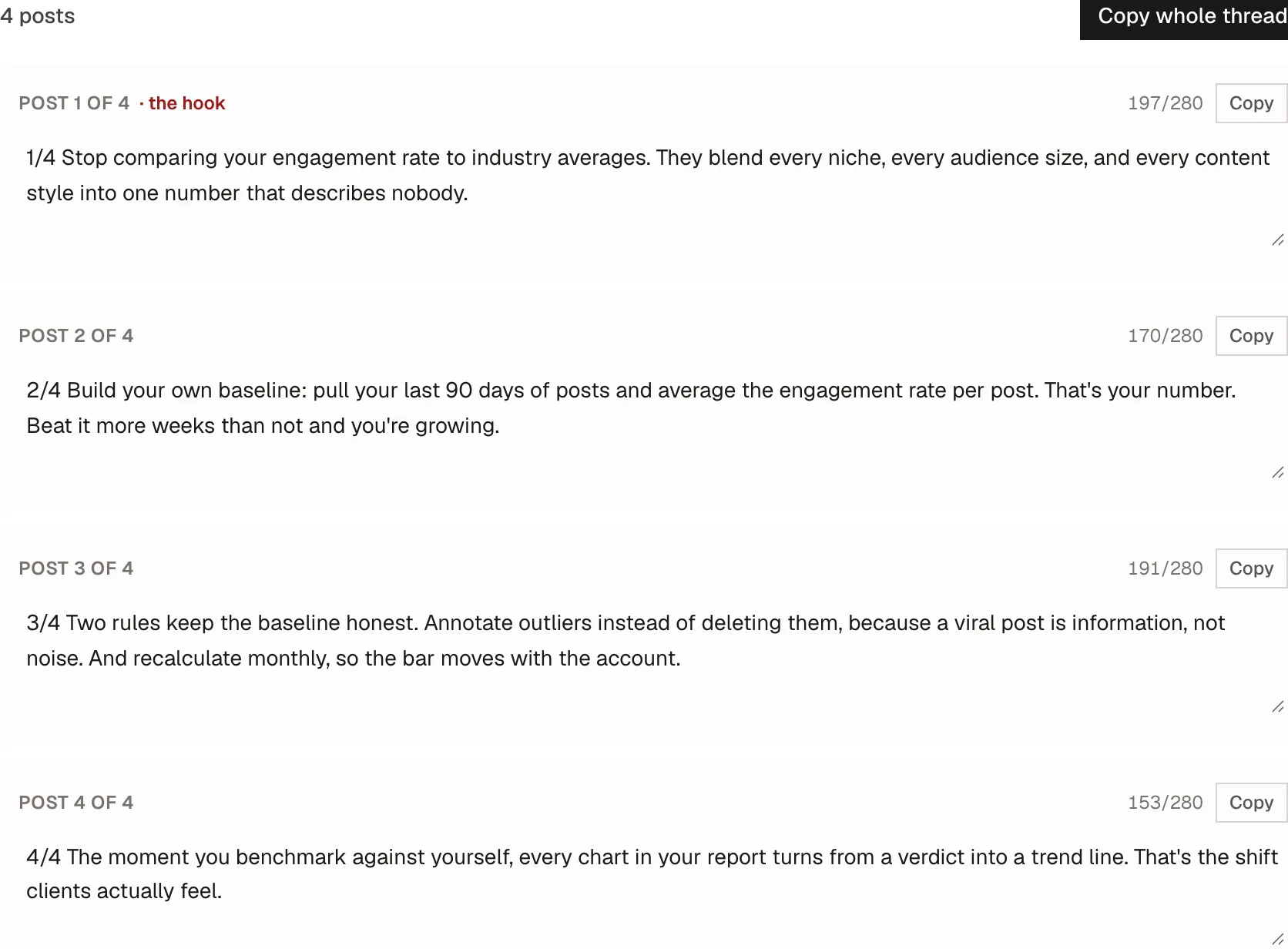
Mechanically, that means writing the thread as discrete beats, not as an essay you slice up afterward. If you do start from a longer draft, don't hand-count characters and guess at the breaks. Paste it into the thread splitter, which cuts on sentence boundaries using each platform's real character math, so no tweet ends mid-thought or blows the limit.
Mind the limit and the fold
The standard tweet is 280 characters, and a tweet that runs right up to the edge reads as dense even when it's good. Leave a little air. Front-load the point of each tweet too: the same way feeds truncate a caption, a reader's eye catches the first line and decides whether to read the rest, so the payoff shouldn't sit at the very end of a packed tweet. People scan before they read; research on how people read online has held that up for two decades, and a thread is scanning turned into a sport.
An image, chart, or screenshot stops the scroll and proves a point words alone have to assert, so put media where it earns attention, on the hook tweet or a key claim, not decoratively on every tweet where it just adds noise.
Close the loop
End the thread on purpose. The last tweet is where the attention you've earned either converts or evaporates, so use it to land the one takeaway and give a single clear next step: follow for more, reply with your version, or a link to the fuller piece. One ask, not five. A thread that just stops at the last point leaves the reader's momentum on the table.
The mistakes that lose readers
Three failure modes account for most abandoned threads. The buried lede: your best line sitting in tweet four, behind three tweets of setup nobody waited through. The essay in disguise: paragraphs jammed into tweets, so the thread reads as work instead of a series of quick wins. And the bait open, a first tweet that promises a payoff the thread never delivers, which wins the tap and loses the follow, because the next thread from you now starts from distrust. Fix the open, keep one idea per tweet, and pay off what you promised, and the thread does the rest.
Frequently asked questions
How do you write a Twitter thread that gets read?
Treat it as a chain of hooks, not a chopped-up article. Make the first tweet a standalone hook that promises a specific payoff, give every following tweet a single idea that points to the next, and keep each one short enough to read at a glance. Readers leave at every break, so each tweet has to earn the next tap.
How long should a Twitter thread be?
As long as the idea needs and no longer, which usually means five to fifteen tweets. Length isn't the goal; momentum is. If a tweet doesn't move the thread forward or stand on its own, cut it. A tight seven-tweet thread that gets finished beats a twenty-tweet one that gets abandoned at tweet four.
How many characters can a tweet have?
The standard limit is 280 characters per tweet, and running right to the edge makes a tweet read as dense even when it's good. Leave some air, front-load the point, and if you're splitting a longer draft, use a tool that breaks on sentence boundaries so no tweet ends mid-thought.
Should every tweet in a thread have its own idea?
Yes. Each tweet is a fresh decision to keep reading, so it should carry one complete, self-contained idea that also points forward. Two thoughts in one tweet means the second gets skimmed; one thought split across two means the first reads as a non-sequitur. One idea, one tweet.