
How to Write Hooks for Social Media: A Repeatable Method
June 14, 2026 · 8 min read · by Jan Oršula
A hook is the opening line that decides whether the rest of your post gets read: the words a feed shows before it folds everything else behind "…more." Writing better ones isn't a talent you either have or don't; it's a repeatable method. A strong hook does three things you can check on purpose: it makes a promise the reader wants, opens a gap they need closed, and stays true to what the post delivers. This guide walks through that test, the frameworks that get you to a first draft fast, and a worked example taking one ordinary idea to a hook worth posting. It's about the written opening line; a short-form video or Reel hook is a related but separate visual and audio craft (the first frame and the first sound) that these principles inform but don't fully cover.
What a hook actually has to do
One job: stop the scroll and earn the second line. That's it, and it's harder than it sounds, because the reader isn't reading. Decades of behavioral research show people scan online text rather than read it, fixating on the opening words and skipping the rest unless something holds them; Nielsen Norman Group's F-shaped reading pattern is the canonical version of this finding. On a social feed it's more extreme still, because the next post is one thumb-flick away and the platform hides most of your text behind a fold anyway.
So the hook carries weight out of all proportion to its length. Everything you wrote underneath it is, functionally, optional. The reader only gets there if the first line does its job. That's also why the hook's length is a real constraint, not a stylistic one: it has to land before your platform truncates it. After you've drafted a hook, drop it into the caption previewer to see exactly where each platform cuts, and make sure the gap you opened is still visible above the fold.
The three tests every hook has to pass
Most hook advice is a pile of formulas with no way to tell a good fill-in from a bad one. Here's the scoring rubric. Run any opening line through three questions:
Promise: does it signal something the reader wants? A hook has to imply a payoff: a problem solved, a curiosity satisfied, a result they could copy. "Here's how we think about onboarding" promises nothing. "Here's the onboarding change that cut our churn in half" promises a result. No promise, no reason to read.
Gap: does it open a loop the reader needs closed? The promise tells them there's something worth having; the gap withholds just enough that they have to keep reading to get it. "We cut churn by fixing onboarding" closes the loop in the hook itself; there's nothing left to learn. "We cut churn in half by removing one onboarding step" opens a gap: which step? The trick is to withhold the answer, not the subject. A gap with no context is a riddle, and riddles get scrolled past.
Truth: does the post actually pay it off? This is the one writers skip, and it's the one that compounds. A hook that overpromises gets the tap and loses the trust, and trust is what makes the next post work. If the hook says "in half" and the real number was 18%, the hook is broken no matter how well it scores on the first two tests. Fix the hook, or fix the post, but never the truth.
A hook that passes all three is rare on the first try. A hook that fails one is the most common thing in any feed: clever lines with no promise, clear promises with no gap, irresistible gaps that the post never pays off.
Start from a framework, not a blank page
You don't write a strong hook by staring at the post hoping a line arrives. You start from a framework, a recurring shape that good openers fall into, and then make it specific. A framework isn't a script; it's the structure underneath thousands of posts that all sound different because the specifics carry the voice. The ones worth keeping in your head:
- Curiosity gap: "The part of X nobody talks about." Pure gap; needs a real payoff or it's bait.
- Contrarian: "Most X advice is wrong." Stops the scroll by disagreeing with something the reader believes.
- Specific number: "4 X mistakes costing you money." A count promises finite, scannable value.
- Proof / result: "We did X and got Y in Z weeks." Leads with the outcome; the strongest framework when you have a real number.
- Story / confession: "I almost quit X. Then this." Lowers the guard faster than any credential.
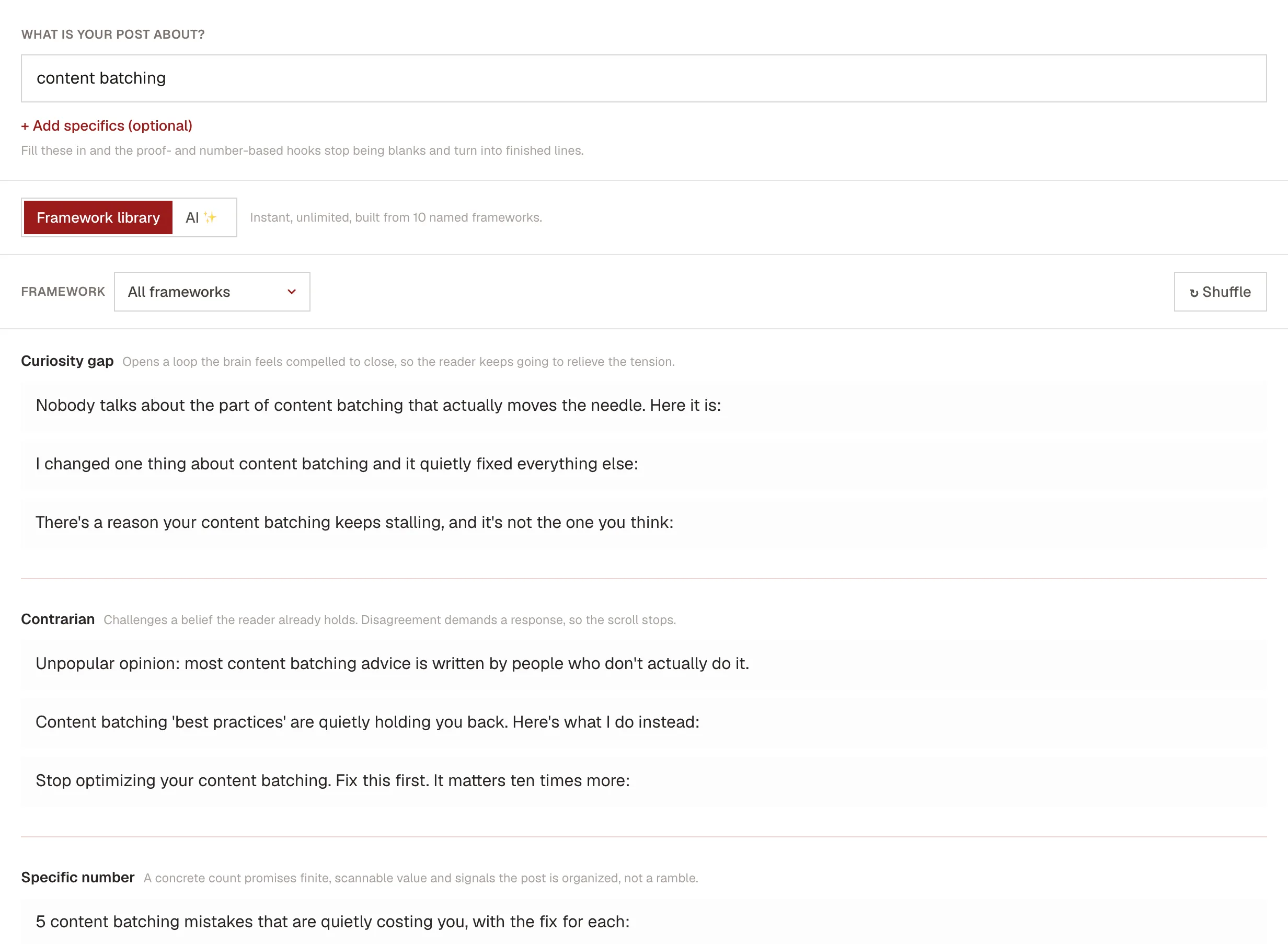
Rather than write these from scratch each time, our hook generator slots your topic into ten of these frameworks at once, so you can see the same post from five angles in a few seconds and pick the one to refine. Switch it to AI mode and the same frameworks get written fresh for your exact topic in a tone you choose. Which framework fits often depends on the post's job. Different content pillars lean toward different hooks, with educational posts favoring curiosity and number hooks while social-proof posts almost always want the result framework.
A worked example: one idea, five hooks
Take an ordinary idea most social media managers have posted some version of: batching your content (writing a week of posts in one sitting) saves time and stress. Flat as written. Run it through five frameworks:
- Curiosity: "I changed one thing about how I make content, and it gave me my mornings back."
- Contrarian: "'Post every day' is the most expensive advice in social media. Here's the cheaper version."
- Number: "Batching cut my content time by 70%. The whole system is 4 steps."
- Proof: "I went from five stressed hours a week to one calm afternoon, same number of posts. Here's how."
- Story: "I almost quit posting because it was eating my mornings. Then I tried batching everything."
Now score them on promise–gap–truth. The curiosity version (1) has a gap but a weak promise: "my mornings back" is vague. The contrarian version (2) is strong but only if you can actually defend the claim in the post, or the truth test fails. The number (3) and proof (4) versions are the most specific, which makes them the most credible, provided the numbers are real. If you genuinely tracked a 70% cut, (3) wins: clear promise (save most of your time), clear gap (what are the four steps?), and it's true. If you didn't measure it, you can't use that hook honestly. Drop to the story version (4 or 5), which promises relief and opens a gap without claiming a number you can't back up.
That's the whole method in one pass: generate from frameworks, score on the three tests, and let the one you can keep honest win.
Make it yours, then stop fiddling
Two moves turn a framework into a finished line. First, fill every blank with something real and specific: a true number, your actual result, your genuine opinion. Specificity is most of what separates a hook that sounds like you from one that sounds like a caption template: "4 steps" beats "a few steps," "cut churn 50%" beats "improved retention." Second, read it aloud. If it sounds like a sentence you'd actually say, keep it; if it sounds like marketing, rewrite it in plain words while holding the framework's shape.
Then check the length against where it has to live. A hook is just an opening line, and the same line that breathes in a LinkedIn post gets cut mid-thought in an X post or a TikTok caption. The character counter shows each platform's fold so you can trim the hook to land before the cut. Once it passes the three tests, fits the fold, and sounds like you, stop. Polishing a hook past "good and true" is time better spent writing three more and keeping the best.
The mistakes that quietly kill hooks
Four failure modes account for most dead posts. Clickbait, a gap the post never closes, wins the tap and loses the reader, permanently. The clever line (wordplay with no promise underneath) entertains you and nobody else. The buried hook: your best line sitting in sentence two, under a throat-clearing "So I've been thinking about…" that the reader never gets past. And the biggest one: writing a single hook and shipping it. The hook is the highest-leverage line in the entire post; drafting ten and keeping one isn't perfectionism, it's spending your effort where it actually decides the outcome. Make the ten cheap (frameworks and the hook generator get you there in a minute) and keeping the one that passes all three tests becomes the easy part.
Frequently asked questions
How long should a social media hook be?
Short enough to land before the platform folds your caption. The exact limit varies (X and TikTok cut a caption far sooner than LinkedIn), so the rule isn't a word count, it's that the gap you opened has to still be visible above the more link. Draft the line, then check it against each platform's fold before you commit.
What's the difference between a hook and clickbait?
The truth test. Both make a promise and open a gap; a real hook pays it off in the post and clickbait doesn't. Clickbait wins the tap and loses the trust, and trust is what makes your next post work, so it's a bad trade even when it spikes one post's numbers.
How many hooks should I write before posting?
More than one. Even strong writers rarely land promise, gap, and truth on the first try, so betting the whole post on a single untested opener is the most common reason good posts die. Frameworks make drafting ten cheap; scoring them on the three tests makes picking the winner fast.
Do the same hooks work on every platform?
The frameworks travel; the exact wording often doesn't. A line that breathes in a LinkedIn post can get cut mid-thought in an X caption, and an educational curiosity hook that fits a carousel may be wrong for a result-driven Reel. Keep the framework, then refit the specifics and the length to wherever it's going.