
Share of Voice: The Formula, Three Versions, and How to Track It
October 13, 2026 · 8 min read · by Jan Oršula
Share of voice (SOV) is your brand's slice of the conversation in your market, compared with the competitors you choose to track. On social media the standard formula is:
Share of voice = your brand's mentions ÷ total mentions of your brand and your competitors × 100
If your brand was mentioned 120 times last month and you and three competitors were mentioned 1,000 times in total, your share of voice is 12%. The formula is simple, but what you count changes the answer. Mentions, engagement and reach each give a different share, and a brand can lead on one while trailing on another. This guide covers the three versions, a worked example where they disagree, how to adjust for sentiment so a complaint wave doesn't look like a win, and how to track it every month.
Share of voice template (.xlsx, 31 KB)
Set up your competitor set once, type each month's counts, and it calculates all four shares, net sentiment and the gap to your market share. Excel, Google Sheets and Numbers. No sign-up.
Download the template
The three versions, and what each one answers
| Version | Formula | The question it answers |
|---|---|---|
| Mention share | your mentions ÷ all mentions | How often are we talked about? |
| Engagement share | engagement on posts about you ÷ engagement on posts about everyone | How much do people react when we come up? |
| Reach share | estimated reach of posts about you ÷ reach of posts about everyone | How many people see us mentioned? |
Mention share is the default, and the one most tools show first. It's the easiest to collect and the least distorted by one viral post. Engagement share tells you whether the conversation about you is lively or flat. Reach share is the closest to "how many people noticed us", but it depends on estimated audience numbers, which are the least reliable input of the three.
Two rules apply to all three:
- Count the same things for every brand. Same platforms, same dates, same kind of search (brand name, handle, common misspellings and product names). Change the method for one brand and the percentages mean nothing.
- Count what others say, not what the brand posts itself. Your own posts are a choice, not a signal. Most listening tools count mentions by other people.
A worked example: one roaster, three competitors
Ember Roasters, a small specialty coffee roaster, tracks three competitors for September. Here's what a month of listening shows:
| Brand | Mentions | Engagement on those posts | Estimated reach | Positive mentions |
|---|---|---|---|---|
| Ember Roasters | 120 | 9,000 | 60,000 | 90 |
| Northline Coffee | 300 | 12,000 | 240,000 | 160 |
| Pine & Co | 180 | 6,000 | 90,000 | 110 |
| Halcyon | 400 | 13,000 | 410,000 | 140 |
| Total | 1,000 | 40,000 | 800,000 | 500 |
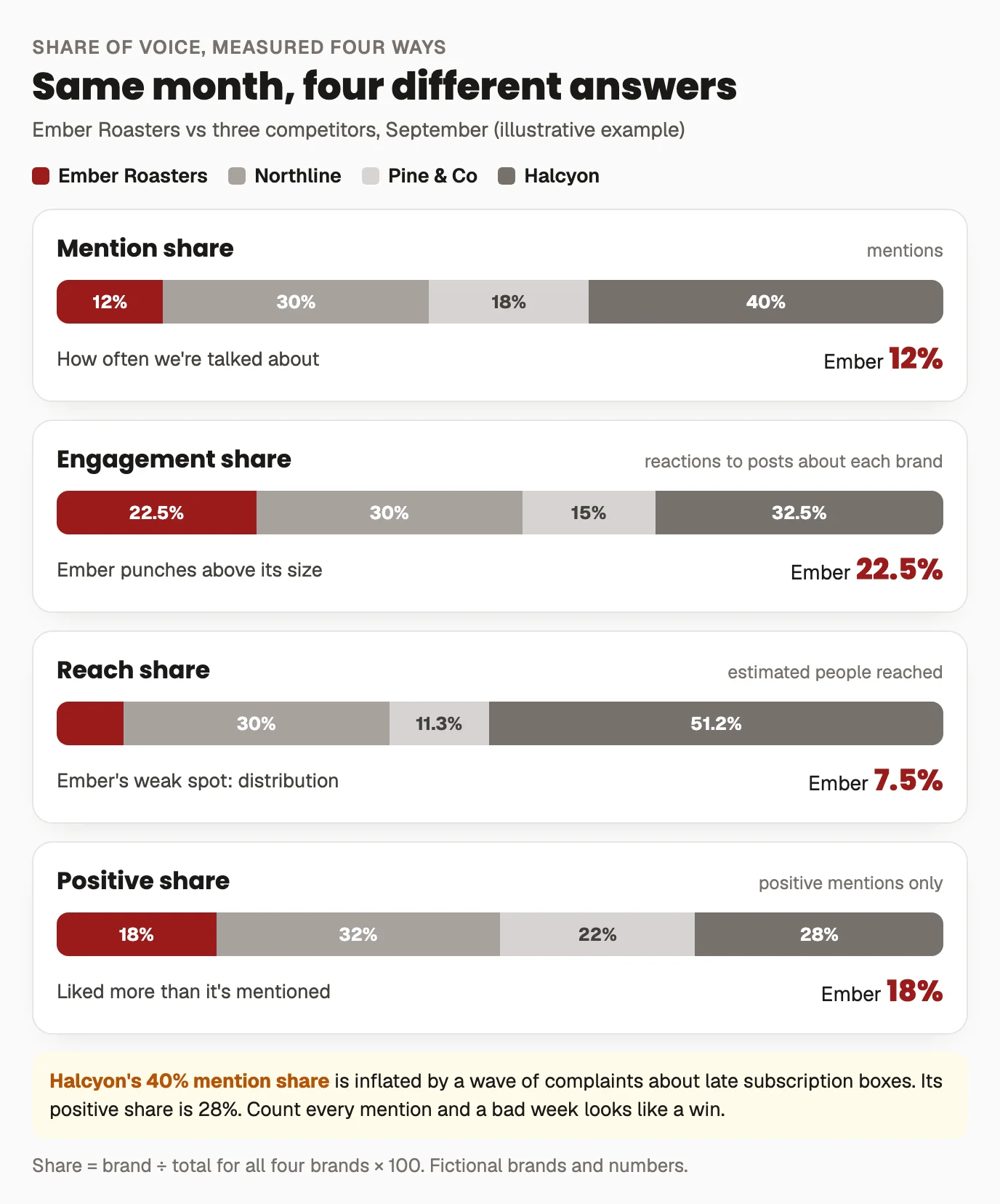
Run the formulas for Ember:
- Mention share: 120 ÷ 1,000 = 12%
- Engagement share: 9,000 ÷ 40,000 = 22.5%
- Reach share: 60,000 ÷ 800,000 = 7.5%
Read together, they tell a story none of them tells alone. Ember is mentioned less than its rivals and seen by fewer people, but when it does come up, people react: it earns almost twice the engagement share its mention share would suggest. The problem isn't the product or the content. It's distribution. That points to collaborations, creator partnerships or paid reach, rather than posting more of the same.
Halcyon looks like the leader on every count, with 40% of mentions. But only 140 of its 400 mentions were positive, and most of the rest came from a batch of complaints about a delayed subscription box. Which is why mention counts need one more step.
Adjust for sentiment
A complaint is a mention. A brand in the middle of a bad week can top every share-of-voice chart. Two simple adjustments fix that:
- Positive share of voice: your positive mentions ÷ all positive mentions in the set. For Ember: 90 ÷ 500 = 18%, higher than its 12% mention share. For Halcyon: 140 ÷ 500 = 28%, well below its 40%.
- Net sentiment alongside share: report the share and the positive-minus-negative balance next to each other, so a spike can be read as praise or a pile-on at a glance.
Sentiment labels from any tool are approximate (sarcasm and slang fool them), so spot-check a sample before you put a number in a report. The social listening guide covers how sentiment is scored and where it goes wrong.
Share of voice vs market share
The comparison that gives share of voice its strategic weight is with market share. Advertising research, starting with John Philip Jones in 1990 and continued by Les Binet and Peter Field for the IPA, found that brands whose share of voice is above their market share (called "excess share of voice") tend to grow, and brands below it tend to shrink.
Treat that as a direction, not a law, for social. The research measured share of advertising spend, not organic mentions. But the question is still useful: if Ember has about 10% of the local specialty coffee market and 12% of the conversation, it's being talked about slightly more than its size suggests. A brand with 25% of the market and 10% of the conversation should worry that it's being forgotten.
How to measure it every month
- Pick the competitor set. Three to five brands your customers actually compare you with. Keep the set fixed so the trend means something.
- Write one search per brand. The name, the handle, common misspellings and product names, and exclusions for unrelated meanings (a brand called Pine needs to exclude trees). The Boolean search guide and the Boolean query generator help here.
- Count the same period on the same platforms for every brand. A calendar month is easiest to compare.
- Remove the noise: duplicates, the brands' own posts, and mentions that aren't really about the brand.
- Calculate mention share first, then positive share. Add engagement share if you have the numbers.
- Track the trend, not the snapshot. One month's share says little. Three months moving the same way is a finding. Put it in the monthly report as one line: our share, the change, and why.
The template above follows these steps: a setup tab for the competitor set and searches, a monthly counts tab, and a shares tab that calculates everything, with the Ember example filled in.
Counting by hand works for small brands with a few hundred mentions a month. Beyond that, a listening tool does the counting and keeps the history. Kadenzo's social listening tags each keyword as your brand, a competitor or a topic, and calculates share of voice from the brand and competitor mentions only, leaving industry topics out so they don't inflate everyone equally.
What is a good share of voice?
There's no universal number, because it depends entirely on how many competitors you track and how big they are. Tracking yourself against one rival, 50% is parity. Against four, 20% is. Two better benchmarks:
- Your own trend. Is your share growing month on month?
- Your market share. Is your share of the conversation at or above your share of sales?
Frequently asked questions
How do you calculate share of voice on social media?
Divide your brand's mentions by the total mentions of your brand and the competitors you track over the same period, then multiply by 100. If you had 120 mentions and the whole set had 1,000, your share of voice is 12%. You can swap mentions for engagement or reach to answer different questions.
What's the difference between share of voice and engagement rate?
Engagement rate measures how people respond to your own posts, relative to your audience. Share of voice measures how much of the conversation in your market is about you rather than your competitors. So a strong engagement rate can sit alongside a small share of voice, and the reverse.
Should share of voice include negative mentions?
The standard formula counts every mention, which means a complaint wave can raise your share. Report positive share of voice or net sentiment alongside it, so a spike can be read as praise or as a problem.
How many competitors should you include?
Three to five that your customers genuinely compare you with. Too few and the percentages swing wildly; too many and small changes disappear. Keep the set the same from month to month so the trend is meaningful.
Can you measure share of voice for free?
Yes, for a small brand. Search each brand's name, handle and misspellings on the platforms that matter, count the mentions for the same month in a spreadsheet (the free template on this page does the maths), and apply the formula. It gets slow above a few hundred mentions a month, which is when a listening tool earns its cost.