
Boolean Search for Social Listening
October 3, 2026 · 5 min read · by Jan Oršula
Boolean search is a way of writing a listening query out of logical operators (AND, OR, NOT, quotation marks, and parentheses) so a monitoring tool returns every mention that matters and drops the mentions that don't. It exists because the two lazy options both fail: search your bare brand name and you drown in noise (especially if the name is also a common word), or search one exact phrase and you miss half the conversation. Boolean is how you thread between those: cast wide with OR, tighten with AND, and cut the junk with NOT. This guide covers each operator, then builds a real brand-monitoring query step by step so you can see the logic assemble.
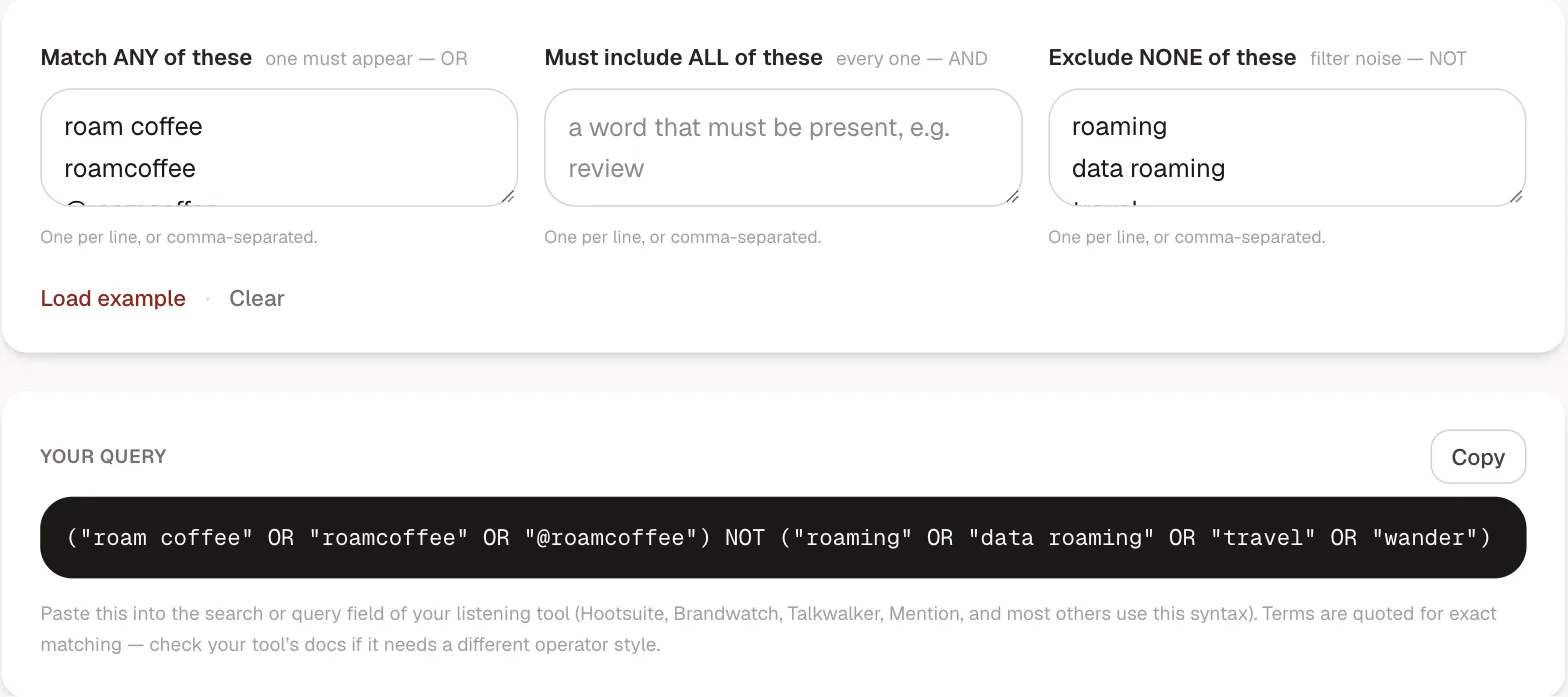
If you'd rather assemble the string with the operators handled for you, our boolean query generator lets you enter your brand, its variants, and the terms to exclude, and outputs a query ready to paste into your listening tool.
The five operators, and exactly what each does
Everything in Boolean is built from five pieces. Learn what each one does to your result set and you can read or write any query.
- AND: require all.
apple AND computerreturns only mentions containing both words. AND narrows; every AND you add shrinks the results and raises their relevance. It's the fix for a brand name that doubles as an everyday word. - OR: match any.
sneakers OR trainers OR kicksreturns mentions containing any of those. OR widens; use it to gather every way people refer to the same thing, from synonyms and nicknames to common misspellings and your name with and without spaces. - NOT (or a minus sign): exclude.
jaguar NOT cardrops any mention containing "car," leaving the animal or the guitar. NOT trims; it's how you remove a known source of noise once you've spotted it in your results. - "Quotation marks": exact phrase.
"social media manager"matches those three words in that order, not any post that happens to contain all three scattered about. Quote anything that only means what you want as a set phrase. - (Parentheses): group the logic. Parentheses control the order operations run in, exactly like in maths.
(nike OR "just do it") AND shoesmeans either term, and then shoes. Without the brackets the tool guesses, and it usually guesses wrong.
Most tools also offer proximity operators ("these two words within N words of each other"), but the syntax varies by platform, so check your tool's docs. The five above are universal and carry the vast majority of the work.
Building a real query, step by step
Say you're monitoring a coffee brand called Roam. "Roam" is also a common English word, so a bare search would bury real mentions under travel posts and roaming-charge complaints. Here's how the query grows.
Start with the brand and its variants. People won't all spell it the same way, so gather them with OR:
"roam coffee" OR roamcoffee OR @roamcoffee
Force the topic with AND. On its own "roam" is hopeless, so require a coffee-context word alongside the bare name, but keep the already-specific variants unrestricted by grouping:
("roam coffee" OR roamcoffee OR @roamcoffee OR (roam AND (coffee OR espresso OR beans)))
Cut the known noise with NOT. You keep seeing mobile-phone roaming and travel posts, so exclude them:
(...) NOT (roaming OR "data roaming" OR travel OR wander)
Assemble it. The finished query, brackets doing the heavy lifting:
("roam coffee" OR roamcoffee OR @roamcoffee OR (roam AND (coffee OR espresso OR beans))) NOT (roaming OR "data roaming" OR travel OR wander)
Read it back and the logic is plain: any clearly-branded mention, or the bare word only when it appears with coffee context, and never the phone or travel senses. That's the whole craft: cast wide, then subtract.
The two ways queries go wrong
Almost every bad query fails in one of two directions, and the fix is different for each.
Too broad: you're drowning in noise. The result feed is full of mentions that have nothing to do with you. The cause is usually a bare common-word brand name or an OR list that's too loose. Fix it by adding an AND with a context word, or a NOT to exclude the specific junk you can see. Add exclusions one at a time and re-check. A NOT that's too aggressive silently deletes real mentions.
Too narrow: you're missing mentions. The feed is suspiciously quiet, or you find mentions in the wild that never showed up. The cause is usually over-quoting (an exact phrase that people rarely type verbatim) or a missing variant. Fix it by loosening quotes to individual AND-ed words and widening your OR list with the misspellings, nicknames, and no-space versions of your name.
The tell for both is checking the actual results, not admiring the query. Skim the first page of mentions: if you see irrelevant posts, tighten; if you know you're missing conversations, widen. A listening query is never finished. It's tuned against what comes back, and the mentions that get through are only useful once someone routes and replies to them, which is the real point of building a clean query in the first place.
Handling brand names that are also common words
The hardest case deserves its own note, because it's where most listening setups fail. If your brand is "Apple," "Amazon," "Roam," "Ace," or any everyday word, the bare name is unusable because the noise-to-signal ratio makes the feed pointless.
The reliable pattern is specific-OR-contextual: gather the unambiguous forms of your name (the @handle, the no-space version, the name plus a product word) with OR so they pass freely, then require a context word via AND only for the bare, ambiguous form. That's exactly the nested structure in the Roam example above. The branded variants need no guard, while roam alone is chaperoned by (coffee OR espresso OR beans). It lets the clearly-yours mentions through untouched and only polices the risky word.
Do this well and your listening feed becomes something you can actually act on (the mentions that need a reply, the questions worth answering, the user-generated posts worth resharing) instead of a firehose you learn to ignore. And a feed you act on is where listening turns into community management: the response, not the capture, is what people remember.
Frequently asked questions
What is Boolean search in social listening?
It's a way of writing a monitoring query out of logical operators - AND, OR, NOT, quotation marks, and parentheses - so your listening tool returns exactly the mentions you want. OR widens the net to catch every variant and synonym, AND requires context so a common-word brand name is not buried, and NOT strips out known noise. The result is a feed of relevant mentions instead of an unusable firehose.
What do AND, OR, and NOT do in a query?
AND requires all the joined terms to appear, which narrows results and raises relevance - useful for forcing a context word next to an ambiguous name. OR matches any of the joined terms, which widens results to gather synonyms, nicknames, and misspellings. NOT (or a minus sign) excludes any mention containing the term, which trims out a known source of noise once you have spotted it in your feed.
How do I monitor a brand name that is also a common word?
Use a specific-or-contextual pattern. Gather the unambiguous forms of the name - the @handle, the no-space version, the name paired with a product word - with OR so they pass freely, then require a context word with AND only for the bare, ambiguous form. Group it all with parentheses so the branded variants stay unrestricted while the risky common word is chaperoned by relevant context.
Why is my social listening query returning too much or too little?
Too much noise usually means the query is too broad - a bare common-word name or a loose OR list - so add an AND context word or a NOT exclusion, one at a time, re-checking as you go. Too few mentions usually means it is too narrow - an over-quoted exact phrase or a missing variant - so loosen quotes into AND-ed words and widen your OR list with misspellings and nicknames. Tune against the actual results, not the look of the query.