
How Far in Advance to Schedule Social Media Posts
August 16, 2026 · 8 min read · by Jan Oršula
There's no single right number, and "one month ahead" is the wrong answer to memorize. How far ahead you should schedule depends on the content type: evergreen posts can sit in the queue for weeks with no downside, campaign posts want a medium runway of one to three weeks, and reactive or topical posts should be built the same day they go out. The trap is treating all three the same and filling a three-month queue. It looks productive, then quietly rots, because facts change, your tone drifts, and you've boxed out the space you need to react. Below is a lead-time matrix that sorts your posts by shelf life instead, and what our own scheduling data says people actually do: in posts scheduled through Kadenzo, more than half are set less than 24 hours before they go out.
Why "one month" is the wrong frame
Most advice lands on two to four weeks, and that range is fine as an average, but you never publish an average. You publish a specific post, and its safe lead time is set by how fast it dates. A "how to write a good hook" tip is as true in six weeks as it is today. A "join our webinar Thursday" post is worthless the moment Thursday passes. Averaging those two together gives you a number that's wrong for both.
So the useful question isn't "how far ahead should I schedule," it's "how far ahead can this post survive." Sort by shelf life and the horizon falls out on its own.
What our scheduling data shows
We looked at the timing of posts people scheduled by hand in Kadenzo between September 2025 and October 2026, leaving out posts timed automatically by a queue or a recurring schedule. Each account counts equally, so a few very active accounts don't skew the percentages. We used timing data only, never the content of a post.
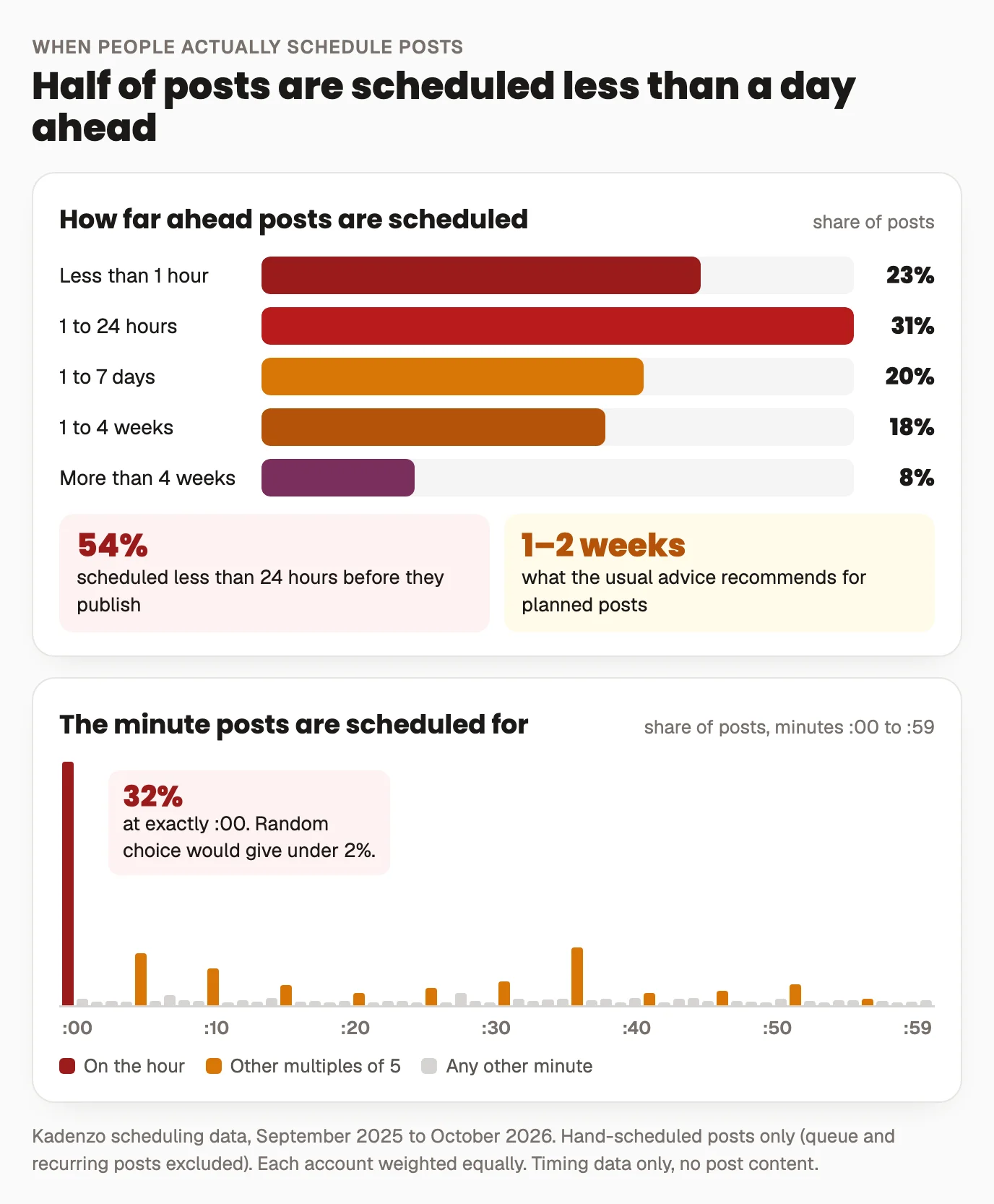
| Scheduled ahead | Share of posts |
|---|---|
| Less than an hour | 23% |
| 1 to 24 hours | 31% |
| 1 to 7 days | 20% |
| 1 to 4 weeks | 18% |
| More than 4 weeks | 8% |
The typical account schedules its posts about 21 hours before they publish. Some of that is healthy: reactive posts belong on the day. But it's unlikely that half of all posts are reactive. More often, a campaign or evergreen post that could have been banked simply got made late.
What scheduling the night before costs you
- No time for approval. A post set the same day either skips the check or misses its slot. A weekly approval window only works when posts exist a few days early.
- No time to catch mistakes. A broken link or a badly cropped image gets fixed when someone reads the post the next morning. If it publishes at 9am and was written at 8:40, nobody does.
- No buffer when publishing fails. Tokens expire and uploads get rejected. Posts scheduled days ahead give you time to notice; the troubleshooting guide covers the common reasons.
- Every post becomes urgent. When the week is made day by day, a sick day leaves the account silent.
The lead-time matrix
Three buckets cover almost everything you publish. Assign each post to one as you build it.
Evergreen: schedule as far ahead as you like
Evergreen posts are still true and useful months from now: how-tos, principles, definitions, framework explainers, timeless tips. These are the backbone of a resilient posting queue because they carry no expiry risk. Bank them deep. They're also what makes a queue survivable when a busy week hits, because you can lean on the evergreen bench and skip a day of net-new work. Building a proper library of these is worth its own effort; that's the whole point of an evergreen content bank.
Campaign: one to three weeks out
Campaign posts tie to something scheduled: a launch, a sale, an event, a content series. They're not reactive, but they are dated, so they want a medium runway: far enough ahead to prep and approve, close enough that the details are still locked. One to three weeks is the sweet spot. Any earlier and you risk the offer, date, or link changing under you; any later and you're scrambling through approvals the night before.
Reactive: same day, sometimes same hour
Reactive posts respond to something live: a trend, a news moment, a comment thread worth amplifying, a competitor's move. These can't be scheduled ahead by definition, since the whole value is timeliness. Don't try to pre-plan them; instead, protect room for them by not packing the calendar wall to wall.
Why a three-month queue goes stale
Scheduling a quarter ahead feels like getting ahead. It's usually the opposite, for three mechanical reasons.
Facts move. Prices, product names, stats, links, feature availability: anything factual you wrote twelve weeks ago has a real chance of being wrong by the time it publishes, and a wrong post erodes trust faster than a missing one.
Tone drifts. Your brand voice, your priorities, and the mood of your audience all shift over a quarter. Posts written in a different headspace read as off-key when they finally surface, even if nothing in them is factually wrong.
You can't react. A wall-to-wall queue leaves no slack. When a moment worth jumping on appears (or worse, when something goes wrong and you need to go quiet), a packed schedule fights you. The most common version of this is publishing a cheery scheduled post into a bad news cycle because nobody paused the queue, which is exactly the failure mode crisis planning exists to prevent.
Leave slack for real time
Aim to keep the queue full enough that you're never scrambling, but not so full that you can't move. A practical shape: bank evergreen deep, keep campaigns on their one-to-three-week runway, and leave roughly one slot in five open for reactive or last-minute posts. That gap is a feature, not a hole. It's the room your reactive bucket lives in.
The horizon also interacts with how much you post. If you publish daily you need more banked than if you post twice a week, so set the queue depth against your actual posting frequency, then fill it the efficient way by batching the making in one session and loading the whole set at once, rather than scheduling one dated post at a time.
The round-number habit
The data turned up a second habit: about a third of hand-scheduled posts go out at exactly :00, the top of the hour. If people picked minutes at random, fewer than 2% would. Two thirds are set to a multiple of five minutes.
On algorithmic feeds (Instagram, TikTok, Facebook, LinkedIn, X's For You) it doesn't matter, because posts aren't shown in the order they were published: 9:00 and 9:07 compete the same way. It can matter where posts appear in time order, such as the Following feeds on X, Threads and Bluesky, or Telegram channels, where everyone who rounds to 9:00 lands in the same moment. Moving a few minutes off the hour costs nothing, though there's no evidence it raises reach by itself. The hour, chosen from when your audience is online, matters far more than the minute.
Frequently asked questions
How far in advance should I schedule social media posts?
It depends on the post, not a fixed rule. Evergreen posts can sit in the queue for weeks or months, campaign posts want a one-to-three-week runway, and reactive posts should be made the same day. Sort each post by how fast it dates and the horizon sets itself.
Is scheduling three months ahead a bad idea?
For most posts, yes. Over a quarter, facts drift out of date, your tone and priorities shift, and a wall-to-wall queue leaves no room to react to live moments or pause during bad news. A deep bank of genuinely timeless evergreen posts is the one exception.
How much of my calendar should I leave empty?
Roughly one slot in five is a good starting point. That open space is where reactive and last-minute posts live, and it's the buffer that lets you pause the queue when a moment calls for it. A calendar packed wall to wall is fragile, not productive.
How far ahead do people actually schedule social media posts?
Closer to the deadline than the advice suggests. In posts scheduled through Kadenzo, more than half are set less than 24 hours before they publish, nearly a quarter less than an hour before, and only about a quarter a week or more ahead. The typical account schedules about 21 hours ahead.
Should evergreen and time-sensitive posts be scheduled differently?
Yes, that's the core idea. Evergreen content carries no expiry risk, so bank it as far ahead as you want. Time-sensitive campaign and reactive posts have a shelf life, so keep them on a short leash: a medium runway for campaigns, same-day for anything reacting to a live moment.