
Evergreen Social Media Content: Build a Bank
August 19, 2026 · 5 min read · by Jan Oršula
Evergreen social media content is anything still true and useful months after you post it: no expiry date, no tie to a trend or event. The payoff isn't just that it ages well; it's that you can reshare the same proven post again and again, so you're not inventing something new every single day. That's the part most guides skip: building evergreen content is really about building a re-queueable bank you draw from on a cadence. First, one distinction that keeps this from collapsing into a different idea. Recycling a post is not the same as repurposing it, and mixing them up is where evergreen strategies go wrong.
Recycling is not repurposing
These two words get used interchangeably and they mean opposite things mechanically.
Recycling is re-sharing the same proven post (same core asset) again later, because it's still good and most of your audience never saw it the first time. One post, published multiple times over months.
Repurposing is turning one core idea into new formats: a blog point becomes a carousel becomes a Reel becomes a thread. One idea, many different assets. That's a separate workflow with its own mechanics, covered in content repurposing.
This article is about recycling: getting more mileage out of the exact post you already made. Both are legitimate, but the tactics don't transfer. Recycling asks "how long before I run this again, and how do I vary it," not "what new format can I spin off." Keep them separate and each stays sharp.
What actually counts as evergreen
Evergreen isn't a topic, it's a shelf life. The same subject can produce an evergreen post or a disposable one depending on how you write it. "Our 3 rules for a strong hook" is evergreen; "React to this week's viral hook" is gone in days. So don't sort by category; sort by durability.
Content that tends to hold up:
- How-tos and tutorials: the steps don't change.
- Principles, definitions, and frameworks: the why behind a tactic outlasts the tactic.
- Answers to recurring questions: if people ask it every month, the answer works every month.
- Checklists and reference lists: useful on demand, forever.
- Testimonials and results: social proof doesn't date.
Content that usually doesn't: anything pinned to a date, a trend, a current price, a live event, or a "this year" framing that expires when the year turns.
The is-it-evergreen test
Before you file a post as evergreen, run it through three questions. It has to pass all three:
- Will this still be true in six months? If a fact, price, feature, or date inside it will have changed, it's not evergreen, or it needs the dated part stripped out.
- Will it still be useful to someone discovering it cold? Evergreen posts serve the reader who finds them with no context. If it only makes sense in this week's moment, it fails.
- Would I be comfortable resharing it unchanged? If reposting it in three months would feel stale or embarrassing, it's not a bank candidate.
Pass all three and it belongs in the bank. Fail one and either fix it or treat it as a one-time post.
Build the re-queueable bank
The bank is a tagged library of your passed-the-test posts, organized so you can pull from it on a schedule. Three steps.
Tag as you create. When a post clears the test, mark it evergreen and note its theme, ideally along your content pillars so the bank stays balanced across topics instead of overloading one. Do this at creation time; reconstructing it later is painful.
Watch what earns its place. A bank is only worth resharing if the posts were good. Let engagement decide which posts graduate into the reshare rotation. The ones that performed the first time are the ones worth running again. Weak posts don't get better on a second airing.
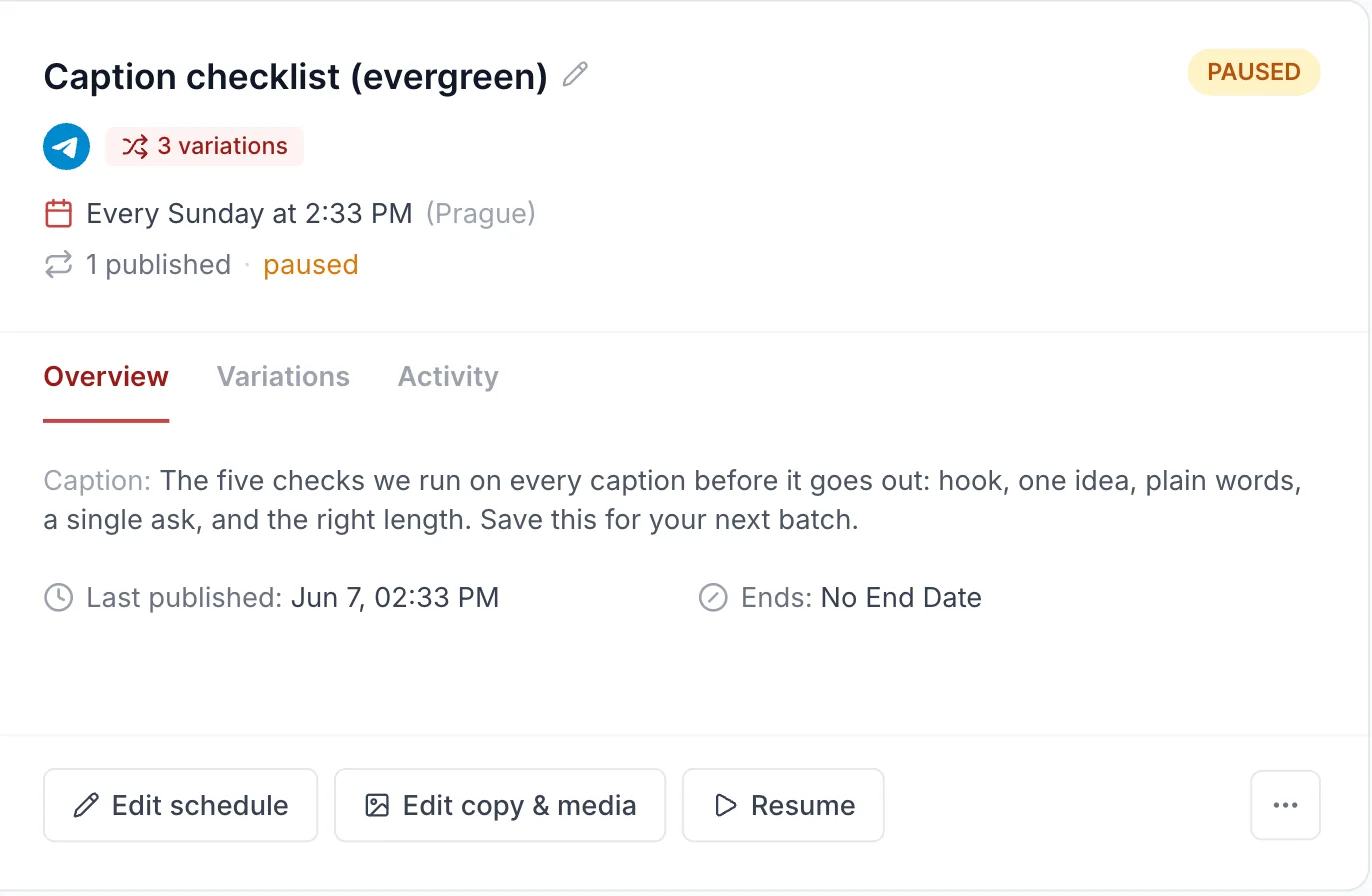
Reshare on a cadence, not on a whim. Slot evergreen reshares into your content calendar as a standing lane, say one or two reshared posts a week alongside your fresh content. This is exactly what makes a deep evergreen bench so valuable for scheduling further ahead: timeless posts carry no expiry risk, so they fill the queue safely while your dated content stays on a short runway. A recurring-posts feature automates the cadence so a strong post recirculates without you re-queuing it by hand each time.
How long to wait, and how to vary it
Two rules keep reshares from reading as lazy repeats.
Spacing. Don't rerun a post while it's still fresh in feeds. A practical floor is several weeks between airings of the same asset, stretching to a few months for your very best pieces, long enough that the overlap between who saw it then and who sees it now is small. The faster your account grows, the sooner you can safely rerun something, because more of the audience is new each time.
Variation. Change the wrapper, keep the core. Rewrite the caption or hook, swap the thumbnail, update a stat, lead with a different angle, or reframe it as a question. The underlying value is the same; the surface is different enough that it doesn't read as a copy-paste. A reshare that changes nothing at all invites "didn't you already post this", while a reshare with a fresh hook just looks like you're making the same good point a better way.
Done right, the bank means a real share of your calendar runs on work you already did, and the new content you do make is building next quarter's bench.
Frequently asked questions
What is evergreen social media content?
Content that stays true and useful long after you post it, with no tie to a date, trend, or event: how-tos, frameworks, answers to recurring questions, checklists, and social proof. The practical value is that you can reshare it repeatedly, so a chunk of your calendar runs on work you already did.
Is recycling a post the same as repurposing it?
No, and the difference matters. Recycling is resharing the same proven post again later. Repurposing is turning one idea into new formats such as a carousel, a Reel, or a thread. Recycling reuses the exact asset; repurposing creates new ones. They use different tactics, so it helps to treat them as separate workflows.
How do I know if a post is evergreen?
Run it through three questions: will it still be true in six months, will it still help someone who finds it cold with no context, and would you happily reshare it unchanged? It has to pass all three. If a price, date, or feature inside it will change, either strip that part out or treat it as a one-time post.
How long should I wait before resharing the same post?
Several weeks at a minimum, stretching to a few months for your strongest pieces, so the overlap between who saw it then and now stays small. Fast-growing accounts can rerun sooner because more of the audience is new each time. And vary the wrapper (new caption, new thumbnail, updated stat) so it reads as a fresh take rather than a copy-paste.