
How to Batch Social Media Content Without Burning Out
July 16, 2026 · 6 min read · by Jan Oršula
Batching means making a week or a month of posts in one focused session instead of scrambling to produce something new every day. It works, but not for the reason most people think. The win isn't that you "work harder in one block." It's that you stop paying the context-switching tax: the mental reset every time you jump from thinking up an idea to writing a caption to editing a video to figuring out the hashtags. Do all your idea-thinking at once, then all your writing at once, and the same posts take a fraction of the time and drain far less of you. This guide covers why that works, how to batch by mode rather than by post, and how far ahead to run.
Why batching beats posting daily
Posting daily from scratch means starting cold every single day (deciding a topic, finding an angle, writing, making the visual, scheduling), and each of those is a different kind of thinking. Switching between them is where the time goes. Research on task-switching is consistent: every switch carries a restart cost, and creative work is especially expensive to interrupt because you have to reload the whole context.
Daily posting maximizes those switches; batching minimizes them. When you write ten captions back-to-back, you're warm. The tenth is faster and usually better than the first, because you're in one groove instead of restarting the engine ten times. That's the real mechanism: batching doesn't add hours to your week, it removes the friction between them.
Batch by mode, not by post
Here's the mistake that makes batching feel like it doesn't work: people batch by post, as in "I'll fully finish Monday's post, then fully finish Tuesday's." That's just daily work done in one day, and it keeps every switch. Batch by mode instead. Group the same kind of task across all the posts, and do each kind in its own block:
- Ideate. Sit down and generate a week (or month) of ideas at once, pulling from your content pillars so you're rotating themes, not inventing from nothing. Output: a filled slot for every post, with an idea, angle, and format. No writing yet.
- Write. Now write every caption in one pass, warm and in voice. If you get stuck on openers, an AI caption generator can push out first-draft options to react to, which is faster than a blank box.
- Design. Make all the visuals together, same tools open, same aesthetic in your head, so slide decks, thumbnails, and images come off one production line.
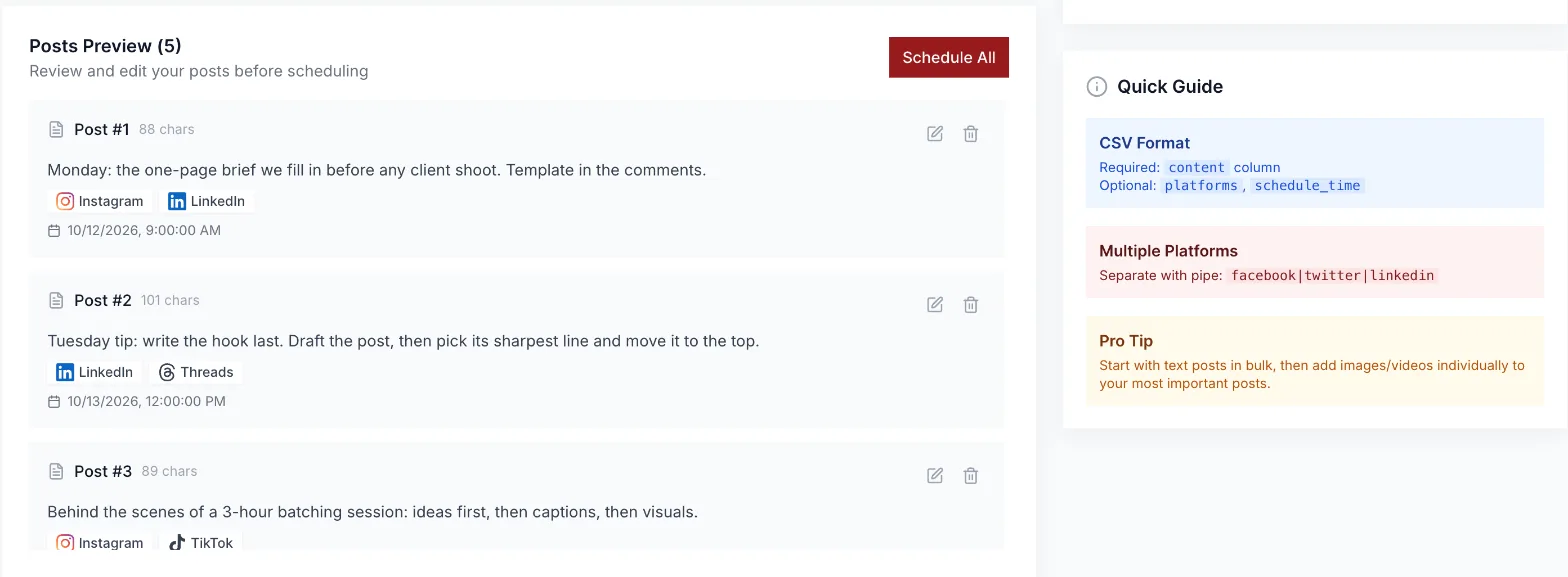
- Schedule. Load the whole batch into the content calendar in one go, so publishing is automatic and you're not back in the app every day.
Each block stays in one mode. That's the entire trick.
How far ahead to batch (and keep a buffer)
A week is the natural batch for most people; a month works if your topics don't go stale fast. Whichever you pick, aim to always sit a buffer ahead, a few posts banked beyond today, because the buffer is what protects you when a busy week hits. Without it, one bad week breaks the streak and you're back to daily scrambling; with it, you coast through and refill on the next batch day.
The batch pairs with the plan: build the calendar in a short weekly ritual so the ideate block always has slots to fill, then do the writing and design blocks against it. Two sittings replace seven scrambles, and the content is usually better, because it was made in a groove instead of under a daily gun.
Frequently asked questions
How do you batch create social media content?
Group the same kind of task across all your posts and do each in its own block: ideate everything first, then write every caption, then make every visual, then schedule the lot. The mistake is batching post-by-post, which keeps every context switch; batching by mode is what actually saves the time.
Does batching content actually save time?
Yes, mainly by cutting context-switching. Doing all your writing in one warm session is far faster than restarting the writing brain every day, and the work tends to be better because you're in one groove. It doesn't add hours. It removes the friction between the different modes of making a post.
How far in advance should you batch content?
A week suits most people; a month works if your topics don't date quickly. More important than the horizon is keeping a small buffer (a few posts banked ahead of today) so a busy week doesn't break the streak. The buffer is what makes batching resilient rather than fragile.
How many posts should you batch at once?
However many fill your sustainable cadence for the batch period: if you post four times a week and batch weekly, that's four, not twenty. Batching more than you'll actually publish just front-loads work that may go stale. Match the batch to the calendar, not to how productive you feel that day.