
How to Make a Social Media Content Calendar You'll Actually Keep
July 15, 2026 · 6 min read · by Jan Oršula
A social media content calendar is a dated plan of what you'll post, where, and when. But the version that works isn't a pretty grid you fill in once. It's a weekly ritual that keeps the grid full. Almost every calendar dies the same way: someone builds a beautiful empty template, fills week one, and by week three it's a graveyard of "TBD." The fix isn't a better template; it's designing the calendar for maintenance. This guide builds one that survives: starting from your themes, not the dates; run on a repeatable weekly loop; with every slot filled by something you can actually make.
Start from pillars, not empty dates
The blank calendar is the trap. Staring at seven empty boxes and asking "what should I post Tuesday?" is how you end up posting nothing, because you're making a hundred tiny decisions from scratch every week. Start one level up: with a small set of content pillars, the three-to-five recurring themes your account is actually about. Now the weekly question isn't "what do I post?" but "what's this week's take on each pillar?" That's a far smaller, more answerable question.
Pillars turn the calendar from a void into a set of slots with a job. A slot isn't "Tuesday, 9am"; it's "Tuesday, the education pillar." You'll never run dry, because you're not inventing a topic each time. You're rotating through themes you've already decided matter.
Set the cadence you can sustain
Before you fill anything, decide how many slots there are, and set that number by what you can keep up, not by what some best-practice chart says. A calendar with five daily slots you'll abandon is worse than three weekly ones you'll hit, because consistency is the thing the algorithm and your audience both reward. Work out a realistic posting cadence first, then build exactly that many slots. An honest calendar with fewer boxes beats an aspirational one with empty ones.
Fill each slot with an idea, not a placeholder
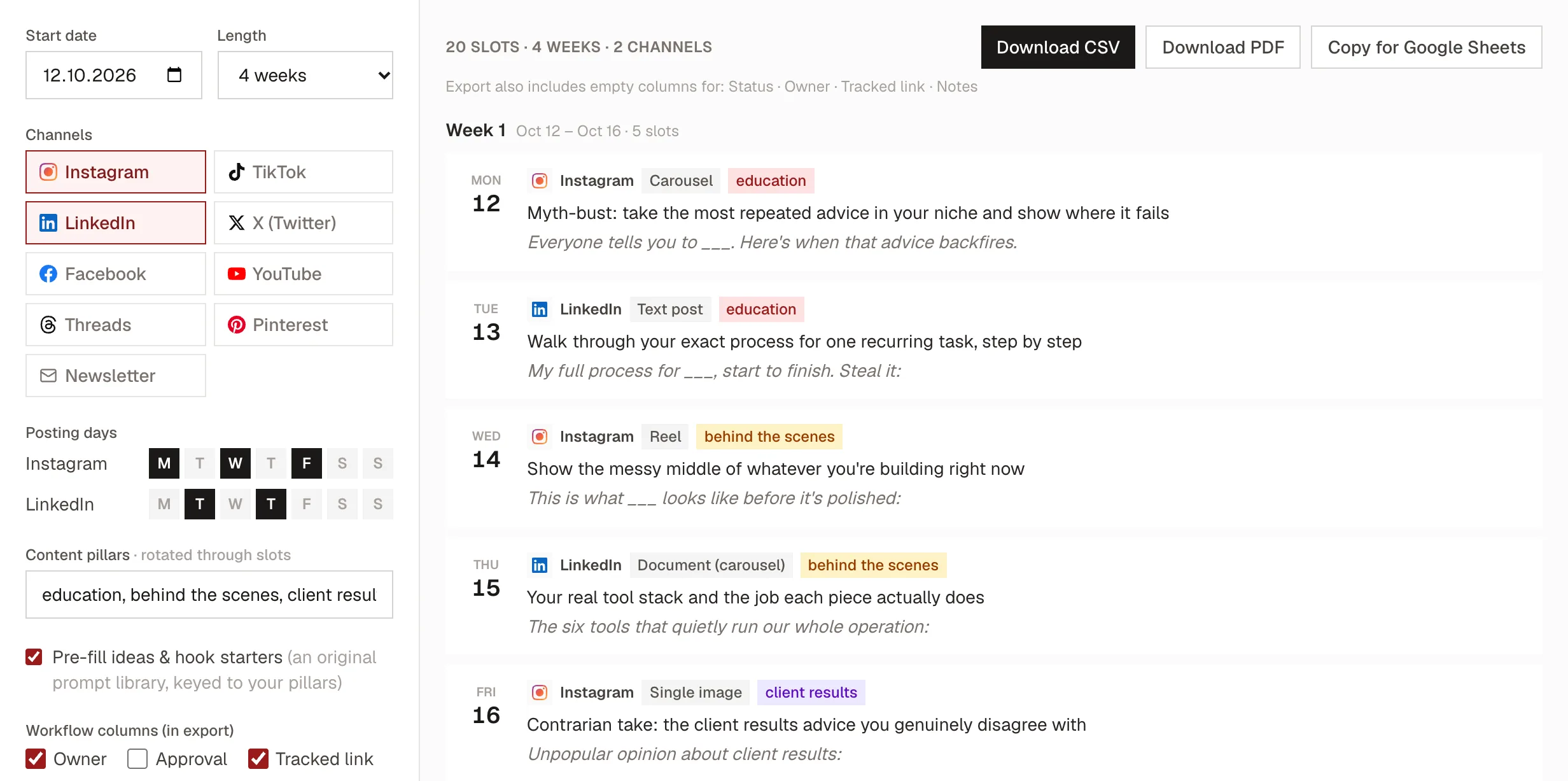
Here's where most calendars quietly fail: they mark "Reel, Tuesday" and call it planned. That's not a plan; it's a reminder to panic on Tuesday. A slot is only really filled when it has three things: the idea (the specific topic), a hook starter (the angle or opening line), and the format (Reel, carousel, single image, thread). With those three, the actual creation is execution, not invention. You're not deciding what to make under deadline, only making it.
If you'd rather not build the grid from scratch, our content calendar template generates a dated calendar for your channels and posting days with every slot pre-filled with an idea, a hook starter, and a format (the exact three fields above), so you start from a full calendar instead of an empty one.
Run it as a weekly ritual
The calendar is a habit, not a document. Block a recurring 30–60 minutes, the same slot every week, to do one thing: look at next week and make sure every slot has its idea, hook, and format. That's it. This is the single move that separates calendars that last from calendars that die: the empty grid never had a standing appointment to fill it. Pair the planning ritual with batching your creation and the whole week's content gets made in two sittings instead of seven scrambles.
Keep it alive
Two habits keep the calendar from calcifying. First, treat it as a parking lot: when an idea shows up mid-week, drop it onto a future date instead of losing it in a notes app. A good calendar is where ideas live, not just where they're scheduled. Second, reschedule freely: a plan that can't move gets abandoned the first time life interferes, so drag a post to next week rather than declaring the whole system broken. The calendar that survives is the one loose enough to bend and structured enough to fill itself. Build that, run the weekly ritual, and "what do I post?" stops being a question you dread.
Frequently asked questions
How do I make a social media content calendar?
Start from your content pillars rather than empty dates, decide a cadence you can actually sustain, and give every slot three things: the idea, a hook starter, and the format. Then run a weekly ritual: a standing 30–60 minutes to make sure next week's slots are all filled. The ritual, not the template, is what keeps it alive.
What should a content calendar include?
At minimum: the date and platform, the content pillar or theme, the specific idea, a hook or angle, and the format. Marking only Reel, Tuesday isn't a plan; it's a reminder to panic on Tuesday. The extra fields turn creation into execution instead of last-minute invention.
How far ahead should you plan social media content?
Far enough to batch, but not so far it goes stale. That means a week or two of fully-detailed slots, with a looser month-ahead view for campaigns and launches. Planning the whole quarter in detail usually just means rewriting it when things change; a rolling one-to-two-week horizon is the sweet spot most teams keep.
Why do content calendars stop getting used?
Almost always because they were built for week one, not for maintenance: a pretty empty grid with no standing time to fill it. Give the calendar a recurring weekly appointment, start each slot from a pillar so you're never inventing topics cold, and let posts reschedule freely instead of breaking the system.