
How to Find Trending TikTok Sounds
· 7 min read · by Jan Oršula
The most reliable place to find trending TikTok sounds is inside TikTok itself (the app surfaces rising audio as you create and scroll), because there is no reliable public "top sounds" chart to bookmark right now. TikTok's trending-songs chart in its Creative Center is currently unavailable, so the static "top 50 TikTok sounds" lists you'll find ranked in Google are usually scraped, undated, and days stale. This guide covers where to look in the app right now, how to tell a sound is genuinely rising rather than already peaked, how to use one for reach, and the commercial-music catch that trips up business and agency accounts.
Where to find trending sounds on TikTok
There's no single dashboard anymore, so you triangulate from a few spots inside the app, all free, all first-party:
- The "Add sound" screen. Start a post (the + button) and tap Add sound. The top of that screen is TikTok's own recommended and trending audio, personalised to your niche, which is more useful than a generic global chart, because it surfaces what's rising for content like yours. Sounds with an upward arrow are climbing.
- The sound's detail page. Tap the spinning disc in the bottom-right of any video to open that sound. You'll see how many videos use it and can scroll those videos, your fastest read on whether a sound is small and climbing or already everywhere.
- Your For You feed. This is the real signal. If you see the same sound two or three times in a day from different creators, it's trending in your corner of TikTok. Save it on the spot (the bookmark on the sound page).
- Search. Search a topic and open the Sounds filter, or use Creator Search Insights (in TikTok's Creator tools) to see what audio is attached to content people are looking for.
One honest note on sourcing: TikTok's Creative Center still has a great trending hashtags chart (we maintain a monthly pull of it), but its songs chart went dark during TikTok's music-licensing disputes and hasn't reappeared, so treat it as paused rather than gone for good. Either way, for audio specifically the app is the source of truth right now, not a chart.
How to tell a sound is actually rising (not already peaked)
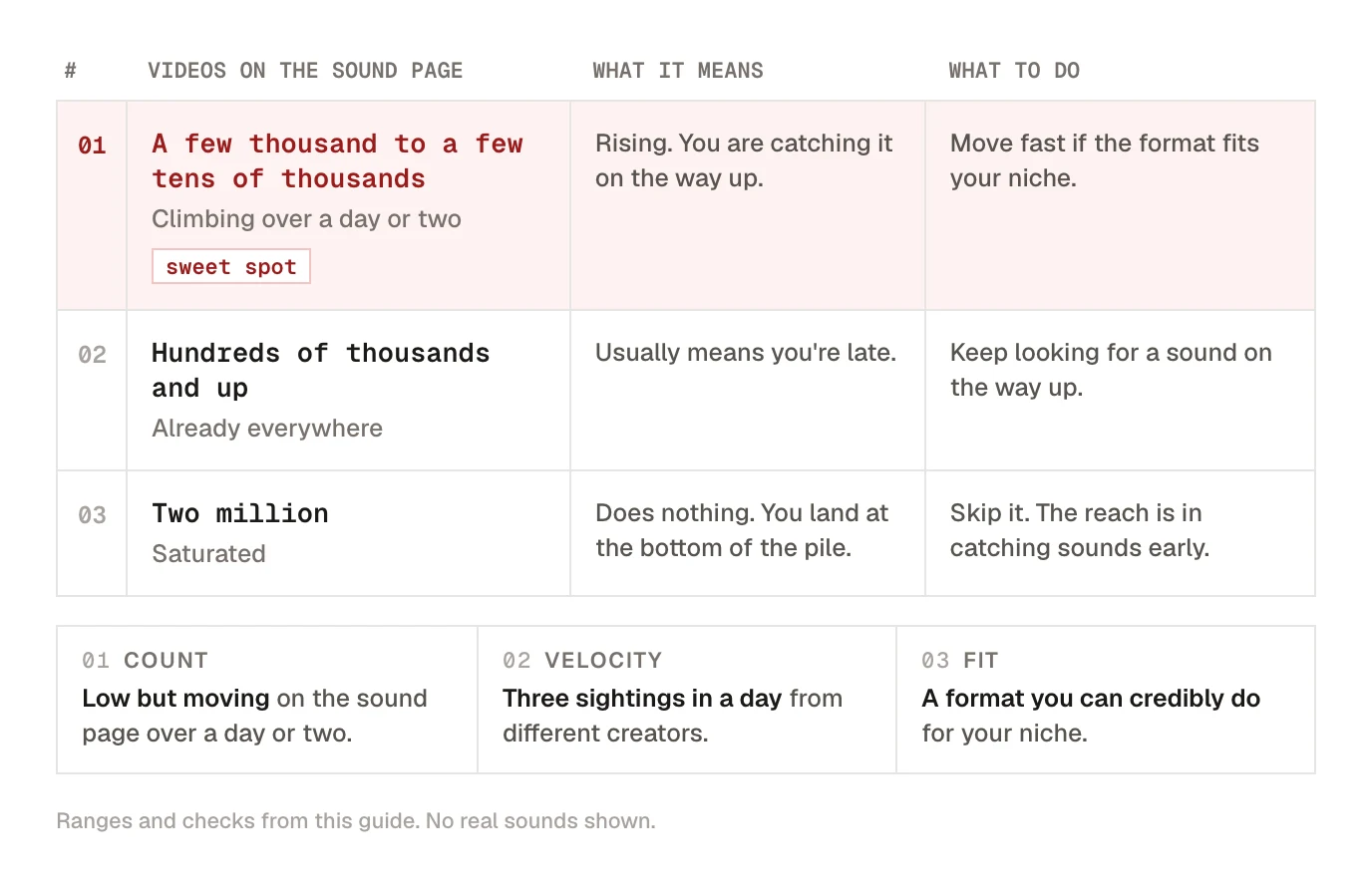
Using a sound that already has two million videos does nothing. You're at the bottom of a saturated pile. The reach is in catching a sound on the way up. Three quick checks:
- Video count, low but moving. On the sound page, a few thousand to a few tens of thousands of videos, climbing over a day or two, is the sweet spot. Hundreds of thousands and up usually means you're late.
- You're seeing it repeatedly, fast. Three sightings in a day from different creators beats one sighting a week. Velocity matters more than the raw number.
- The format is replicable. A rising sound is only useful if you can make something for your niche with it. If the sound is married to a format you can't credibly do, it's not your trend, so skip it.
This is the same discipline behind trending hashtags: relevance and timing beat raw popularity.
How to use a trending sound for reach
Sound choice influences distribution, because TikTok groups and surfaces content by audio, but it doesn't override quality. The win is using a rising sound as a vehicle for content that already works:
- Move fast. A sound's window is days, sometimes hours. Attaching it early is most of the benefit.
- Fit the sound to the format. The best trending-sound posts feel native to what that sound is "for": a beat drop on a reveal, a dialogue clip on a reaction. Forcing an unrelated sound onto your post reads as off and won't hold viewers.
- Lead with the hook anyway. The sound gets you considered; the first three seconds decide whether you're watched. Don't let a trending sound do the job your opening should.
- Lower the volume under talking. If your video carries information, duck the trending sound under your voiceover so it signals the trend without burying the message.
The commercial-music catch for businesses and agencies
This is where most "just use trending sounds" advice quietly fails the people this site is written for. Business accounts on TikTok cannot use the full personal music catalogue. They're limited to the Commercial Music Library, tracks TikTok has cleared for commercial use, to avoid copyright liability. So a song trending across personal accounts may be unavailable, or muted later, on a brand account.
If you manage brand or client accounts, build the habit:
- Check before you commit. When you add a sound on a Business account, TikTok flags whether it's cleared for commercial use. If it isn't available, that's your answer. Don't work around it.
- Trend within the Commercial Music Library. The CML has its own popular and rising tracks; pick a cleared sound that fits rather than risking a personal-catalogue hit. TikTok documents the commercial-music rules in its own business help resources.
- Lean on original audio. Original sound you record (a voiceover, a hook line, a snippet that becomes a trend) sidesteps the licensing question entirely, and original audio that catches on is its own reach engine.
The short version: a trending sound is only an asset if your account is actually allowed to use it. Verify, don't assume.
Trending sounds, songs, and original audio: what's the difference?
People search all three, and they overlap:
- Songs are licensed music tracks. The most volatile and the most commercially restricted for brands.
- Sounds is TikTok's umbrella term: songs plus original audio, dialogue clips, and effects. "Trending sound" is the broadest, most accurate phrase.
- Original audio is anything a creator records themselves. Lowest legal risk, and the category most within your control to start a trend rather than chase one.
For a brand account, the safety order is roughly: original audio → Commercial Music Library → everything else (check first).
The one-line version
Find trending sounds where they actually live: TikTok's "Add sound" screen, sound pages, and your own For You feed. Grab the ones that are rising and fit your niche, move fast, and if you run brand accounts, confirm the sound is cleared for commercial use before you build a post around it.
Kadenzo for TikTok
Schedule the video, add the sound in TikTok
Kadenzo doesn't find trending sounds, and it can't attach a library sound to a direct post, so for a sound-led video you send it to your TikTok inbox as a draft and add the rising sound in the app. Videos with original audio can go out as direct posts from the same calendar as your other networks, with privacy, Duet, Stitch and comment settings set ahead. Plans from $19 a month.
Frequently asked questions
Is there a TikTok trending sounds chart?
Not a reliable public one right now. The songs chart in TikTok's Creative Center went dark during its music-licensing disputes and is currently unavailable, so treat it as paused rather than gone for good. The live source is inside the app: the Add sound screen and individual sound pages. Treat any third-party top-sounds list as scraped and days stale.
How many videos does it take for a TikTok sound to count as trending?
There is no fixed threshold; the trajectory matters more than the raw count. A sound climbing from a few thousand videos over a day or two is a better bet than one sitting flat at a million, where you would just be late to a saturated pile.
How often do TikTok sounds trend and fade?
Fast. Often a few days to two weeks for a specific sound, sometimes only hours. That speed is exactly why a live, in-app check beats any saved list, and why attaching a rising sound early is most of the benefit.
Can a business get in trouble for using a trending song?
Yes, if the track sits outside the Commercial Music Library. Business accounts are limited to TikTok's cleared catalogue, so a song trending across personal accounts can be unavailable, muted later, or a liability on a brand account. Check the commercial-use flag before you commit.
What is the difference between a TikTok sound and a song?
A song is a licensed music track, the most volatile and the most restricted for brands. Sound is TikTok's umbrella term covering songs plus original audio, dialogue clips, and effects, so trending sound is the broader, more accurate phrase. Original audio you record yourself carries the lowest legal risk.