
How to Use Hashtags on Social Media (2026 Guide)
July 3, 2026 · 8 min read · by Jan Oršula
The short version: use fewer, more relevant hashtags than you used to, and size the set to the platform rather than dumping the same block everywhere. The old habit of thirty tags stuffed into a first comment is not just outdated, it's now actively blocked on Instagram, which caps posts at five hashtags. In 2026 a hashtag is a categorization and search signal, not a reach lever you pull harder for more views. This guide covers whether they still matter, how many to use on each platform, how to choose the right ones, and where to put them.
Do hashtags still work in 2026?
Yes, but their job changed, and that's the root of most of the confusion. For years hashtags were sold as a reach multiplier: add more, get in front of more strangers. The major feeds have since moved to recommending content by predicted interest (what the post is actually about and who tends to engage with that topic), so the hashtag stopped being the thing that earns reach. The content earns the reach; the hashtag helps the system file the content correctly.
That's still worth doing, for two reasons. First, categorization: a couple of accurate tags help the algorithm understand the topic and audience of a post that might otherwise be ambiguous. Second, search: people genuinely browse and search hashtags and keywords on Instagram and TikTok to find content in a niche, and a relevant tag is how you show up there. So hashtags are worth the ten seconds, as a precision tool, not a volume play. What stopped working is the volume play itself.
How many hashtags should you use?
There is no universal number, which is exactly why copy-pasting one block everywhere fails. Each platform rewards a different count, and the single biggest 2026 change is at the top of the list:
- Instagram: up to 5. Instagram now hard-caps posts and Reels at five hashtags (down from the old limit of 30); extra tags are stripped or ignored, and the caption and comments are counted together, so the first-comment dump no longer buys you anything. Make all five relevant and specific.
- TikTok: 3 to 5. Content-matched tags, where the first one matters most for how the For You system categorizes the video. Mix one broad community tag with niche ones tied to the exact topic.
- X (Twitter): 1 to 2. More than two reads as spam and tends to lower engagement. Often zero is the right answer.
- LinkedIn: 3 to 5. Professional, followable tags (ones people actually subscribe to), not a wall of them.
- YouTube: 3 to 6 in the description. The first three appear above the title, so order matters; lead with the broad topic tag.
- Threads: 1. A single topic tag per post is the native pattern.
- Facebook: 2 to 4. Hashtags do little for reach here; keep them for branding and searchability.
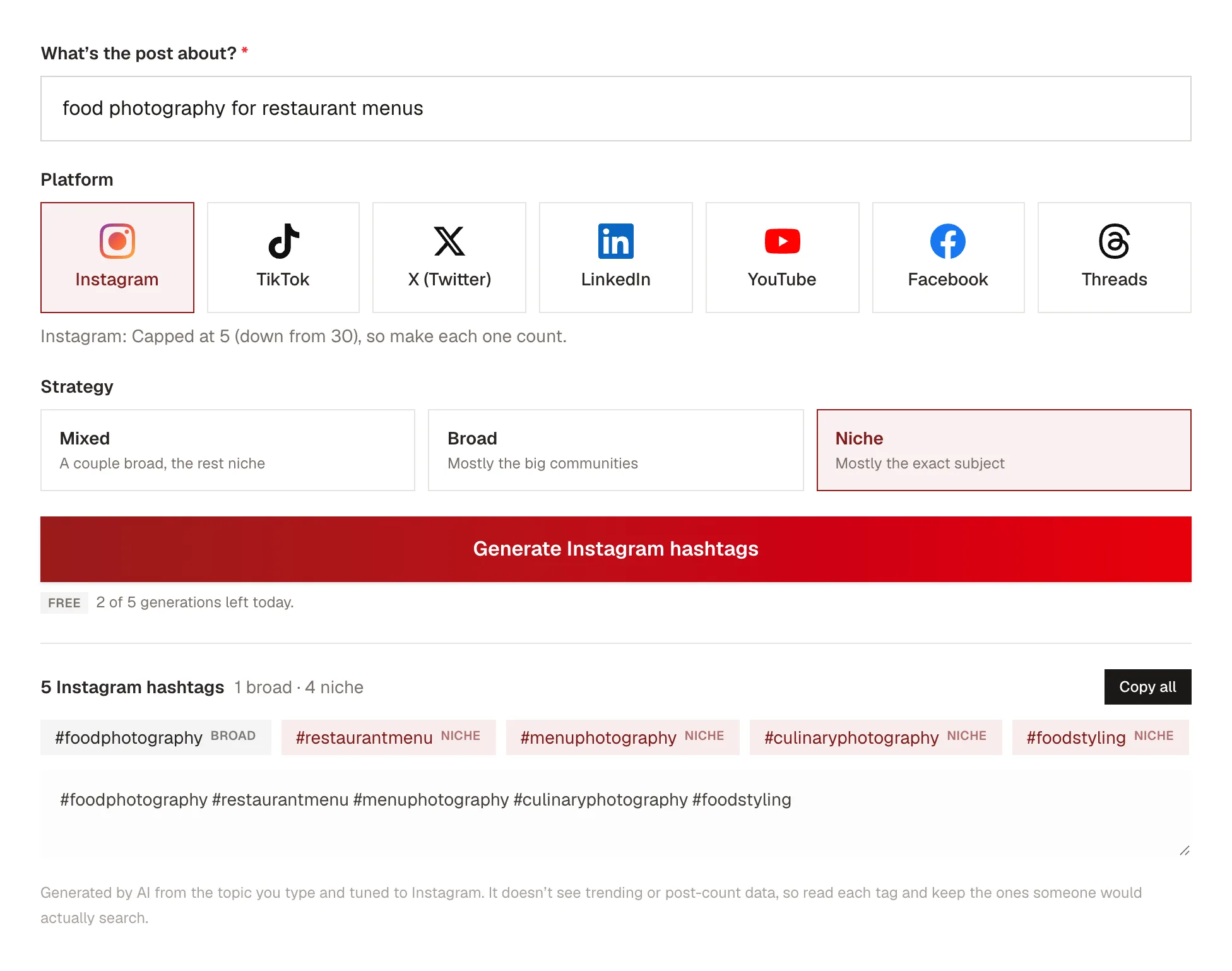
If sizing a set per platform sounds like busywork, that's exactly what our hashtag generator is for: it produces a relevant set capped to each platform's count from a topic you type, rather than scraped "trending" lists that go stale in days. And because hashtags count toward your caption's character budget, it's worth running the finished caption through the character counter, plus a quick hashtag counter to confirm you're under each platform's limit, before you post.
How to choose hashtags: broad, niche, branded
Relevance beats popularity every time. A massive tag like #love (billions
of posts) buries you instantly and tells the algorithm nothing useful; a
precise tag puts you in front of the few hundred people who actually want
your topic. The way to get a relevant set without overthinking it is to pick
in three layers and then trim to the platform's limit:
- One broad community tag: the space you're in. For a sourdough
account that's
#breadmaking: big enough to have an active audience, specific enough to mean something. - Two or three niche tags: the exact topic and audience.
#sourdoughtips,#beginnerbaker,#opencrumb. Smaller pools, far higher intent. This is where most of the value sits, because the competition is thin and the audience is precisely yours. - An optional branded tag: your own (
#yourbrandbakes). It does nothing for discovery on day one, but it compounds: it's how you collect your own content and, eventually, other people's.
That's broad → niche → branded. On Instagram you might keep one broad, three niche, one branded and you're at the five-tag cap with every slot earning its place. On X you'd keep just the one niche tag. The layers scale down cleanly; a single fat block doesn't. Tie the niche layer to the themes you post about most. The same content pillars that structure your calendar make a natural, reusable hashtag shortlist.
One thing to deliberately skip: chasing unrelated "trending" tags. Putting a viral-but-irrelevant tag on your post to ride its volume is the fast track to the wrong audience (who don't engage) and, on a bad day, a spam flag.
Where do hashtags go, the caption or the first comment?
For years the advice was to hide a block of hashtags in the first comment to keep the caption clean. With Instagram's five-tag cap and combined caption-plus-comment counting, that trick is dead: there's no big block to hide, and a comment dump doesn't escape the limit. So put your handful of tags where they read best:
- Instagram & Threads: at the end of the caption, after a line break (Instagram collapses blank lines, so keep the spacing on purpose). With only a few relevant tags, they don't clutter anything.
- TikTok: woven into or appended to the caption; they're part of how the caption reads aloud in the creator's voice.
- LinkedIn & X: inline or on the final line, sparingly.
- YouTube: in the description, with the most important first.
Because the first line of your caption is what gets truncated in-feed, keep hashtags well clear of it. Check exactly where each platform folds your text with the caption previewer so a tag never lands in the visible hook.
The mistakes that actually hurt you
Most "hashtag strategy" worry is misplaced. Two things genuinely cause trouble, and neither is "using the wrong number":
Reusing one identical block on every post. Posting the exact same set of tags on everything is the pattern platforms read as spammy, and it's the real seed of most shadowban stories. Vary the set to match each post, which is easy when you're only choosing a handful by relevance anyway.
Using restricted or banned tags. Some tags get quietly limited because
they attract spam or policy-violating content, and including one can suppress
the whole post. You don't need a checker for this; just avoid vague,
spammy-feeling mega-tags (#followforfollow, #like4like) and tags that have
obvious moderation baggage.
The genuine "shadowban," for the record, is mostly a myth in the dramatic form people fear. There's rarely a secret blacklist. A post that suddenly underperforms is far more often a content or timing issue than a hashtag curse. Keep the tags relevant and varied and hashtags will never be the thing holding a post back.
The one-line version
Pick a few genuinely relevant tags (one broad, a couple niche, maybe a branded one), size the set to the platform, vary it per post, and let the content do the reach. That's the whole strategy in 2026. If you want the set written for you, generate one from your topic and paste the best ones in.
Frequently asked questions
How many hashtags should you use on Instagram in 2026?
Up to five. Instagram now hard-caps posts and Reels at five hashtags, and caption and comments are counted together, so extra tags get stripped. Make every one of the five specific and on-topic rather than padding the set.
Do hashtags actually increase reach anymore?
Not directly. The feeds recommend posts by predicted interest, so the content earns the reach and the hashtag just helps the system file the post and surface it in search. Treat tags as a precision categorisation tool, not a volume lever.
Should hashtags go in the caption or the first comment?
In the caption now. The hide-them-in-the-first-comment trick died once Instagram capped tags at five and started counting caption and comments together. Put your handful at the end of the caption after a line break, well clear of the first line that shows in-feed.
Is it bad to use the same hashtags on every post?
Yes. Reusing one identical block is the pattern platforms read as spammy, and it is the real seed of most shadowban stories. Vary the set to fit each post, which is easy when you are only picking a few tags by relevance anyway.
Can banned or restricted hashtags hurt a post?
They can. A tag that gets quietly limited for attracting spam can suppress the whole post it sits on. You do not need a checker for it; just skip vague mega-tags like #followforfollow and anything with obvious moderation baggage.