
Social Media Competitor Analysis: A Five-Step Method and Free Template
October 12, 2026 · 8 min read · by Jan Oršula
A social media competitor analysis is a structured look at how three or four rival brands use social media, done to learn what works in your market and what's missing from it. The useful version takes about two hours a quarter: pick the competitors your customers actually compare you with, scan their profiles, log their last ten posts each, read the comments under their best and worst posts, and finish with three things to steal, three to avoid, and three gaps nobody fills. The method below follows those five steps, with a worked example for a plant shop, and the free template does the counting.
Social media competitor analysis template (.xlsx, 32 KB)
Competitors, profile scan, content log, comment mining and findings, with the plant shop example filled in. Excel, Google Sheets and Numbers. No sign-up.
Download the template
What it's for, and what it isn't
A competitor analysis is good for three things: seeing how rivals position themselves, spotting the formats and topics that get their audience talking, and finding out what customers in your market want that nobody gives them.
It's bad at telling you whether you're doing well. You can see a competitor's likes, comments and follower count, but not their reach, their paid promotion, or how many of their followers are real. So any "their engagement rate vs ours" table compares your real numbers with their guesses. Judge your own performance against your own baseline, and use competitors for ideas.
Step 1: Pick three or four competitors
More than four and the analysis gets shallow; fewer than three and you can't tell a pattern from one brand's quirk. A useful mix:
- Two direct competitors: same customers, same price range, same area or niche.
- The one customers mention. Look at your reviews, sales calls and DMs for the name that comes up as "I was also looking at…".
- One that's doing social well, even if it's slightly outside your niche. You learn more from a strong account than from a weak rival.
Write down why each one is on the list. If you can't, swap it for one you can explain.
Step 2: Scan each profile (10 minutes each)
Open each profile logged out, the way a customer would, and note:
- What the bio promises, in one line.
- Where the link goes: shop homepage, a quiz, a booking page, a link page with eleven options.
- Which platforms they're active on, and roughly how often they post (count the last 30 days).
- Your first impression. It's what a customer feels in five seconds, and it's often the most honest note in the file.
Step 3: Log their last ten posts
For each post, record the format, the topic, the first line (in your own words), and the number of likes and comments. The template's Patterns tab then shows each competitor's format mix and their average comments per post, and flags each brand's two most-discussed posts.
Weight comments over likes. A like costs a thumb; a comment means the post gave someone something to say. Look at which topics and first lines the top posts share, not just the format. "Short video" doesn't explain a hit; "short video correcting a mistake people make" might.
Step 4: Read the comments
This is the step most competitor analyses skip, and it's the most useful. Open each brand's two best and two worst posts and read the comments. You're looking for recurring themes, not single comments:
- Praise: what customers love about them. That's the bar you have to meet.
- Questions: what people still don't understand. Unanswered questions are free content ideas.
- Complaints: what goes wrong. Your positioning lives in their complaints.
- Requests: what people ask for that the brand doesn't offer.
Note themes in your own words, and leave out names and handles. You're learning what the market wants, not collecting people.
Step 5: Steal, avoid, gap
A SWOT grid tends to get filled in and filed. Three short lists with owners get acted on:
- Steal (3): patterns that clearly work for them and fit your brand, rebuilt in your own voice with your own products.
- Avoid (3): things that visibly don't work: posts that get no comments, questions left unanswered, a link page nobody can navigate.
- Gap (3): what customers ask for in their comments that nobody covers. This list usually produces your best next month of content.
Give each item an owner and a way to test it, the same way the audit's findings page does.
A worked example: a plant shop and three rivals
An agency runs this for Fern & Fig, a plant shop that sells in-store and online. Competitors: Leafline (same city, delivers next day), The Plant Room (the shop customers mention in reviews) and Greenhaus (online-only, posts rare plants and ranks above Fern & Fig in search).
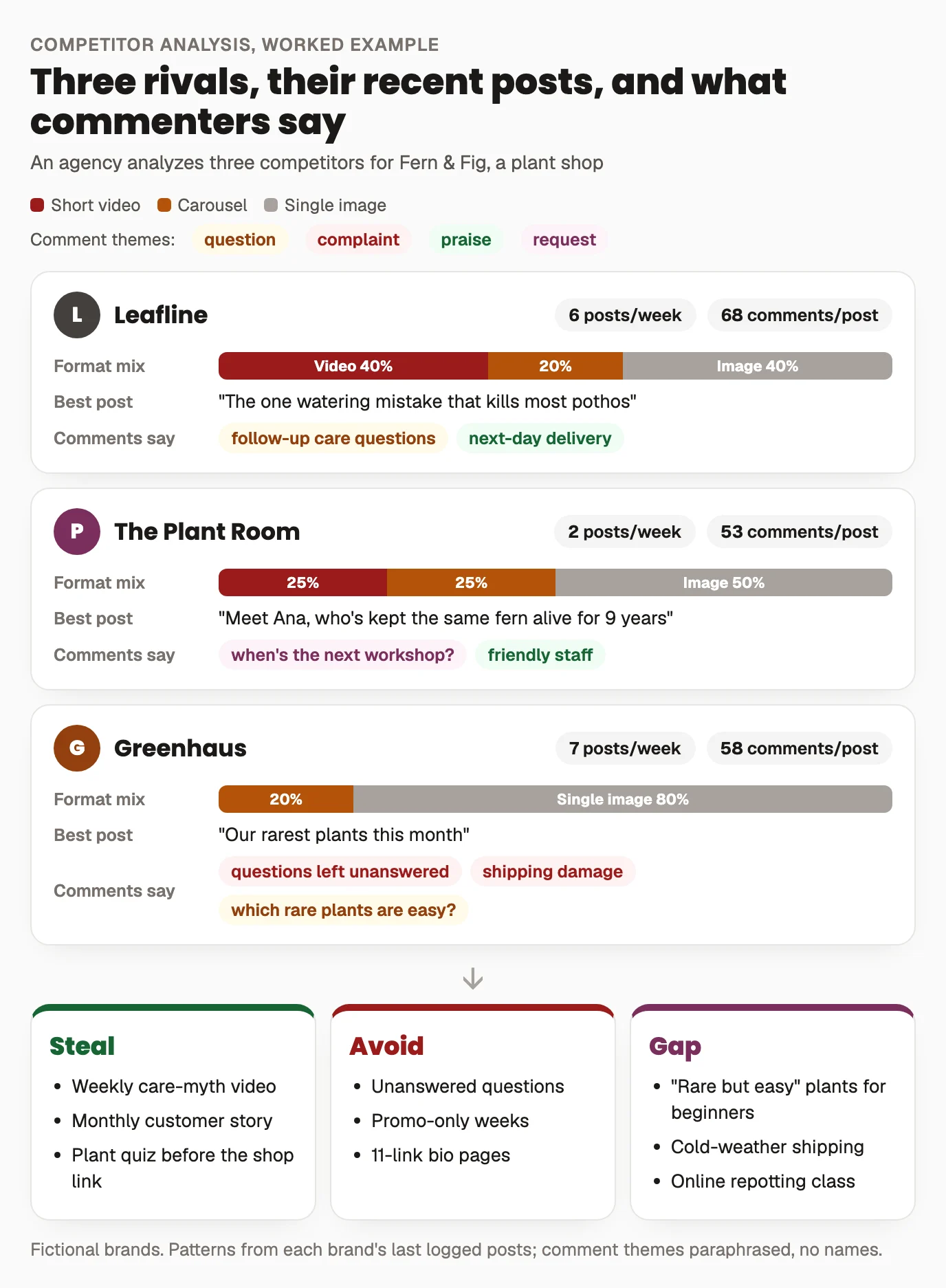
What the analysis found:
- Leafline posts about six times a week, mostly short videos and carousels about plant care, and gets the most comments per post. Its best post corrects a common watering mistake; its promotional posts get almost no comments.
- The Plant Room posts twice a week. Its customer stories and workshop recaps do well, and under every post people ask when the next beginner workshop is. It keeps selling out.
- Greenhaus posts daily, almost all single product images of rare plants. Plenty of likes, but the comments are full of unanswered questions, autumn shipping damage, and beginners asking which rare plants are easy.
So Fern & Fig decides to steal the care-myth video format and the customer stories; avoid promo-only weeks and leaving questions unanswered; and fill three gaps: a "rare but easy" carousel for beginners, a video on how it packs plants for cold weather, and a test of a small online repotting class. Every one of those came from reading the comments rather than counting the likes.
How often to do it, and what to automate
Quarterly is enough for most brands, with the same competitor set each time so you can see what changed. Between analyses, two things are worth tracking continuously:
- Mentions of each competitor, so you notice a launch, a complaint wave or a viral moment when it happens. A listening tool does this; the share of voice guide covers turning those mentions into one comparable number.
- Their best posts, saved to a swipe file as you come across them, so the next analysis starts with examples rather than a blank page.
Everything in this method uses what anyone can see on a public profile. There's no need to scrape anything, and no point copying a competitor's posts: their audience has seen them, and yours deserves your version.
Frequently asked questions
What should a social media competitor analysis include?
The competitors and why they're on the list, a quick profile scan (bio, link, platforms, posting frequency), a log of their recent posts with formats, topics and comments, the recurring themes in their comment sections, and a short list of what to steal, avoid and build. Numbers like follower counts are context, not the point.
How many competitors should you analyze?
Three or four. Fewer and you can't tell a pattern from one brand's habit; more and the analysis gets too shallow to act on. Include at least one brand that's genuinely good at social, even if it's slightly outside your niche.
Can you compare engagement rates with competitors?
Only loosely. You can see their likes and comments, but not their reach or paid promotion, so their engagement rate is an estimate while yours is real. Compare patterns, such as which formats and topics get them comments, and judge your own performance against your own history.
How long does a competitor analysis take?
About two hours for three or four competitors: ten minutes per profile scan, twenty minutes logging posts and reading comments for each, and half an hour on findings. Repeat it every quarter with the same competitors.
Is it OK to copy what competitors post?
Learn from the idea, don't copy the post. If their care-tip videos get comments, make your own care tips with your products and your voice. Copying their content is easy to spot, may break copyright, and gives your audience nothing new.