
Popular Instagram Hashtags (What Actually Works in 2026)
· 7 min read · by Jan Oršula
Here's the uncomfortable truth: the most popular Instagram hashtags are the
ones you should avoid. Tags like #love, #instagood, and #photooftheday
have billions of posts. Adding one drops your photo to the bottom of an ocean
in seconds and tells Instagram nothing about what your post is actually about.
And in 2026 it matters more than ever, because Instagram now caps posts at
five hashtags, so there's no room to waste on popular-but-useless ones. This
guide explains why the old "top 100 Instagram hashtags" lists are dead, and how
to pick the handful of relevant tags that genuinely help.
Why the most popular hashtags are the ones to skip
Popularity and usefulness are inversely related on Instagram. A hashtag with two billion posts isn't an opportunity; it's a crowd so large you're invisible the instant you join it, and it's so broad it gives Instagram's recommendation system no signal about your topic or audience. The tags that actually help are the small, specific ones: a few hundred thousand posts, tightly on-topic, used by the exact people who'd want your content.
So when you search "popular Instagram hashtags" hoping for a magic block to copy, the honest answer is that copying the popular ones is the mistake. What you want is the relevant ones, and those are different for every account.
Instagram now caps posts at 5 hashtags
This is the single biggest change, and it quietly kills the entire "hashtag list" genre. Instagram limits posts and Reels to five hashtags. Add more and the extras are stripped or ignored, and because the caption and comments are now counted together, the old trick of dumping thirty tags into the first comment buys you nothing.
Five slots. That's it. A "top 50 Instagram hashtags" page is mathematically useless when you can only use five, and each of those five should be chosen for your post, not pulled from a generic chart.
What to use instead: relevant beats popular
The method is simple once you stop chasing volume. Pick in layers, then trim to five:
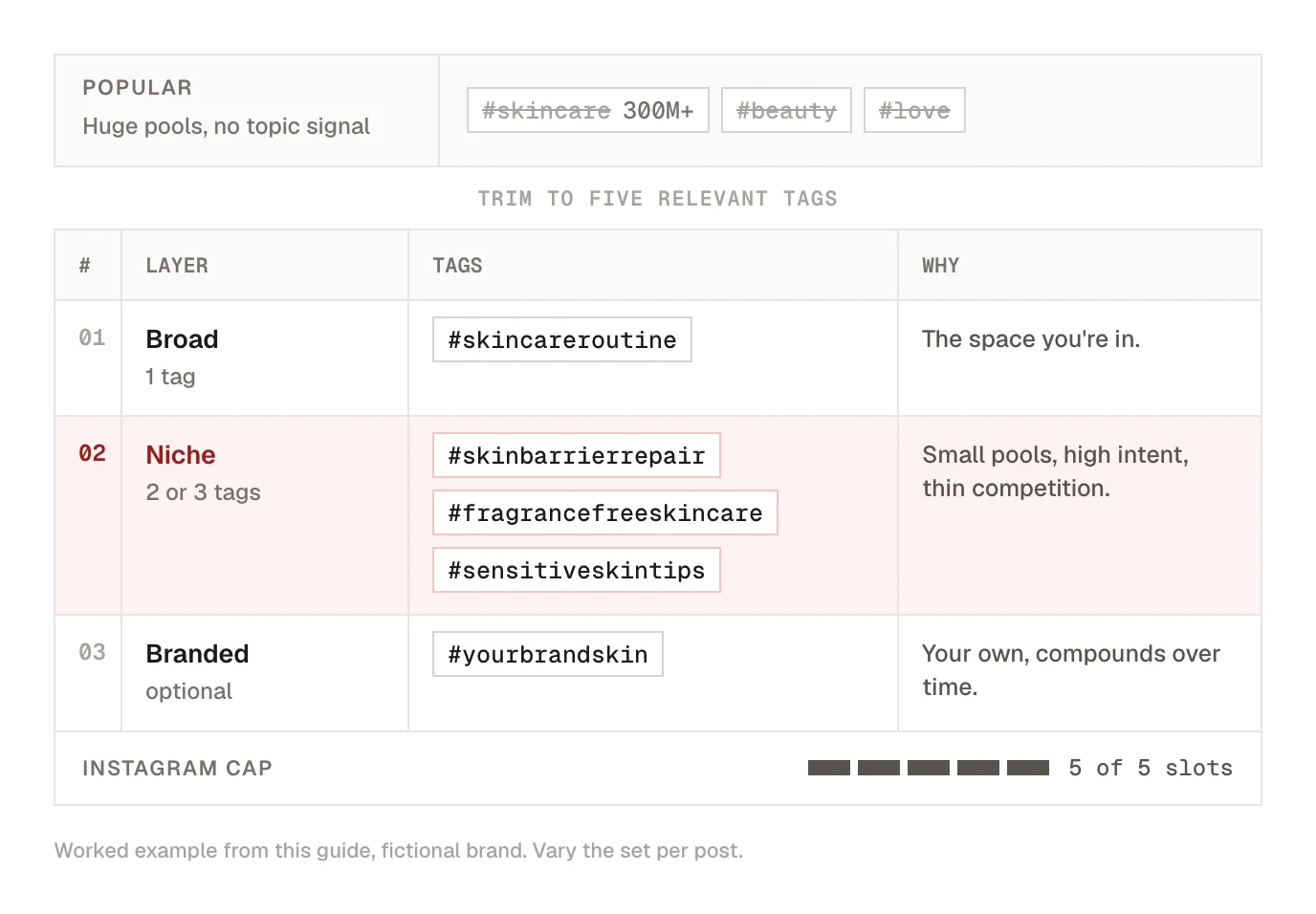
- One broad community tag: the space you're in.
- Two or three niche tags: the exact topic and audience. This is where the value sits: small pools, high intent, thin competition.
- One optional branded tag: your own, which compounds over time.
A worked example. A small skincare brand reaching for popular tags would post
#skincare (300M+), #beauty, #love. And disappear. The version that works
trims to five relevant ones: #skinbarrierrepair, #fragrancefreeskincare,
#sensitiveskintips, #skincareroutine, and a branded #yourbrandskin. Same
five slots, every one earning its place in front of people who actually care
about sensitive skin.
The same build works in any niche: one broad tag, two or three that pin the exact topic, an optional branded one. These aren't a popular list to copy; they're illustrations of the method, and yours will differ because your account does:
- A home-gym fitness creator:
#homeworkout,#kettlebelltraining,#mobilitywork,#formcheck, and a branded#trainwithsam. Skip#fitness(400M+) and#gym; the specific movements are what reach people who train the way you do. - A vegan meal-prep account:
#veganmealprep,#highproteinvegan,#budgetveganrecipes,#plantbaseddinner, plus a branded#sarahseats. Not#foodor#vegan. The descriptive combinations catch searchers with real intent. - A Lisbon travel guide:
#lisbonportugal,#lisbontravel,#alfamalisbon,#portugaltravel, and a branded#roamlisbon. A precise place plus a neighbourhood beats#travel(700M+) every time, because local and regional tags are where trip-planners actually look.
That's the whole approach. The full per-platform version (counts, placement, how to choose) lives in how to use hashtags on social media; this page is the Instagram-specific cut. And if you'd rather have a relevant set written for you, the hashtag generator produces one tuned to Instagram from a topic you type, capped to the five that count.
How to find genuinely good Instagram hashtags
There's no public chart of trending Instagram hashtags. Instagram doesn't publish one, so any "live top hashtags" list you find is scraped, undated, and usually stale. You find good tags inside the app instead:
- Search a seed tag. Type a relevant hashtag into Instagram search and read the related tags it suggests, plus the post count next to each. That number is your relevance-versus-reach gauge. Lean toward the smaller, specific ones.
- Watch your niche. Note the tags recurring on the best-performing recent posts from creators in your space.
- Check the Reels and audio pages for how content like yours is tagged.
The same native-source method for TikTok and YouTube is in how to find trending hashtags, but the principle is identical: go to the source, ignore the scraped lists.
Hashtags for Reels vs feed posts
The rules don't change much by format (the five-tag cap applies to Reels too), but the job shifts slightly. On Reels, hashtags help Instagram categorise the video for the Reels feed and Explore, so a couple of accurate topic tags matter for reach into new audiences. On feed posts they lean more toward search and categorisation. Either way: a few relevant tags, not a popular block.
Restricted hashtags and the real risk
Two things genuinely hurt you on Instagram, and neither is "using too few":
- Reusing one identical block on every post. Posting the exact same five tags everywhere is the pattern Instagram reads as spammy, and it's the real seed of most "am I shadowbanned?" panics. Vary the set to match each post, which is easy when you're choosing by relevance anyway.
- Restricted or spammy tags. Some hashtags get quietly limited because they
attract spam, and one can suppress the whole post. You don't need a checker;
just avoid vague mega-tags (
#followforfollow,#like4like) and anything with obvious moderation baggage. Those also happen to be some of the most "popular" tags, which is one more reason to skip the popular ones.
Where do the hashtags go: caption or first comment?
With only five tags and combined caption-plus-comment counting, the hide-them-in-the-first-comment trick is dead. Put your handful at the end of the caption, after a line break so they don't clutter your opening. And keep them well clear of the first line. That's what shows in-feed before the "more" fold, so check where Instagram truncates your caption and make sure a hashtag never lands in the visible hook.
The one-line version
Ignore the "popular Instagram hashtags" lists: popular means invisible, and you only get five slots anyway. Pick five genuinely relevant tags (one broad, a few niche, maybe a branded one), vary them per post, and let the content carry the reach.
Kadenzo for Instagram
A fresh set of five on every post
Kadenzo schedules Instagram posts, carousels and Reels from one calendar, and each post stays editable until it publishes, so you can write a set of tags that fits that post instead of pasting one block everywhere. It doesn't research or suggest hashtags; choosing the five is still your call. Plans from $19 a month.
Frequently asked questions
Do Instagram hashtags still work in 2026?
Yes, but as a relevance and search signal rather than a reach hack. A couple of accurate tags help Instagram categorise your post and help people find it in search; the volume play of more tags for more reach is the part that stopped working.
How many hashtags should I use on Instagram?
Up to five. That is the hard cap on posts and Reels now. Make all five specific and relevant to your exact post rather than padding the set with popular tags, since extras are stripped or ignored anyway.
What are the best Instagram hashtags to use?
The ones most relevant to your exact niche, not the most popular ones. Best is account-specific: a precise tag with a few hundred thousand posts beats a generic one with two billion every time, because the smaller pool is full of people who actually want your topic.
Is there a list of trending Instagram hashtags?
Not a public, first-party one; Instagram does not publish a hashtag chart. Any third-party trending Instagram hashtags list you find is scraped and goes stale fast, so use in-app search and the post counts it shows instead.
Can popular hashtags get me shadowbanned?
The popular tag itself is rarely the issue. The bigger risks are reusing the same block on every post or including a restricted, spam-magnet tag. Vary your relevant set per post and avoid the obvious mega-tags and you will not have a hashtag problem.