
How to Measure Social Media ROI Without Guessing
July 14, 2026 · 7 min read · by Jan Oršula
Social media ROI is the value you got back divided by what it cost you to get it. The reason it feels impossible to measure is that it's a chain you have to instrument, not a number the platform hands you. You can't measure the ROI of a link you didn't tag or an outcome you never assigned a value. So measuring it is less about a clever formula and more about wiring the path from a post to a result before the post goes out. This guide covers the model, the one setup step that makes attribution possible at all, and the honest part most ROI guides skip: what to do about the real value you'll never be able to trace to a click.
The model, and why it usually breaks
ROI is simple arithmetic: (value returned − cost) ÷ cost. The trouble is never the math; it's the two inputs. Most teams can't state the value of a social outcome (what is a sign-up worth? a booked call?), and they can't attribute the outcome back to the post that caused it. Miss either and the equation has no numbers to run.
So measuring ROI is really three jobs done in order: decide what outcome you're counting and what it's worth, instrument the path so you can trace it, and then, only then, do the division. Skip the middle job and every result quietly lands in "direct traffic," which is analytics for we have no idea where this came from.
Step 1: define the outcome and its value
Pick the outcome that actually matters to the business, not a proxy. Reach and engagement are how you get there; they aren't the return. The return is the sign-up, the lead, the booked demo, the sale. Then give it a value: a real number for e-commerce, or a sensible stand-in elsewhere (a lead is worth your average deal size × your close rate; a newsletter sub is worth its average lifetime value). It doesn't have to be perfect. It has to exist, because "we got some engagement" isn't something you can put a currency sign in front of.
Step 2: instrument the path (this is the whole game)
Here's the step that decides whether any of this works: tag every link you post
so the outcome carries its origin with it. A UTM builder adds
consistent source / medium / campaign tags to your links, so a click from your
Instagram bio and a click from a LinkedIn post arrive in analytics labelled
instead of dissolving into one anonymous pile. Untagged, social's contribution is
invisible by construction: not zero, just unmeasured, which in a report reads the
same as zero.
With tags in place, your analytics can group results by exactly the campaign, platform, and post you care about. If your outcome lives on your website, a 30-minute GA4 setup turns those tagged links into a channel you can actually read: sessions, conversions, and value, split by where they came from. This is the difference between claiming social drove results and showing it.
Step 3: do the division, and report it
Now the arithmetic has inputs. Sum the value of the attributed outcomes, subtract the cost (ad spend, tools, and an honest slice of the hours), and divide, or drop the numbers into the ROI calculator to get net profit, ROAS, and cost per lead in one step. Put it in the monthly report next to the outcome count (our report generator has a section for it), so the number has a story: this many tagged clicks became this many sign-ups worth this much, against this cost. A single ROI figure with no chain behind it invites an argument; the chain ends it.
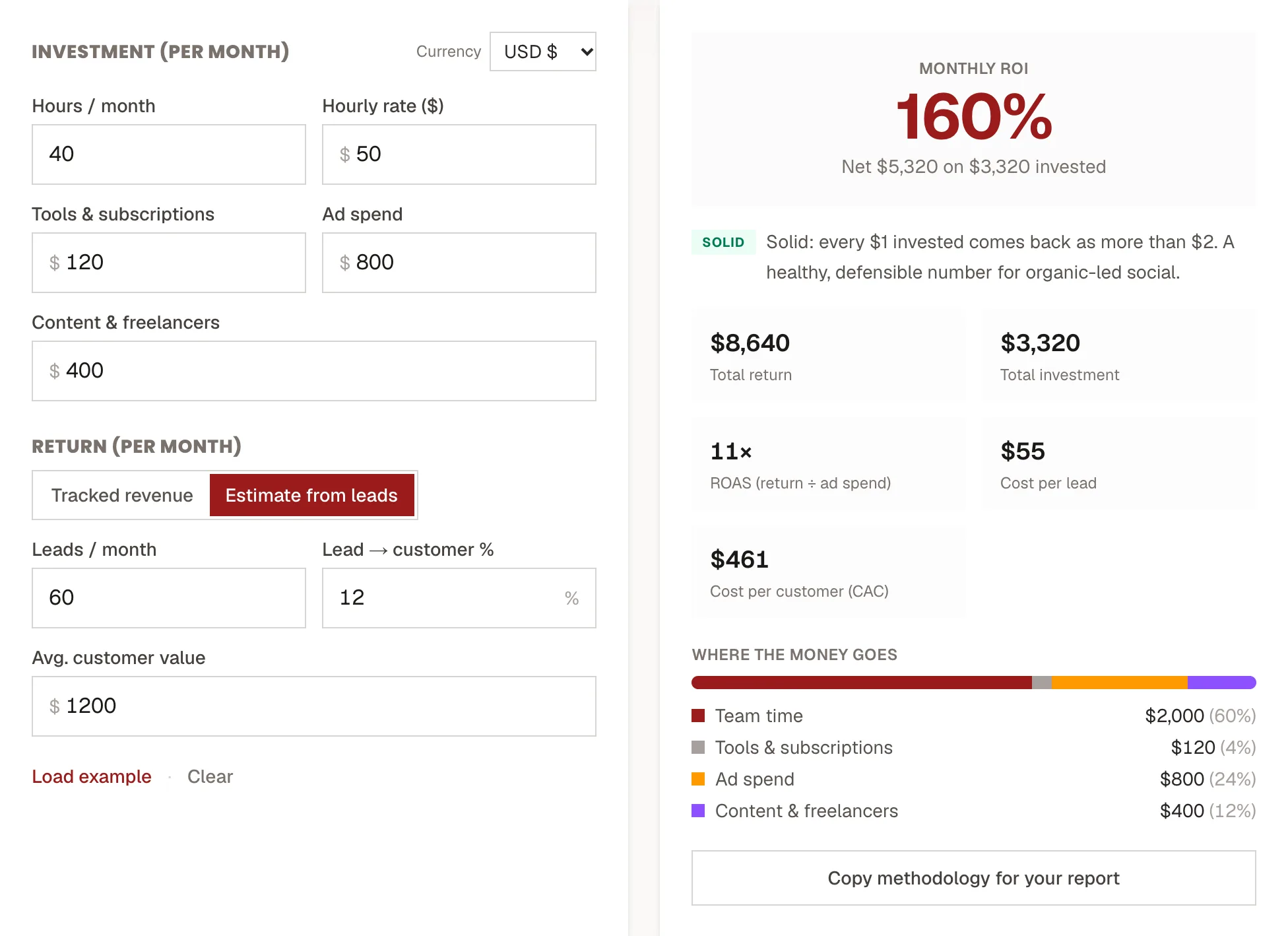
As for what's a good social media ROI, the rule of thumb people quote is roughly 3:1 (and closer to 5:1 for paid), but treat that as directional, not a target. The benchmark that actually matters is beating your own cost, measured with the tracking you set up above; a ratio you can't reproduce from tagged data isn't a benchmark, it's a hope.
The honest part: value you can't attribute
Last-click attribution is tidy and incomplete. A lot of social's real value never shows up as a tagged click: the brand a founder built by posting for a year, the reach that made your name familiar before someone searched it directly, the reply in DMs that closed a deal off-platform. Pretending that value is zero because it resists a UTM is as wrong as inventing a number for it.
So measure what you can attribute rigorously, and name what you can't rather than burying it. Track the leading indicators of the untraceable value (reach trend and the engagement signals that actually matter) alongside the hard ROI, and say plainly which is proven and which is directional. A report that's precise about what it can prove and honest about what it can't is more credible than one that claims a clean number for everything, and it's the one that survives the follow-up question.
Frequently asked questions
How do you calculate social media ROI?
Subtract the cost from the value returned, then divide by the cost. The hard part is the inputs, not the formula: you need a defined outcome with a dollar value, and you need to attribute that outcome back to social, which only works if you tagged your links first.
Why can't I track social media ROI?
Almost always because the links weren't tagged. Without UTM parameters, clicks from social land in your analytics as anonymous direct traffic, so the outcomes they drove can't be traced back. The contribution is unmeasured, which in a report looks identical to zero. Tag every link and the path becomes visible.
What counts as a return on social media?
The business outcome, not the engagement that leads to it. Sign-ups, leads, booked calls, and sales are returns; reach and likes are the path there. Assign each outcome a value (a real figure for sales, or a sensible stand-in like lead value elsewhere) so there's a number to divide.
How do you measure the value of brand awareness from social?
You largely don't measure it as hard ROI, and you shouldn't pretend to. Track its leading indicators (reach trend, branded search, engagement quality) and report them as directional, separate from the attributed, tagged results. Being explicit about what's proven versus what's directional is more credible than forcing one clean number onto everything.