
What Is Social Listening? How the Tools Work, and What They Can't See
November 1, 2026 · 8 min read · by Jan Oršula
Social listening is tracking the public conversation about your brand, your competitors and your industry, then acting on what you find: answering a question, fixing a recurring complaint, spotting a problem early, or turning the questions people keep asking into content. Tools do the finding by searching public posts for the words you choose. What most explanations leave out is that they can only search part of the internet. Open platforms like Reddit and X are searchable; Instagram and Facebook mostly show only posts that tag you; DMs and group chats are invisible to everyone. This guide explains how listening works, step by step, using one example brand.
Social listening vs social monitoring
The two terms get used interchangeably, but they answer different questions.
| Social monitoring | Social listening | |
|---|---|---|
| The question | "Who mentioned us, and do they need a reply?" | "What are people saying overall, and why?" |
| Time frame | Today, mention by mention | Weeks and months, as a pattern |
| What you do | Reply, help, thank | Change a product, a message, a plan |
| Example | Answering a complaint about a late order | Noticing that late-order complaints doubled since a supplier changed |
In practice you need both, and the same tool usually does both: monitoring is the first half of the job, and listening is what you do with the results.
How social listening tools work, step by step
Every listening tool, from free alerts to enterprise suites, does the same four things. To make each step concrete, take Roam, a specialty coffee roaster with two cafés and an online bean shop. Its name is also an ordinary English word, which makes it a good test of whether listening is set up well.
1. You decide what to track
Listening starts with words, not platforms: your brand name and its misspellings, product names, competitors, and the topics your customers talk about. For Roam that's "roam coffee", "roamcoffee" and "@roamcoffee", plus two competitor cafés and the topic "specialty coffee subscription".
The words alone aren't enough when your name is a common word. A search for "roam" returns travel posts and complaints about phone data roaming. That's where a Boolean query helps: combine words with AND, OR and NOT so the search catches real mentions and skips the noise. Our guide to Boolean search for social listening builds Roam's full query step by step, and the free Boolean query generator writes one from plain lists.
2. The tool collects posts from its sources
The tool then checks its sources for posts containing those words. Some sources it can search by keyword. Others can only hand it posts that tag your account, and a few (Threads, with Meta's approval) allow both. Here's how that looks when you set up a keyword in Kadenzo's social listening:
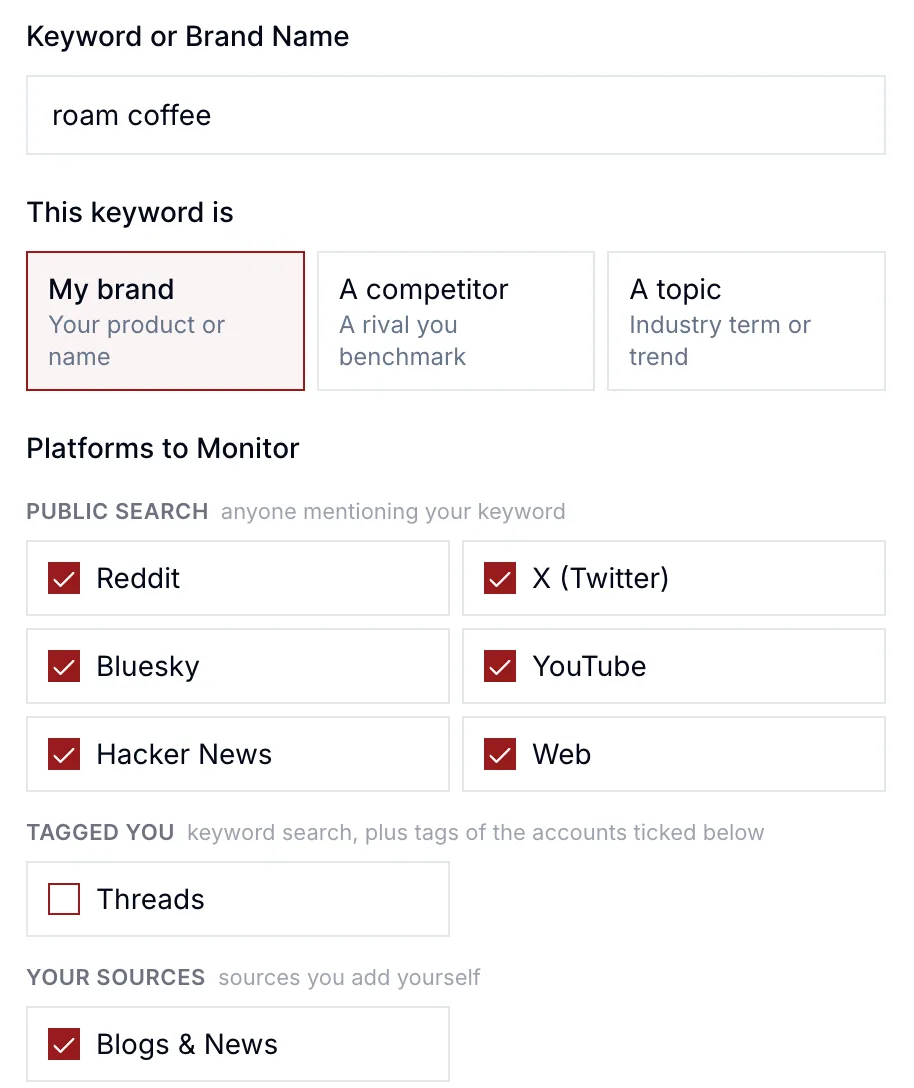
That split isn't a quirk of one tool. It's set by what each platform allows, and it shapes what every listening tool can find. More on that below.
3. It filters out the noise
Raw keyword matches are noisy, so good tools let you describe what the keyword actually means and what rules it out. For Roam, that means excluding "roaming" and "travel", and only keeping posts that also mention coffee, espresso or beans:
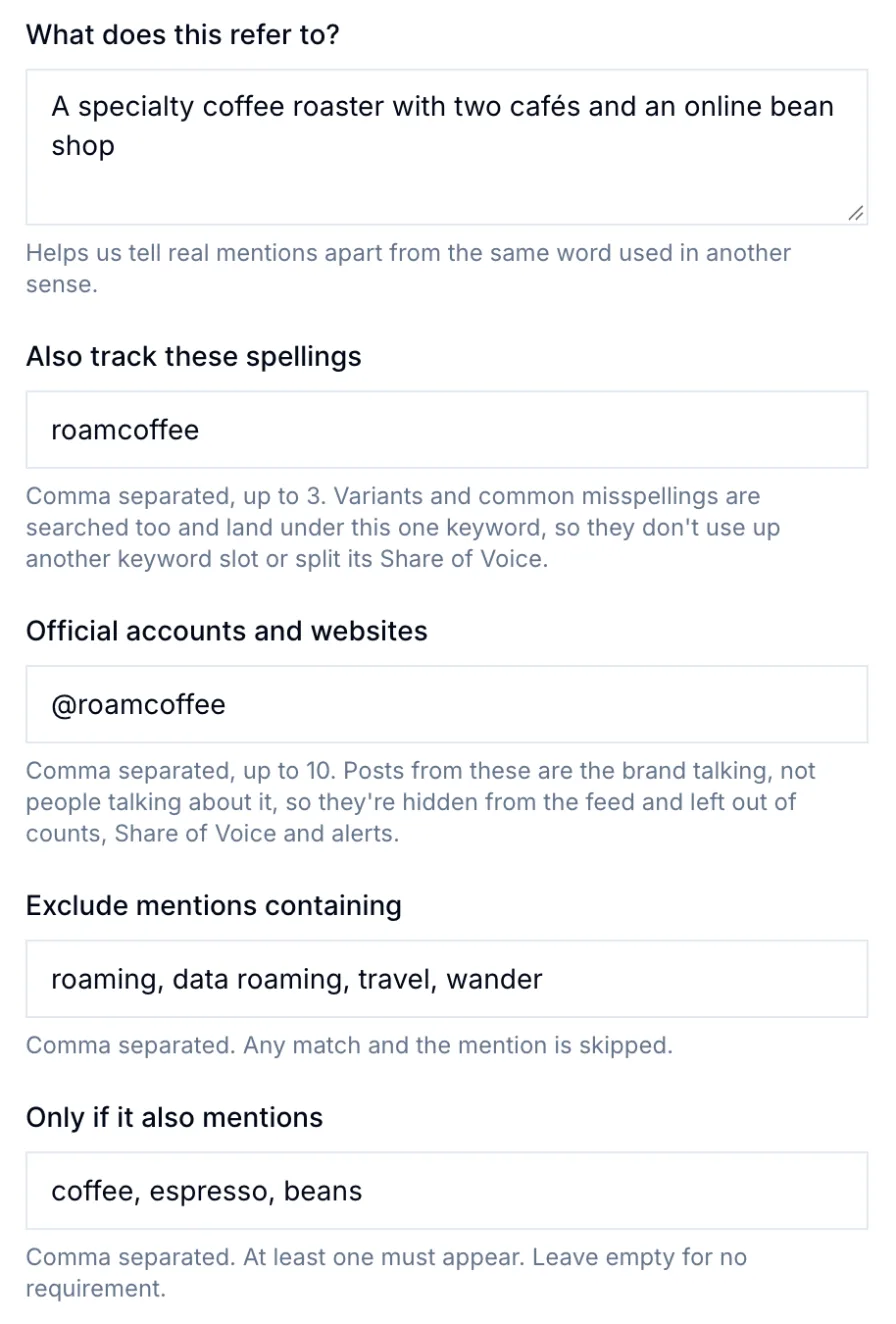
Spend more time here than anywhere else. A feed full of irrelevant posts gets ignored within a week, and an ignored listening tool is the same as no listening tool.
4. It classifies and adds up what's left
Finally, the tool labels each mention, usually by sentiment (positive, neutral, negative), sometimes by intent (a question, a complaint, a recommendation), and adds them up into trends: mention volume over time, the sentiment mix, and share of voice, your slice of the conversation compared with the competitors you track.
Treat sentiment as a rough guide. Models read words, and people don't always mean their words:
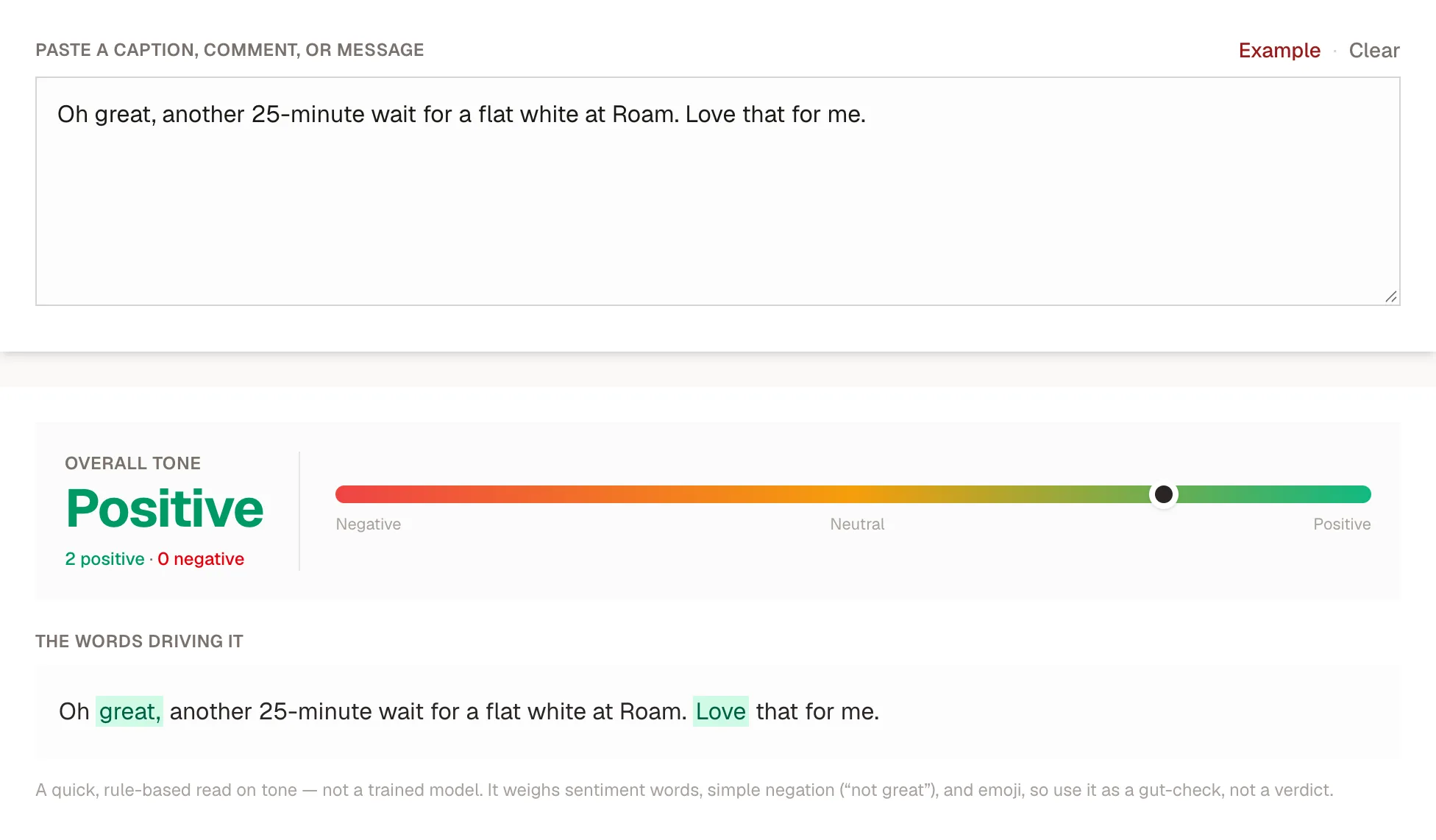
Better tools use language models that catch more sarcasm than simple word lists, but none catch all of it, and Reddit in particular runs on irony. So the rule holds whatever tool you use: when sentiment moves, read the posts behind the number before you act on it.
What listening tools can and can't see
This is the part vendor pages tend to skip. A listening tool only sees what a platform lets it see, and the platforms differ a lot:
| Where | What a listening tool can see |
|---|---|
| Reddit, X, Bluesky, YouTube, blogs and news | Public posts, searched by keyword. Access usually costs the tool money (X, for example, charges per post read), which is why coverage and price vary. |
| Threads | A genuine keyword search exists, but apps need Meta's approval to use it. |
| Posts that @tag your account. Hashtag search is possible but capped at 30 unique hashtags per 7 days and needs special approval. There's no way to search captions for your name. | |
| Your own Page's tags, visitor posts and reviews. There's no search of public posts on the platform. | |
| TikTok | TikTok's research API is limited to academic and non-profit researchers, and commercial use isn't allowed. Tools that offer TikTok listening rely on separate data deals. |
| DMs, private accounts, closed groups, WhatsApp, email | Nothing. No tool can see these, and none should. |
Two practical consequences follow.
On Instagram and Facebook, listening means "who's talking to you", not "who's talking about you." Someone who posts "Roam's new espresso blend is excellent" without tagging the account is invisible to every listening tool. If those platforms matter to your brand, ask customers to tag you, and check your notifications and comments by hand as well.
Listening only ever sees a sample. A lot of the most honest conversation about a brand happens in group chats and DMs, which no tool reaches. What listening gives you is the loudest public slice: very useful, but not the whole picture. A quiet feed only tells you that nothing was said in public.
What to listen for
For most brands, five kinds of keyword cover the useful ground. Roam's list:
- The brand and its spellings: "roam coffee", "roamcoffee", "@roamcoffee".
- Products: the names of its two blends and its subscription.
- Competitors: the two cafés it loses customers to, so it can see what people praise or complain about there.
- Category questions: phrases like "best coffee subscription" or "where to get good beans in" plus the city. These are people asking for a recommendation right now.
- Campaigns: a hashtag or name for anything running this month.
Start with fewer than ten. It's easier to add a keyword that's missing than to rescue a feed nobody reads.
What to do with what you hear
A mention only matters if someone acts on it. The common uses, with what Roam does for each:
- Customer service. Someone posts that their order arrived crushed. Reply the same day, publicly if the post is public, and move the details to DMs.
- Product feedback. Five posts in a month say the subscription is hard to pause. That's a product fix, and a better answer to it than any reply.
- An early warning. A sudden jump in negative mentions is often the first sign of a problem. Our social media crisis management guide covers what to do in the first hour.
- Content ideas. The questions people ask about coffee ("why does my espresso taste sour?") are posts waiting to be written.
- Recommendations. Someone on Reddit asks for a good coffee subscription. A helpful, honest reply from a real person can earn a customer, as long as it reads like advice rather than an ad. Our guide to community management covers how to join conversations without sounding like an ad.
Can you do social listening for free?
Yes, at a small scale. A free routine looks like this:
- Set up Google Alerts for your brand name, product names and competitors.
- Save searches on X, Bluesky and Reddit for the same words, and check them twice a week.
- Keep notifications on for tags and mentions on Instagram and Facebook, since that's all any tool would see there anyway.
- Once a week, spend 20 minutes reading what came in and writing down anything that repeats.
That works for a small business with a handful of mentions a week. Paid tools start to earn their cost when the volume grows, when your name is a common word that needs filtering, or when you need trends and share of voice over months rather than a weekly read.
Is social listening legal?
Reading public posts is generally legal, and listening tools that use official platform access stay within the platforms' rules. Two cautions apply. First, in the EU and UK, public posts still contain personal data, so data protection law applies: businesses usually rely on "legitimate interests" as their legal basis, which the UK regulator explains in its guidance on legitimate interests. In practice that means listening for topics and trends, not building files on individual people. Second, avoid tools or scripts that scrape platforms against their terms; besides the legal risk, that data can disappear the day the platform blocks it.
Frequently asked questions
What is the difference between social listening and social monitoring?
Monitoring is catching individual mentions so you can respond, such as answering a complaint today. Listening is reading those mentions together over weeks to spot patterns, such as complaints about one product rising after a change. Most tools do both; the difference is whether you act on single posts or on the trend.
What is an example of social listening?
A coffee roaster tracks its brand name and notices that, over a month, several customers mention the subscription is hard to pause. Instead of replying to each one, it changes the pause button and then posts about the fix. Acting on the pattern, not just the posts, is what makes it listening.
Can social listening track Instagram?
Only partly. Tools can see Instagram posts that tag your account, and some can search a limited number of hashtags with Meta's approval. They can't search captions for your brand name, and they can't see private accounts, Stories mentions in most cases, or DMs.
How do social listening tools find mentions?
They search the public posts each platform lets them access for the keywords you set, through the platforms' official APIs and through RSS or web feeds for blogs and news. Then they filter out irrelevant matches using your exclusions and rules, and label what's left by sentiment and topic.
What is share of voice in social listening?
It's your brand's share of all the conversation about you and the competitors you track, usually shown as a percentage over a month or a quarter. It answers the question 'are we being talked about more or less than our rivals?', which a raw mention count can't.