TikTok Hooks: How to Win the First Two Seconds
July 20, 2026 · 6 min read · by Jan Oršula
A TikTok hook is the opening moment, roughly the first one to two seconds, that decides whether someone stays or swipes. It carries more weight on TikTok than on any other platform, because TikTok scores your video on retention from the very first frame: a slow open bleeds viewers before the algorithm has any reason to push it. And a TikTok hook is more than a line you write: it's visual, verbal, and textual at once, all firing in the first breath. This guide covers why those two seconds decide the whole video, the three channels a hook works on simultaneously, and the openers that actually hold.
Why the first two seconds decide everything
On TikTok the swipe is instant and free, and the platform is watching your completion rate from frame one. Early drop-off tells the algorithm the video isn't worth showing to more people; early hold earns the distribution. So the opening isn't decoration. It's the test the video has to pass before anything else about it matters.
This is also what makes a video hook different from a written one. A caption has a fold, where the reader chooses to tap "…more." A video has no fold; it just plays, so you don't get a sentence to earn the next sentence, you get a frame to earn the next second. The underlying logic of a good hook still holds: promise something, open a gap, keep it true. TikTok just makes you land it faster and on more than words.
A hook fires on three channels at once
The strongest TikTok hooks hit all three of these in the first moment, aligned on the same promise:
- Visual: the first frame. Motion, a surprising image, your face already mid-action, a striking result on screen. A static, centered talking-head intro is the slowest possible open.
- Verbal: the first words out of your mouth. Start mid-point, in the middle of the interesting part; skip the runway.
- Textual: on-screen text that states the promise, so a viewer watching on mute gets the point instantly (and so does TikTok, which reads it).
Any one of these alone can work, but a hook where the visual, the first words, and the on-screen text all promise the same thing is far harder to swipe past than a clever line delivered over a slow shot.
Openers that hold
A few reliable frames, each of which promises a payoff and implies it's coming fast:
- Result first: lead with the outcome ("this one change doubled my views"), then show how.
- Contrarian: open by disagreeing with something the viewer believes.
- Curiosity with stakes: name a mistake they might be making and what it's costing them.
- In-progress: drop the viewer into the middle of an action or story already underway.
- Direct address: a question that names exactly who the video is for.
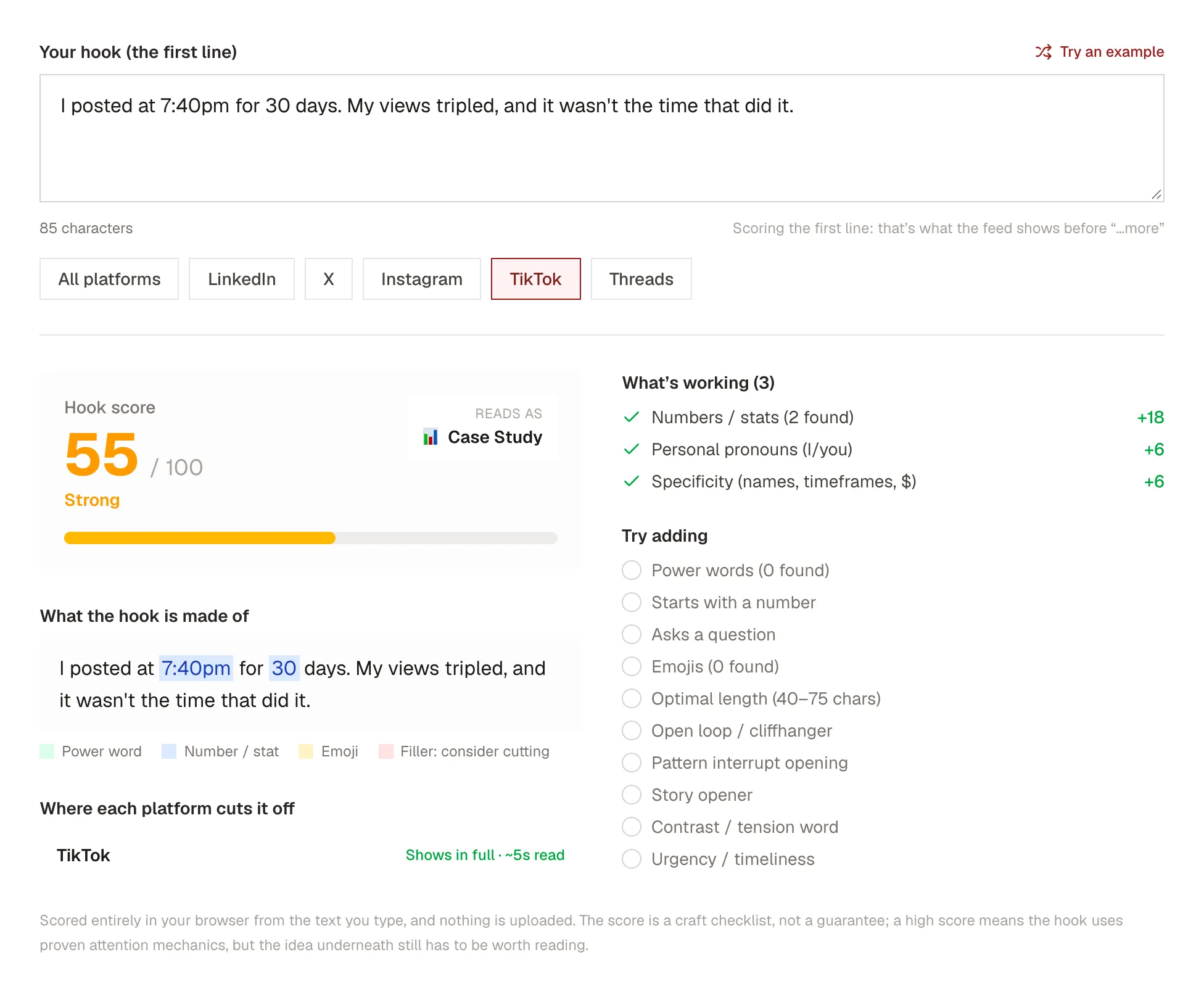
Whichever you pick, pressure-test it before you commit. A hook tester scores an opening line against engagement signals so you're not gambling the whole video on a guess.
The mistakes that kill the open
Three habits waste the most valuable two seconds you have. The greeting ("hey guys, welcome back to my channel") is the single most skippable open on TikTok; it promises nothing and delays the point. The slow ramp, where you set the scene before getting to the reason anyone should watch, bleeds viewers during the exact window the algorithm is judging. And the overpromise, a hook that sells a payoff the video never delivers, wins the second and loses the follow, because the next video from you now starts from distrust. Land what you opened, make all three channels promise the same thing, and the first two seconds stop being where your videos die.
Frequently asked questions
How do you hook viewers on TikTok?
Win the first one to two seconds on all three channels at once: a striking first frame, a first sentence that starts mid-point, and on-screen text stating the promise. Aim them at the same payoff and imply it's coming fast. TikTok judges retention from frame one, so the opening is the test the video has to pass.
Why are the first few seconds so important on TikTok?
Because TikTok scores your video on watch-through starting at the very first frame, and the swipe is instant. Early drop-off signals the video isn't worth pushing and caps its reach; early hold earns distribution. Unlike a caption, a video has no fold to buy you time. It just plays.
What makes a good TikTok hook?
One that promises a payoff and makes the viewer believe it's seconds away, like a result stated up front, a contrarian take, or a curiosity gap with real stakes. The best ones align the visual, the spoken opener, and the on-screen text on that same promise instead of leaning on words alone.
Should you say welcome back at the start of a TikTok?
No. A greeting is the slowest, most skippable open there is, because it promises nothing and delays the point during the exact window TikTok is judging. Start in the middle of the interesting part and let the greeting go entirely.
How long should a TikTok hook be?
One to two seconds. The promise has to land almost immediately, because viewers decide whether to stay in that window and the algorithm is measuring it. If your point hasn't arrived by the second or third second, the hook is too slow.