
Social Media Manager vs Content Creator: Which One Do You Need?
October 25, 2026 · 8 min read · by Jan Oršula
A social media manager runs your accounts: decides what gets posted and when, publishes it, replies to people, and reports what it achieved. A content creator makes the things that get posted: the photos, the short videos, the captions, the carousels. One is accountable for the account, the other for the pieces that go on it. In a small business one person often does both, which is why the titles blur. So start with which of those jobs is currently going undone in your business. This guide sets out what each role covers, the three different people "content creator" can mean, a quick test for which one you need first, and how the two work together once you have both.
What each role is responsible for
| Social media manager | Content creator | |
|---|---|---|
| Owns | The accounts and the plan | The posts themselves |
| Main question | What should we post, where, when, and did it work? | How do we make this look, sound and read well? |
| Typical week | Planning the calendar, scheduling, replies and DMs, approvals, the monthly report | Shooting, editing, writing captions, designing graphics, filming short video |
| Measured on | Account results: reach, engagement rate, clicks, enquiries or sales from social | Each piece: watch time, saves, shares, how much of it is usable |
| Core skills | Planning, writing, judgement in public, reading analytics, client communication | Photography or video, editing, design, writing hooks, knowing current formats |
| Works in | Months and quarters | Batches and shoots |
The split isn't strict. A good manager writes captions, and a good creator knows why a format works. But when something goes wrong, the table tells you who should have caught it: a month with no plan is the manager's problem, a month of flat, badly lit videos is the creator's.
"Content creator" means three different hires
This is where most hiring conversations go sideways. Ask three people what a content creator is and you'll get three different jobs.
- A producer for your accounts. In-house or freelance, they make posts that go out on your profile, under your name. This is the role that pairs with a social media manager, and the one this guide mostly compares.
- An independent creator with their own audience. Often called an influencer. You're paying for access to the people who follow them, and the post goes out on their account. That's a partnership, and it runs on a creator brief, not a job description.
- A UGC creator. They make customer-style videos and photos for you to post on your own accounts or run as ads, but they don't post them to an audience of their own. Closer to a freelance producer than an influencer; the user-generated content guide covers where that content earns its place.
None of the three replaces a social media manager. An influencer campaign still needs someone to plan it, approve the posts, reshare them on your accounts and measure what came back.
Which one do you need first?
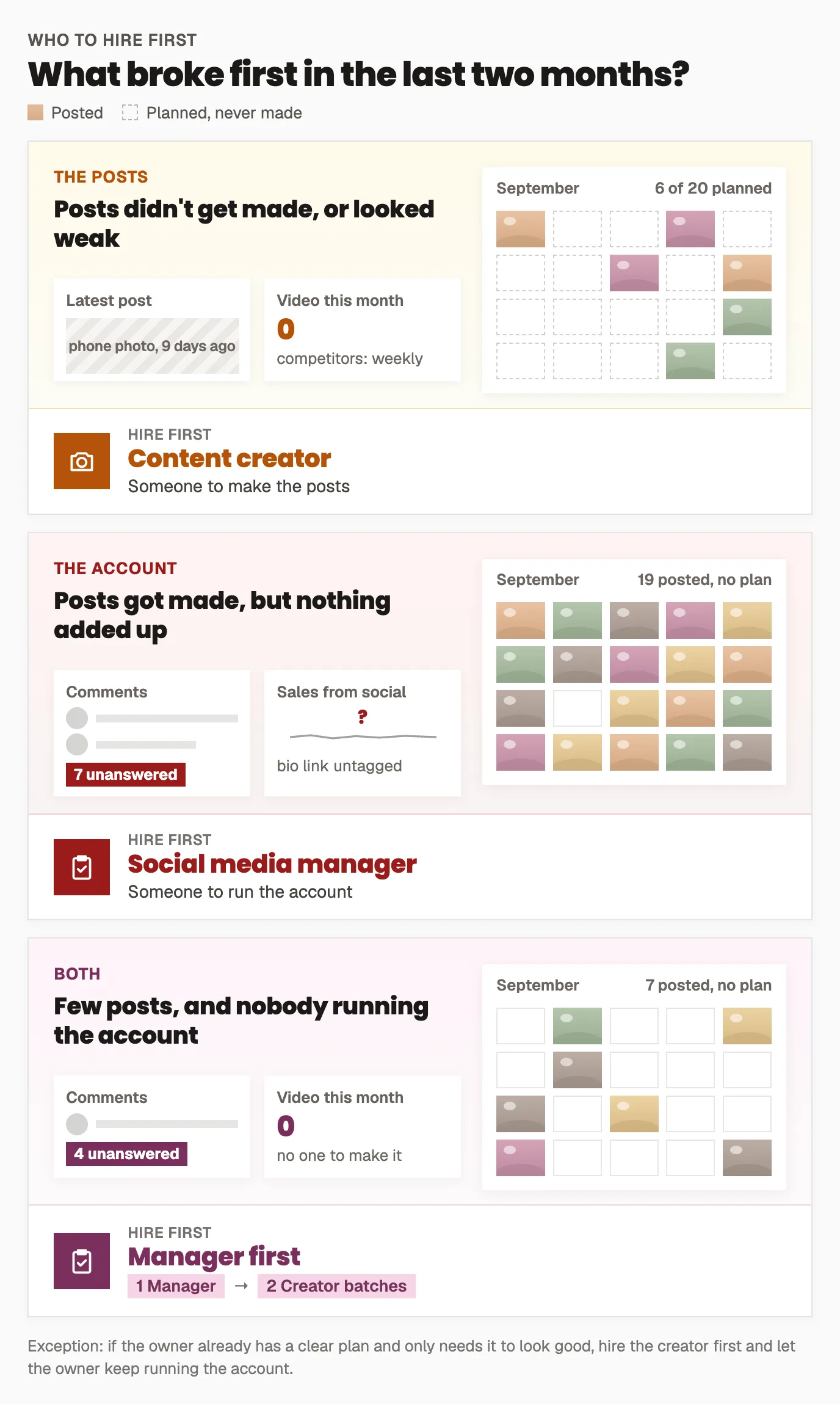
Look at the last two months and ask what broke first.
- Posts didn't get made, or looked worse than your competitors'. The calendar had gaps, the photos were phone snaps of the shelf, video never happened. You need a content creator, because a manager would spend the first months making posts instead of running the account.
- Posts got made, but nothing added up. You posted, but there was no plan behind it, comments sat unanswered for days, nobody could say whether any of it brought in a customer. You need a social media manager.
- Both. Very common in businesses that have never had anyone own social. Start with the manager, and have them buy creation in batches (a freelance shoot day a month, or a UGC creator for product videos). It's easier for a manager to brief a creator than for a creator to invent the plan they're shooting for.
The order flips in one situation: when the business already has a clear plan and strong opinions about what to post (often the owner), and the only thing missing is someone to make it look good. Then the creator comes first, and the owner stays the manager for now.
A worked example: a two-person skincare brand
Lina and Tom run a small skincare brand that sells online. Lina posts to Instagram and TikTok when she has time; Tom handles orders and customer emails. They have budget for one part-time hire.
Their last two months: 19 posts, mostly product photos on a white background, and two videos. Comments asking "does this work for oily skin?" went unanswered for up to a week. Nobody knew which posts sent people to the shop, because the bio link wasn't tagged.
Run the test. Posts did get made, though not well. What broke first was everything around them: no plan, slow replies, no idea what worked. So they hire a part-time social media manager, two days a week. In the first month she:
- writes a four-week plan around three themes (routines, ingredients explained, customer results),
- sets up a daily 15-minute reply slot that Tom covers on her days off,
- tags the bio link so shop visits from social show up in their analytics,
- and books a UGC creator for six short videos of real people using the products, which covers the "looked worse than competitors" gap without a second salary.
Three months in, the manager's report shows which theme sends people to the shop. That's when it makes sense to talk about a regular content creator, because now there's a plan good enough to brief one against.
Can one person do both?
Yes, and in small businesses they usually do. A one-person social role splits roughly into planning and admin on one side and making things on the other, and most people are noticeably stronger at one. That's fine, as long as the job description admits it.
Be wary of job ads that ask for both at a senior level for one salary: strategy, community management, reporting, and professional video production and design. That's two jobs. The usual result is a person who makes today's post every day and never gets round to the plan or the monthly numbers. If you can only afford one person, decide which half you're hiring for and buy the other half in batches.
Two things make a combined role workable:
- Batching. Making a week or a month of posts in one sitting, instead of every morning, frees the rest of the week for replies and planning. The batching guide covers how.
- One approval window. If posts go to a client or owner for sign-off, a fixed weekly approval process stops one person spending half their week chasing yeses.
How they work together
When you have both, the handoff is the part to design. Three things keep it clean:
- The manager briefs, the creator decides how. A brief says what the post is for, who it's for, the one point it has to land, and any must-haves (product, claim, deadline). How it's shot and edited is the creator's call. Briefs that specify every frame produce flat content.
- Batches, not drips. A monthly or fortnightly shoot against a planned list beats daily requests. Creators work best with a run of related pieces.
- Results go back to the creator. Share which pieces worked and why, in the same monthly report the manager writes for the business. A creator who never sees the numbers can't make the next batch better.
Which is the better career?
They lead to different places. Social media managers tend to move toward strategy, team leadership or agency ownership, and their pay follows the size of the accounts and teams they run (our social media manager salary guide has the ranges). Content creators build a craft (video, photography, design) and a portfolio, and often freelance across several brands at once or build an audience of their own.
If you like planning, talking to clients and being able to say what a month of posting achieved, the manager route fits. If you'd rather spend the day making things and judge yourself on how good they are, start as a creator. For the manager route, how to become a social media manager lays out a way in without prior experience.
Frequently asked questions
What's the main difference between a social media manager and a content creator?
Accountability. A social media manager is responsible for the account as a whole: the plan, publishing, replies and whether it brought results. A content creator is responsible for the posts themselves: how they look, sound and read. When a month of posting brings nothing in, the manager is the one expected to explain why and change the plan.
Should a small business hire a social media manager or a content creator first?
Hire for whatever broke first. If posts aren't getting made or look poor, start with a creator. If posts get made but there's no plan, slow replies and no idea what works, start with a manager. If both are missing, a manager who buys creation in batches is usually the better first hire.
Is an influencer the same as a content creator?
Not in hiring terms. An influencer is a creator with their own audience, and you pay them to post on their account. A content creator for your brand makes posts that go out on your account. UGC creators sit in between: they make customer-style content for you to post, without posting it to followers of their own.
Do I still need a social media manager if I work with influencers?
Yes, if the campaigns are meant to add up to anything. Someone has to pick the creators, write the brief, approve the posts, reshare them on your accounts and measure what came back. Without that, influencer posts become one-off spend that nobody can evaluate.