
Social Media Customer Service: A Simple System, With Example Replies
October 11, 2026 · 9 min read · by Jan Oršula
Social media customer service is answering customers' questions, problems and complaints where they raise them: in comments, DMs, mentions and reviews. For a small team, the system that works has five parts: collect everything in one inbox, sort each message into one of four lanes (urgent, complaint, question, praise), answer each lane within a set target, hand off what social can't fix to whoever can, and measure three numbers. Below is each part, the response targets we'd start with, example replies you can adapt, and how a two-person skincare brand runs it.
Step 1: Get everything into one place
Customers don't care which channel you watch. They'll ask on whichever is open: a comment on last week's Reel, a DM, a tag in a story, a review. If those live in four apps, something gets missed, and the missed one is always the angry one.
Before anything else, list every place a customer can reach you and decide how each one reaches a person:
- Comments and DMs on each platform: a unified social inbox, or at minimum one daily round of each app.
- Mentions without a tag: a saved search or a listening tool.
- Reviews (Google, Facebook): notifications to the same person who handles the inbox.
- Email and phone, for the handoff (step 4).
Step 2: Sort every message into four lanes
Most messages fall into one of four kinds, and each needs a different speed and a different person.
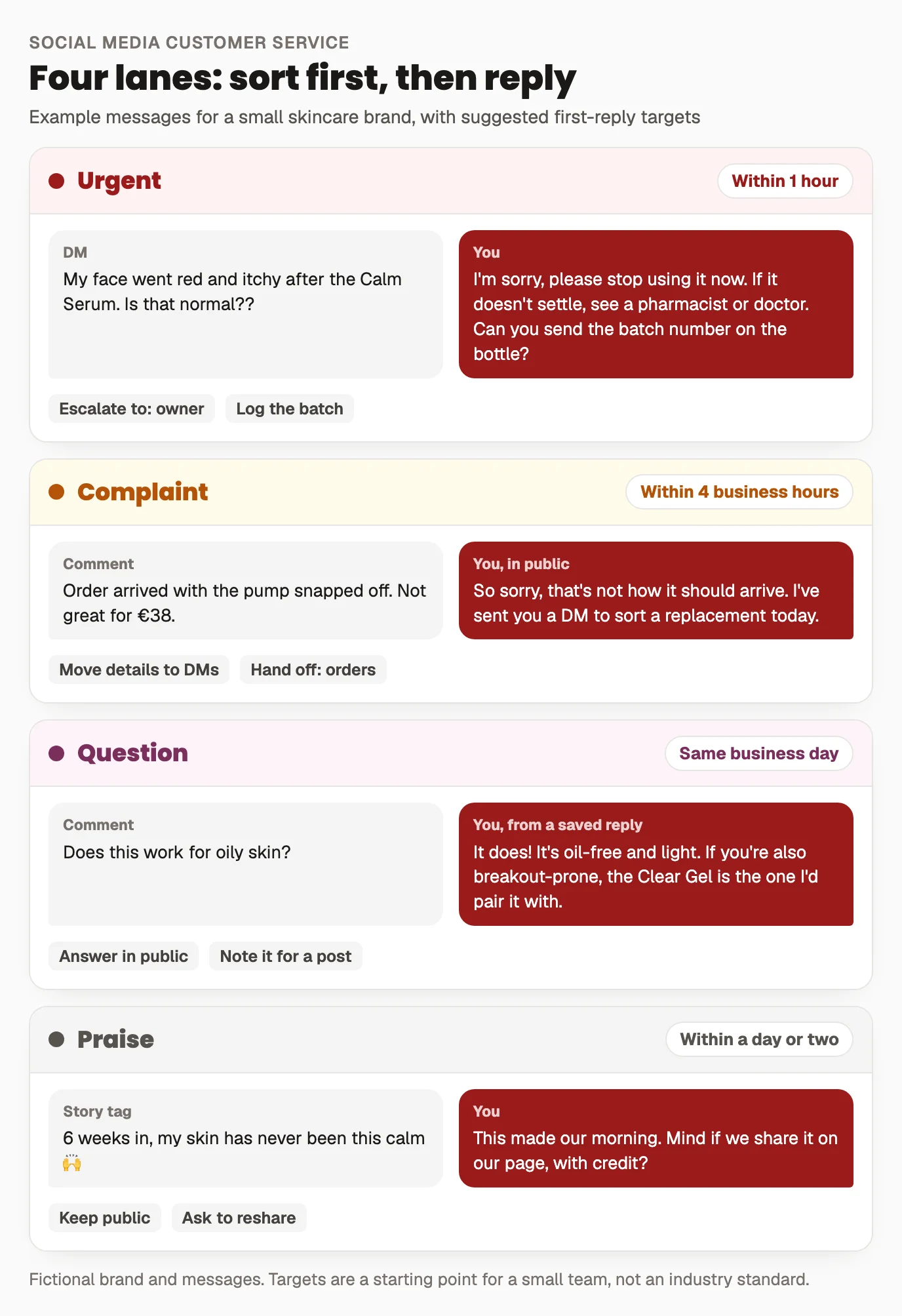
| Lane | What it looks like | Target for a first reply | Who handles it |
|---|---|---|---|
| Urgent | Safety issue, allergic reaction, a hacked account, an order that's clearly lost, anything that could spread | Within 1 hour in business hours | Whoever's on the inbox, escalating at once |
| Complaint | Late order, wrong item, bad experience | Within 4 business hours | Inbox first, then support if it needs a refund or a fix |
| Question | Stock, sizes, opening hours, "does this work for…" | Same business day | Inbox, from saved replies |
| Praise | Thank-yous, photos, tags | Within a day or two | Inbox, with a personal line |
These are starting targets, not a standard. A restaurant may need faster answers at lunch; a B2B software company may answer complaints by email instead. What matters is that the team has written them down and the customer gets roughly what they'd expect.
Step 3: Know when to move to DMs
The rule: acknowledge in public, resolve in private, answer simple questions where they were asked.
- A complaint in the comments gets a short public reply (so everyone reading sees you responded) and a move to DMs for the details. Never ask for an order number or address in public.
- A simple question ("do you ship to Canada?") gets answered right there. Moving it to DMs hides the answer from the next ten people who wanted to ask.
- Praise stays public. It's the best thing on your page.
How to handle the angry or abusive end of the complaint lane, including trolls and when to hide a comment, is in the negative comments guide.
Step 4: Hand off what social can't fix
Whoever runs social usually can't issue refunds, check a warehouse or give medical advice. Write down who can, and how a handoff works:
- Tell the customer what happens next and when. "I've passed this to our orders team; they'll email you by tomorrow lunchtime."
- Pass on everything in one message: the customer's name or handle, the channel, what happened, what you've already said, and the promised time.
- Close the loop on social. When it's solved, a short "glad that's sorted" in the same DM thread means the customer doesn't have to repeat anything if it goes wrong again.
For anything that looks like it could spread (several people reporting the same problem, a safety issue, press interest), switch to your crisis plan instead of handling messages one by one.
Step 5: Saved replies, written like a person
Saved replies save time on the question lane, and the risk is that they sound like a machine. Write each one as a starting point, then add one line that's specific to the person. Examples for a skincare brand:
Question, ingredient:
Hi Sam, yes, the Calm Serum is fragrance-free and suitable for sensitive skin. If you're unsure, patch-test on your inner arm for 24 hours first. Which concern are you shopping for? Happy to point you to the right one.
Complaint, damaged order (public reply):
So sorry, that's not how it should arrive. I've sent you a DM so we can sort out a replacement today.
Complaint, damaged order (DM):
Hi Priya, thanks for the photo. Could you send your order number? I'll pass it to our orders team now and they'll ship a replacement by tomorrow; you don't need to return the damaged one.
Delay you can't fix yet:
We're seeing delays with our courier this week, and your order is one of them. I've asked them for an update and will message you by 3pm with what they say.
Praise:
This made our morning. Six weeks of consistency shows! Mind if we share your photo on our page, with credit?
Keep saved replies short enough to edit, and review them every few months. Anything you promise in a saved reply ("ships today") has to stay true.
Out of hours: say so
You don't need to answer at 11pm, but customers should know when you will. Put your hours in the bio or profile, and use an away message that says when someone will reply:
Thanks for your message. We're a small team and we answer between 9am and 6pm, Monday to Friday. We'll get back to you first thing tomorrow.
The Instagram auto-reply guide covers setting one up, and if a Facebook Page's away message isn't sending, the Messenger troubleshooting guide covers why. Automation can handle the acknowledgment, and the answer itself is better coming from a person, for the reasons in what not to automate.
What to measure
Three numbers, checked monthly:
- First response time: how long until a customer hears from you, per lane. This is what customers notice.
- Response rate: the share of messages that got any reply. Aim for all of them in the urgent, complaint and question lanes.
- Resolved on social: the share of complaints and questions closed without moving to email or phone. Rising is good; it means the saved replies and the handoff rules are working.
Add one qualitative note to the monthly report: the most common question of the month. If the same question keeps coming, it belongs in a post, an FAQ highlight or the product page.
A worked example: two people, one inbox
Lina and Tom run a small skincare brand. Lina handles social, Tom handles orders. Before, comments sat for days and the same "does this suit oily skin?" question was answered from scratch every time.
Now:
- Every comment, DM and review lands in one inbox, which Lina checks at 9:30, 1:00 and 5:00, plus notifications for anything tagged urgent.
- Messages are sorted by lane. A customer reporting a reaction to a product is urgent: Lina replies within the hour, advises them to stop using it and see a pharmacist or doctor, and tells Tom, who logs it with the batch number.
- Damaged or late orders get a public acknowledgment and a DM; Lina passes the details to Tom in one message, and Tom confirms back by email.
- Twelve saved replies cover the most common questions. Each starts with the customer's name and ends with a question back.
- Once a month, the most common question becomes a post. The "oily skin" question became a carousel that now gets saved more than any product post.
Frequently asked questions
How quickly should you respond to customers on social media?
Set targets by type of message. A reasonable start for a small team: within an hour for anything urgent, within four business hours for complaints, the same business day for questions, and a day or two for praise. Post your hours so people know when to expect an answer outside them.
Should you respond to complaints publicly or in DMs?
Both. Reply publicly first, briefly, so others can see you responded, then move the details to DMs. Never ask for an order number, address or other personal details in a public comment. Simple questions are the exception: answer them where they were asked so other people can see the answer too.
Can a small business do customer service on social media without a support team?
Yes. One person with a single inbox, saved replies and a clear handoff to whoever handles orders or refunds can cover most of it. The key is writing down who handles what, so nothing waits because everyone assumed someone else had it.
What metrics matter for social media customer service?
First response time, response rate, and the share of issues resolved without leaving social. Track them monthly, along with the most common question, which usually points to a post, an FAQ or a product page that needs updating.
Should you use a chatbot for social media customer service?
Use automation to acknowledge messages and answer simple, fixed questions like opening hours or shipping times. Keep complaints, refunds and anything involving judgment with a person, and make it easy for customers to reach one.