
Repost vs Quote Post: Which to Use, and When
October 26, 2026 · 7 min read · by Jan Oršula
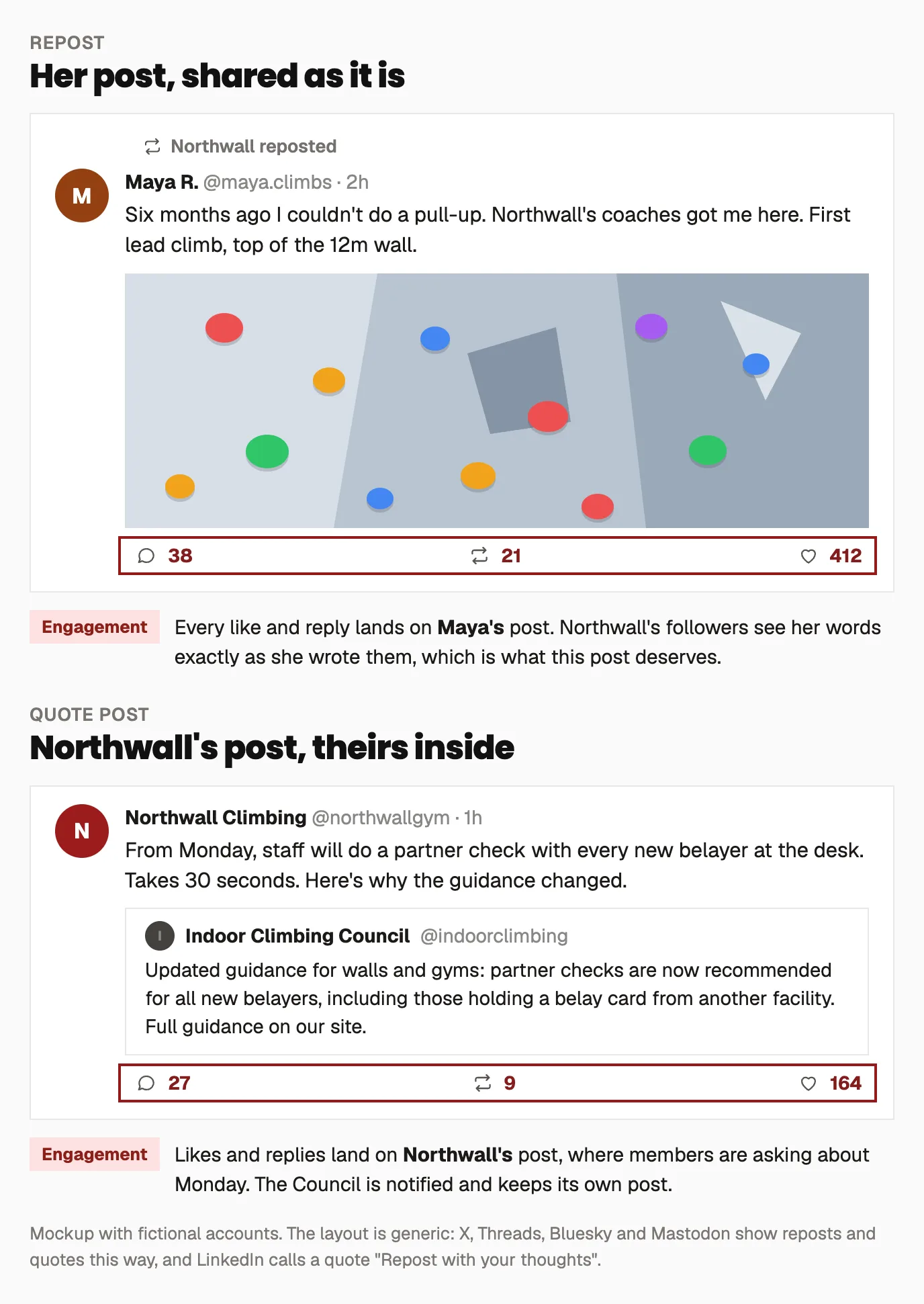
A repost shares someone else's post with your followers exactly as it is, under a small "you reposted" label. A quote post is a new post of your own, with your words on top and their post embedded underneath. The practical difference is where the conversation happens. Likes and replies on a repost go to the original post and its author. On a quote, they go to your post. So the choice comes down to whether you have something worth adding, and whose post should collect the attention. This guide covers how each one works on X, Threads, Bluesky, LinkedIn and Mastodon, a three-question test for choosing, and the one situation where you should do neither.
What each one actually does
| Repost | Quote post | |
|---|---|---|
| What your followers see | The original post, labelled as reposted by you | Your text first, the original embedded below |
| Is it a new post of yours? | No, it points to theirs | Yes, with its own likes, replies and reposts |
| Who collects the engagement | The original author | You |
| Adds your words | No | Yes |
| Undoing it | Un-repost; the original is untouched | Delete your quote like any post |
Because a quote is a post of its own, it can travel without the original: people who have never seen the source can reply to you, repost you, or quote you in turn. A repost can only ever send people back to the original. That's why quotes tend to do more for your own account. No platform publishes a reach bonus for quotes; the advantage comes from there being a post of yours for people to react to and pass on.
Same idea, different names: the platforms side by side
The mechanics are close everywhere, but the names differ, and so do the controls for the person being quoted.
| Platform | Plain share | Share with your words | Can authors limit quotes? |
|---|---|---|---|
| X | Repost | Quote | Only by protecting the account; protected posts can't be reposted or quoted by followers |
| Threads | Repost | Quote | Yes, per post: anyone, profiles you follow, or mentioned only |
| Bluesky | Repost | Quote | Yes: turn off quotes on a post, and detach your post from someone's quote |
| Repost | Repost with your thoughts | No quote setting; posts limited to connections and posts in Groups can't be reposted | |
| Mastodon | Boost | Quote (from version 4.5, if your server runs it) | Yes: anyone, followers only, or nobody, and you can remove your post from a quote |
Sources: X's repost FAQs, Bluesky's anti-toxicity update and Mastodon's quote post announcement. Instagram now has a repost button too, but no quote; the Instagram repost guide covers it.
The right-hand column matters if you manage a brand. On three of these platforms, the person you quote can switch off quoting or cut their post out of yours. A quote that relies on someone else's post can lose its context overnight.
The three-question test
Ask these in order. The first "no" usually gives you the answer.
- Is the post about someone being criticised, including you? If yes, do neither. Reply, or take it to DMs. More on that below.
- Can you add one sentence your followers need? Context for your audience, a number, a reason you agree or disagree, what to do next. If the best you've got is "This" or a pointing emoji, repost instead. An empty quote is a repost that hides the original under your name.
- Whose account should the conversation live on? If you want to send attention to the author (a customer, a partner, a team member), repost and let them collect the replies. If the useful conversation is the one about your take, quote.
A worked example: one climbing gym, three posts
Northwall is an independent climbing gym that runs accounts on X, Threads and LinkedIn. In one week it sees three posts worth sharing.
A member's first lead climb. A member posts a photo from the top of the wall: "Six months ago I couldn't do a pull-up. Northwall's coaches got me here." Nothing to criticise, and nothing Northwall needs to add, because the member said it better than the gym could. The attention should go to her. Repost. Quoting it with "So proud of you" would pull the replies onto the gym's post and leave her with fewer.
New safety guidance from the national climbing association. The association posts that it has updated its recommendations on belay checks. The post is accurate but written for gym owners, and Northwall's members won't know what it means for them. Northwall can add exactly that. Quote: "From Monday, staff will do a partner check with every new belayer at the desk. Takes 30 seconds. Here's why the guidance changed." That sentence answers question 2, and the conversation it starts (members asking about Monday) belongs on Northwall's account.
A complaint. Someone posts: "Third weekend in a row the auto-belays at Northwall are out of order. Not paying for that." It mentions Northwall and it's partly true. Quoting it to explain would put a complaint in front of every follower who hadn't seen it, and invite people to pile on in the replies. Neither. Northwall replies under the original post with the repair date and a note to check DMs, then offers a day pass there. If it turns into a wider problem, that's a job for the crisis plan, not the share button.
Never quote a critic
The third case is the one brands get wrong most often, so it's worth its own rule. When you quote someone, your followers see their post, and the person you quoted gets notified that you did. Quoting a critic to correct them sends your audience to them with your account's reach behind it. Even a polite correction reads as a call-out once a few hundred people are in the replies.
Reply under their post instead, where the people already reading the complaint will see your answer, and only them. Put it in your comment moderation rules and your style guide so it holds when someone else is running the account at 11pm.
How to write a quote worth posting
A quote earns its place with one sentence the original didn't have. A few patterns that work:
- Translate it for your audience: "For anyone running a small shop, this means your Sunday posts will reach fewer people."
- Add the number: "We tried this for a month: replies went from about 8 to 30 a post."
- Disagree with a reason: "Half agree. It works for B2B, but our restaurant clients saw the opposite, and here's why."
- Say what to do next: "Update your bio link before Friday."
The rules from writing captions apply: your first line is what people see, so lead with the point, not with "Great post from…".
Before you repost: what you're putting your name on
A repost carries no words of yours, but it still puts the other account on your profile, one tap from your followers. Two quick checks before a brand reposts:
- Check the account, not just the post. Scroll their recent posts. If you wouldn't want your audience to land on that profile, don't send them there.
- Read to the end. A great first line with a bad third paragraph is still the whole post, now on your profile.
On LinkedIn there's one more consideration. Company Pages generally reach fewer people than personal profiles do (see company page vs personal profile), so a Page repost on its own won't carry a colleague's post very far. If it's worth sharing, ask a few people on the team to repost it with a line of their own as well.
Frequently asked questions
Does the original poster get notified when you quote their post?
Yes, on X, Threads, Bluesky and Mastodon the author is notified when someone quotes them. That's worth remembering before quoting a critic: they'll see it, and so will everyone watching their notifications.
Does a repost or a quote post get more reach?
A quote usually does more for your account, because it's a new post that can collect its own replies and reposts and reach people who never saw the original. A repost sends attention back to the original author. No platform publishes a formula that favours one over the other, so the difference comes from how people react.
Can you stop people from quoting your posts?
Depends on the platform. Threads lets you limit quotes per post to anyone, profiles you follow, or people you mention. Bluesky lets you turn off quotes and detach your post from an existing quote. Mastodon lets you allow anyone, followers only or nobody. On X, only protecting your account stops others reposting or quoting you.
What's the difference between a quote post and a reply?
A reply sits under the original post and is mostly seen by people reading that conversation. A quote is a new post on your profile that goes to your own followers, with the original embedded. If your point is mainly for the author and the people already reading their post, a reply is the better fit.
Is a retweet the same as a repost?
Yes. X renamed retweets to reposts and quote tweets to quotes in 2023. The mechanics didn't change, so advice written about retweets still applies to reposts.