
How to Manage Multiple Social Media Clients Without Mixing Them Up
July 27, 2026 · 6 min read · by Jan Oršula
Managing multiple social media clients isn't hard because the work multiplies. It's hard because your attention has to keep switching between brands, and because one slip can post Client A's content to Client B's account. So the whole job is really about keeping each client's context cleanly separated: their own space, their own approval flow, their own place in your week, so the two never bleed into each other. Get the isolation right and ten clients feel like ten small, tidy jobs; get it wrong and three clients feel like chaos. This guide covers the master view you need first, per-client isolation, batching by client, and the cross-posting mistake that keeps agency owners up at night.
Start with one view of everything
Before any tool, build one inventory: every client, every platform per client, each one's posting cadence, who approves, and who on your team owns getting it out. This single list is the map of your whole operation. Without it, you're managing from memory, which is exactly where things slip through. Capture it at onboarding so a new client's setup is recorded the day they sign, not reconstructed in a panic three weeks later.
Give every client their own isolated space
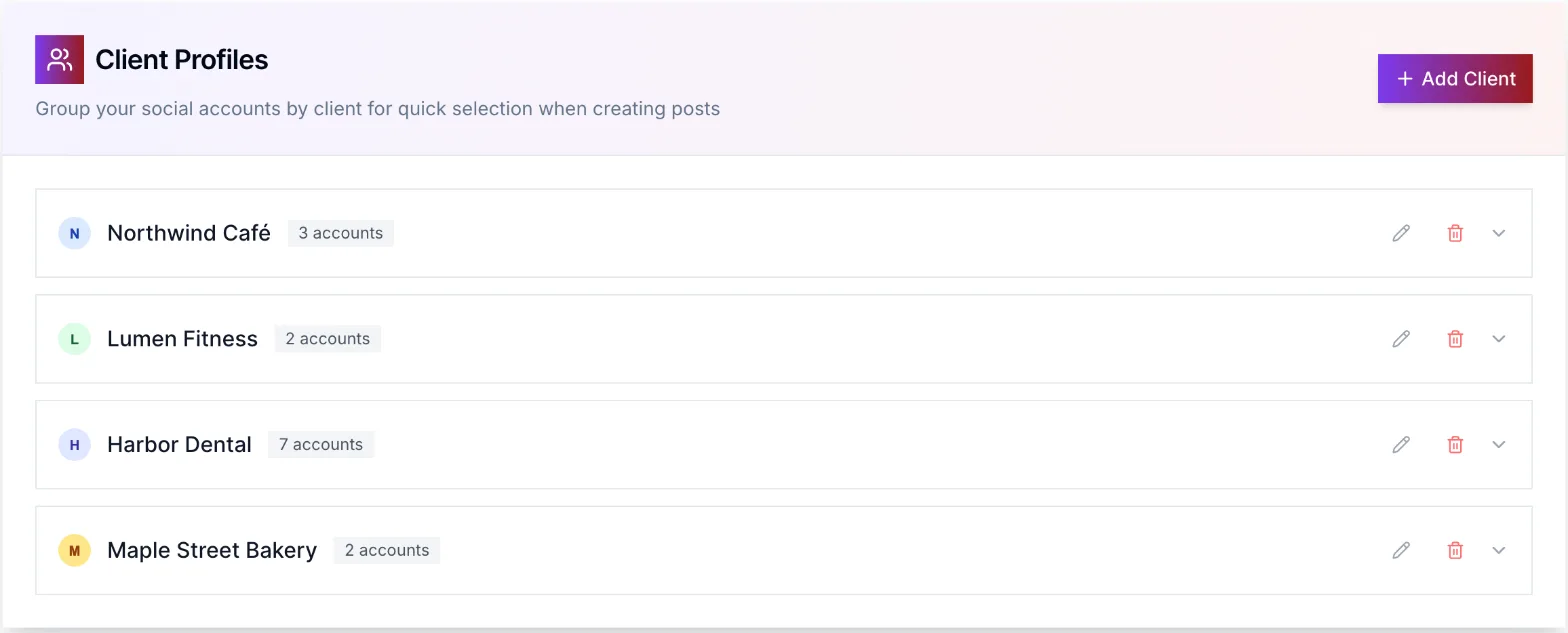
The decision that separates a multi-client setup that scales from one that melts down is simple: does each client have their own environment, or do they all share one messy pile? Each client should have a dedicated space (their calendar, their content, their approvals, their assets) walled off from every other client, so you never scroll past Brand B's posts to find Brand A's. That's exactly what client profiles are for: one login, but every client filtered into their own clean timeline. Isolation isn't tidiness for its own sake; it's what prevents the cross-contamination that comes next.
The one-workflow trap
The most expensive operational mistake is running a single approval workflow for the whole agency. It doesn't survive real clients: one wants every post reviewed by their legal team, another approves over Slack and never logs in, a third has three stakeholders who sign off independently. Set the approval workflow per client, matched to how they actually work, and capture each client's process at onboarding so you're not rediscovering it every single week.
Batch by client, not by day
Switching between brand voices all day is cognitively expensive and quietly degrades the work: Brand A's playful tone bleeds into Brand B's buttoned-up one when you whipsaw between them. So batch by client: dedicate a block to one client, get fully into their voice, produce their week, then switch. You pay the context-switch cost once instead of forty times, and each client's content actually sounds like them.
The nightmare: posting to the wrong account
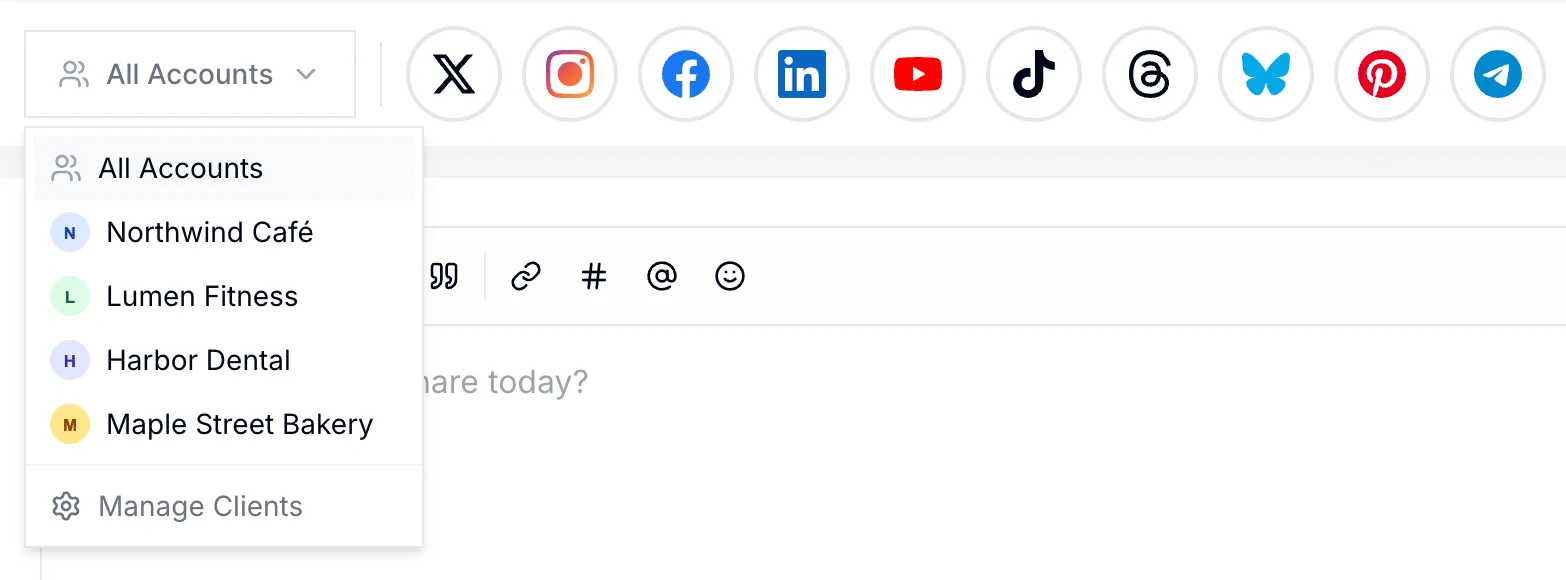
Every agency's recurring fear is posting one client's content to another's account. The offhand joke that lands on the corporate page, a competitor mention on exactly the wrong brand. It happens precisely when contexts aren't isolated: shared logins, one giant merged calendar, five account tabs open at once. The defenses are structural, not willpower: keep one client's context visible at a time, use a scheduler that shows you which account a post is going to before it publishes, and never juggle raw platform logins across clients. Isolation isn't just tidy; it's the safety rail that keeps the nightmare from happening.
Write it down
The last piece is a light SOP, the repeatable steps for how a post goes from idea to published on your accounts, so the process lives in a document instead of one person's head. It's what lets you add a client, or a team member, without the whole system depending on you remembering everything, and it pairs with clear roles: who creates, who approves internally, who publishes. Documented and isolated, more clients stops meaning more chaos and starts meaning more of the same tidy, repeatable job.
Frequently asked questions
How do you manage multiple social media clients?
Keep each client's context isolated (their own space, their own approval flow, their own batch block) and start from one master view of every account you run. The hard part is the context-switching and the risk of cross-contamination, not the raw volume of work.
How do you avoid posting to the wrong client's account?
Isolate contexts structurally rather than relying on care: view one client at a time in a filtered workspace, use a scheduler that shows which account a post is going to before it publishes, and never juggle shared platform logins across clients. The mix-ups happen when everything is merged into one view.
Should each client have their own approval workflow?
Yes. A single agency-wide approval flow doesn't survive real clients, who each sign off differently: one via legal, one over Slack, one with three stakeholders. Set the workflow per client and capture how they approve during onboarding so you're not relearning it every week.
How do agencies stay organized with many clients?
One master inventory of every account and who owns it, an isolated workspace per client, batching content by client to protect brand voice, per-client approval flows, and a light SOP so the process isn't trapped in one person's head. Isolation and documentation are what let it scale.