
How to Respond to Reviews: A Formula, Examples, and What You're Allowed to Do
October 10, 2026 · 9 min read · by Jan Oršula
Respond to every negative review and as many positive ones as you can, within a day or two. A good reply thanks the person, mentions something specific from their review, deals with the problem if there was one, and moves any back-and-forth to a private channel with a named person. Keep it short, never argue, and never share anything about the customer you wouldn't want quoted. The reason it matters: a reply is read by everyone who reads the review after it, so you're mostly writing for the next customer. Below is the formula, example replies for every kind of review, what to do about fake ones, and what Google, Facebook and US law allow.
Who you're really writing for
The person who left a one-star review has usually decided. The dozens of people who read that review next week haven't. They're checking two things: whether the problem sounds like it would happen to them, and how you behave when something goes wrong.
That changes what a good reply looks like. A defensive paragraph that's technically right reads badly to a stranger. A calm, specific reply that fixes the problem can make a bad review do more for you than a good one.
The four-part formula
For any review that mentions a problem:
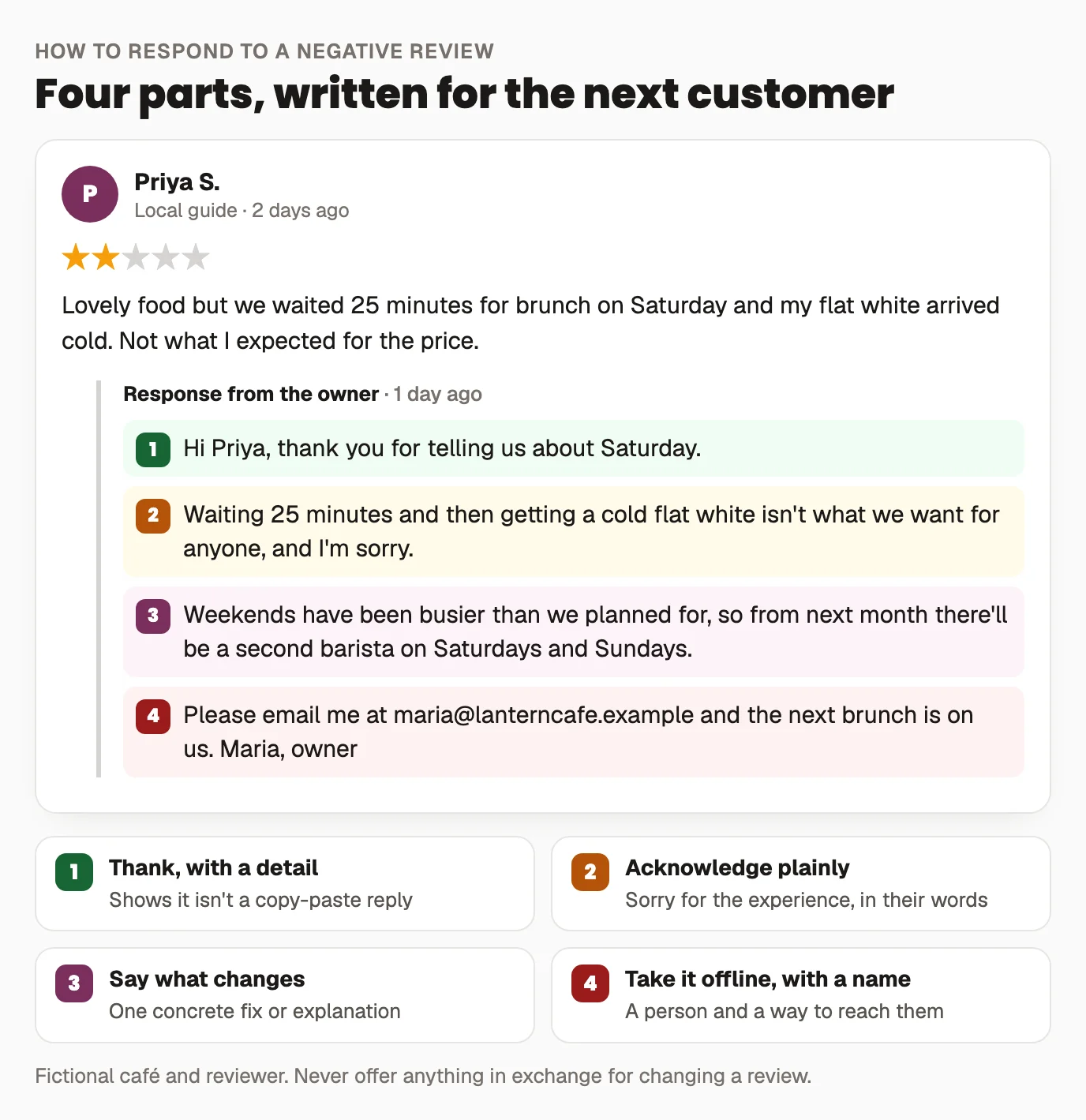
- Thank them and name the specific thing they said, so it's clearly not a copy-paste reply.
- Acknowledge the problem in plain words. "I'm sorry your order was late" works. You can be sorry for their experience without admitting anything you'd need a lawyer for.
- Say what you've done or will do. A fix, a change, or an explanation of what happened, in one or two sentences.
- Take it offline with a name: "Please email Maria at hello@… so we can put it right." A named person reads as real; "contact us" reads as a brush-off.
For positive reviews, steps 1 and 3 are enough: thank them for something specific, and add one line that makes them want to come back.
Example replies, by kind of review
These are for a fictional café, Lantern. Swap in your own details; the specific line is what makes a reply work.
Five stars, with details:
Thank you, Jess! So glad the cardamom bun made your Saturday. It's Tomás's recipe and he'll be very pleased to hear it. See you next weekend?
Five stars, no text:
Thank you for the five stars. We hope to see you again soon.
Short is fine here. Don't invent details the reviewer didn't give.
Three stars, mixed:
Thanks for the honest review, Ben. Glad you enjoyed the food, and you're right that it gets loud at weekend lunchtime. We've added a quieter table area at the back. Ask for it next time and we'll keep it for you.
One or two stars, a fair complaint:
Hi Priya, I'm sorry. Waiting 25 minutes and then getting a cold flat white isn't what we want for anyone. Weekends have been busier than we planned for, so from next month there'll be a second barista on Saturdays and Sundays. I'd like to make this one up to you: please email me at maria@lanterncafe.example and the next brunch is on us. Maria, owner
One star, unfair or mistaken:
Hi Tom, thanks for taking the time to write this. I think there may be a mix-up: we don't serve dinner, so this may be about another café on the street. If it was us, please email me at maria@lanterncafe.example and I'll look into it straight away.
Stay polite even when the reviewer is wrong. Readers usually spot the mistake on their own, and a calm reply makes that easier.
About something you've since fixed:
Thanks, Alex. You were right about the step at the entrance, and we've installed a ramp since your visit. We'd love to welcome you back.
Healthcare and other private services: don't confirm the person is a patient or client, and never mention their treatment. In the US, health privacy law applies to review replies too. Reply generally ("We take every concern seriously. Please call our practice manager on…") and handle the details privately.
What not to do
- Don't argue in public, even when you're right. Correct a fact once, politely, and move on.
- Don't paste the same reply under every review. Readers notice, and it undoes the point of replying.
- Don't offer something in exchange for changing or removing a review. You can fix the problem and let the reviewer decide what to do with their review.
- Don't reveal anything personal: order details, appointment times, what they bought. Even "as we discussed on the phone" can be too much.
- Don't stuff replies with keywords. "Thanks for visiting the best café in Leeds city centre" reads like a robot wrote it.
Fake reviews, and what you can remove
You can't delete reviews on Google or Facebook, but you can report ones that break the platform's rules: fake reviews, spam, reviews about a different business, conflicts of interest (a competitor or ex-employee), and offensive or off-topic content. On Google, open your Business Profile, find the review, and choose Report; Google's help page lists what qualifies. A review that's simply negative won't be removed.
While a report is pending, reply to a suspected fake review calmly and factually:
We can't find any record of a visit or order matching this, and we'd like to understand what happened. Please contact us at hello@… so we can look into it.
On Facebook, you can't remove a single review, but you can report it. Turning off reviews for the whole Page is possible, but it hides your good reviews too, which is rarely worth it.
What the rules allow when you ask for reviews
Asking customers for reviews is fine, and it's the best defence against a few bad ones. Three things to avoid, under platform rules and, in the US, the FTC's 2024 rule on fake reviews:
- Buying reviews, or writing them yourself (including with AI).
- Rewarding a particular kind of review. Offering a discount for "a five-star review" isn't allowed. Thanking everyone who leaves a review, whatever they say, is a different matter, but check each platform's rules first, since Google discourages incentives of any kind.
- Only asking happy customers, or putting off people who might be critical. Ask everyone the same way.
Making it part of the routine
- Route review notifications to the same person who handles comments and DMs, so reviews get the same response targets as the rest of social media customer service.
- For clients, agree who replies to negative reviews. Many businesses want to approve those before they go out; build that into the approval process with a same-day turnaround.
- Watch for patterns. Three reviews about the same problem point to something the business needs to fix, so pass it on to whoever can. If reviews start arriving in a burst, follow your crisis plan.
- Use the good ones (with permission) as social proof in posts; the user-generated content guide covers asking.
Frequently asked questions
Should you respond to every review?
Respond to every negative and mixed review, and as many positive ones as you can. Short, specific thanks under positive reviews shows readers the business is paying attention, and a calm reply under a negative one often matters more to future customers than the review itself.
How quickly should you respond to a negative review?
Within a day or two, ideally the same business day for anything serious. A fast reply shows you take it seriously, but don't reply while you're angry. A short, calm reply a few hours later is better than an immediate defensive one.
Can you remove a bad Google review?
Only if it breaks Google's policies, for example if it's fake, spam, about a different business, written by a competitor or ex-employee, or offensive. Report it from your Business Profile. A review that's simply negative won't be removed, so reply to it instead.
Can you ask a customer to change a negative review?
You can fix the problem and let them know it's been fixed, but don't offer anything in exchange for changing or removing the review. Some customers update their review on their own once the issue is resolved.
Is it OK to offer a discount for reviews?
Offering anything in exchange for a positive review isn't allowed under the FTC's rule in the US, and platforms like Google discourage incentives for reviews in general. Asking every customer for an honest review, with nothing attached, is always fine.