How to Choose a Social Media Username
July 2, 2026 · 7 min read · by Jan Oršula
A good handle is short, easy to say out loud, easy to spell after hearing it once, and, ideally, identical on every platform. Get those right and your username quietly does its job for years; get them wrong and you're either invisible in search or stuck explaining "that's with two underscores and a zero." The method is simple: brainstorm from your name or niche, design for the platform with the strictest limit so the handle fits everywhere, run it through three quick tests, check it's free, and claim it across every app at once. This guide walks each step.
What makes a username worth keeping
Before the brainstorming, know what you're aiming at. A handle that lasts passes three tests:
- Say it. Read it aloud as if recommending your account on a podcast or at an event. If it needs spelling out ("that's f-i-t underscore t-h-e-n"), it fails. The best handles survive being spoken once.
- Spell it. Could someone type it correctly having only heard it? Swapped
letters for numbers (
gr8), silent extra characters, and creative misspellings all fail this. People won't hunt; they'll give up. - Outlast it. Will it still make sense in two years? A handle tied to one narrow trend, a current job, or a city you might leave dates fast. Tie it to your name or your niche instead. Those are the parts of you that travel.
Two habits break all three tests at once: stacking numbers and underscores
(fit_coach_sam_2025 is unsayable, unspellable, and date-stamped) and
chasing a clever pun nobody can reproduce. When in doubt, plainer wins.
One last check before you commit: read the handle as one unbroken string, the
way it actually appears without the spaces you imagine. Plenty of clean
word-pairs hide an unfortunate word across the seam (the classic being
penisland for a pen shop). Then search the name to make sure it isn't an
existing brand or trademark you'd be colliding with, since that's a fight you
lose later even if the handle is free today.
Design for the strictest limit
Here's the rule that saves the most pain: pick a handle that fits the tightest platform, and it fits them all. Username length limits vary a lot, and the floor is low:
- X (Twitter): 15 characters, the tightest of the majors.
- Snapchat: 15.
- TikTok: 24.
- Instagram, YouTube, Threads, Pinterest: 30.
- Facebook: 50.
Design to X's 15-character limit and you can hold the same handle
everywhere, which matters more than people think. One consistent username
makes you findable, makes you taggable without guesswork, and reads as far
more credible than being @yourname on one app and
@yourname.official.real on another. Allowed characters differ too (X and
Snapchat won't take a period; LinkedIn wants hyphens, not underscores), so a
handle built from plain letters and maybe one separator travels furthest.
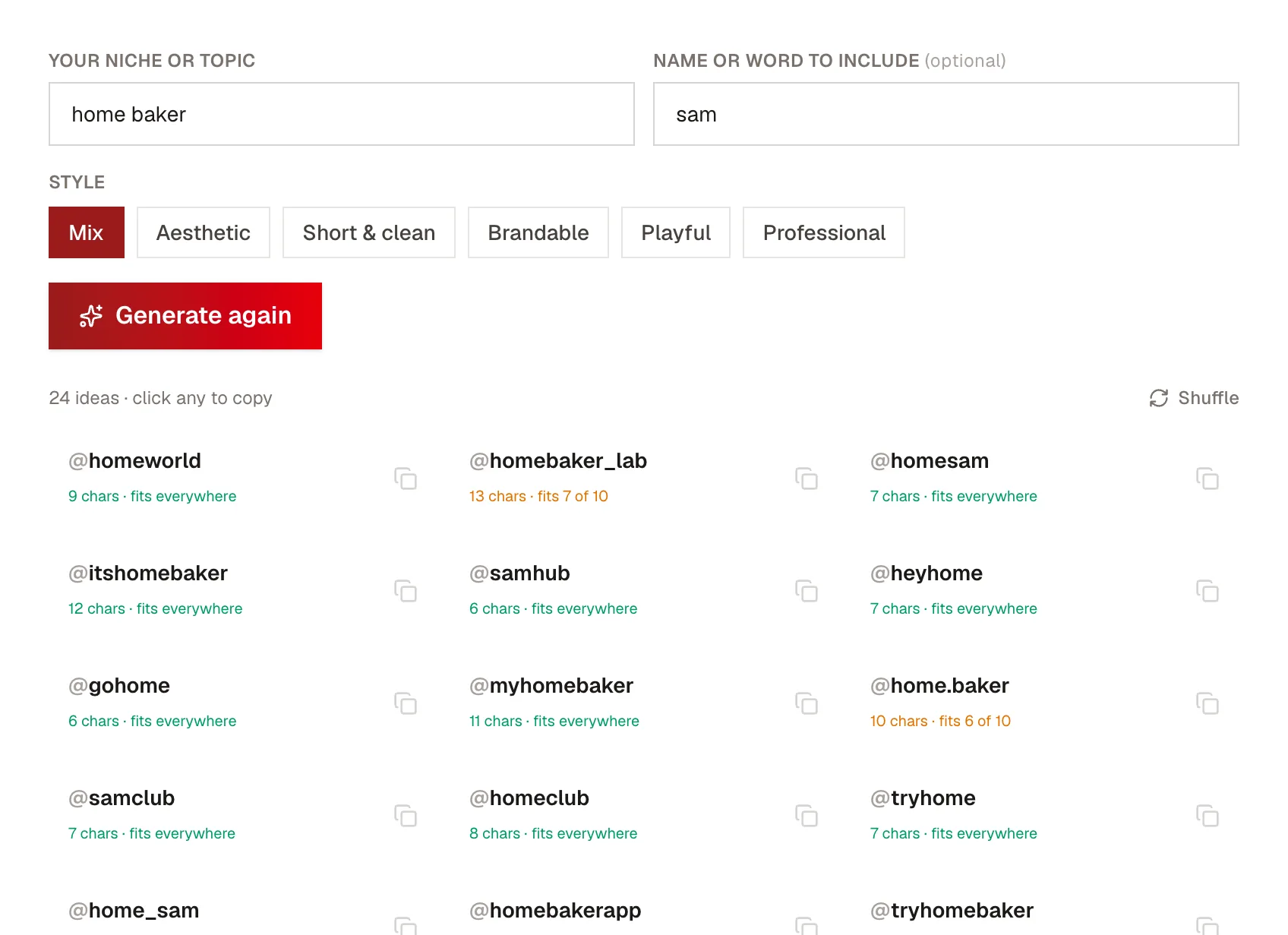
If you're staring at a blank box, our username generator turns your niche and name into dozens of ideas in a few styles (short, brandable, aesthetic), each labelled with its character count so you can see at a glance which ones clear the 15-character bar.
When the handle you want is taken
Most plain names are gone, so expect to work for it. The goal when adapting is to stay readable: you're adding a word, not noise. In rough order of preference:
- Add a descriptive word, not a number.
sambakesbeatssam_2847. A niche word (sambakes,sam.studio,sam.coffee) keeps it meaningful and often reads better than the bare name. - Add a small action or article word.
getsam,trysam,heysam,thesamcoare natural prefixes that platforms and people parse instantly. - Use a category suffix.
samhq,samstudio,sammediafor a brandable, businesslike feel. - Only then consider light separators: a single period or underscore, never stacked.
What to avoid: a string of digits, a doubled letter to dodge a clash
(saambakes), or a different adaptation on each platform. If getsam is your
answer, it should be your answer everywhere. Generating a batch and scanning
for the variant that's both readable and likely free is exactly what the
generator is built for.
How to actually check availability
Once you have a shortlist, verify it, and do it the reliable way. The honest answer to "is this handle free?" lives on the platform itself, so the fastest check is to open each platform's profile URL for the handle: a loaded profile means it's taken, a "user not found" page means it's almost certainly free. Our username checker does this for ten platforms at once. It tells you whether the handle is even valid on each (length and allowed characters) and opens the real profile page for you to confirm. It deliberately doesn't show an automatic green/red verdict, because the tools that do are frequently wrong: they hammer endpoints platforms block, and their answers go stale the moment someone claims the name.
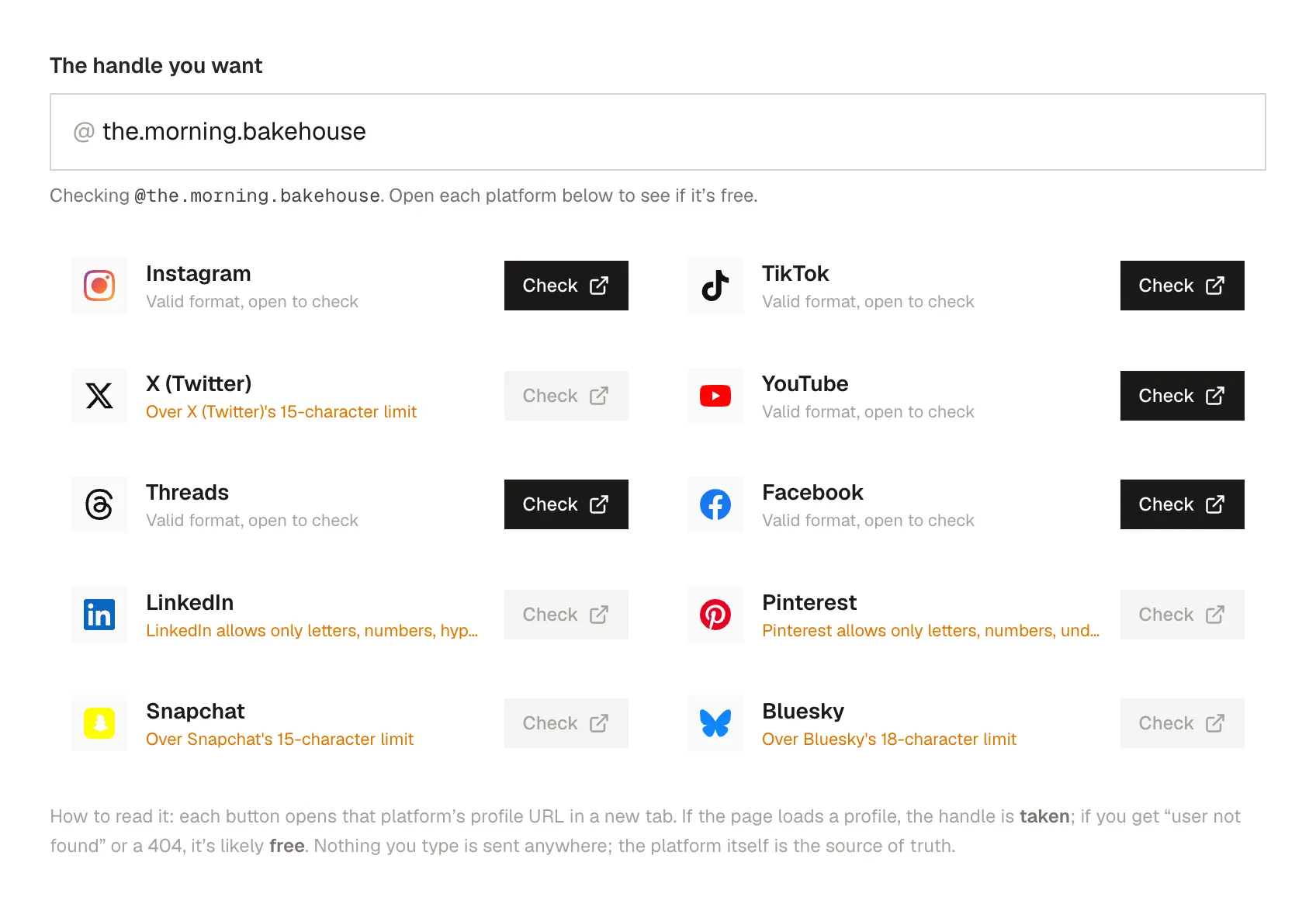
One caveat even a 404 can't cover: some names are reserved for legal, safety, or brand reasons and will show no profile yet still be rejected at sign-up. So treat an open handle as "very likely free" and confirm it for real by starting registration before you build a brand around it.
Claim it everywhere, then lock the profile down
When you find one that's free across the platforms you care about, register it everywhere at once, even on apps you don't plan to use yet. Handles are first-come, and reclaiming one from a squatter ranges from hard to impossible. Securing the name on a platform you might grow into later costs five minutes now and nothing in maintenance.
With the handle claimed, the profile is the next job: a bio that says who you're for and why to follow, sized to each platform's limit. Our bio generator handles that part, and the character counter confirms it fits before you save.
The one-line version
Brainstorm from your name or niche, keep it short enough for X's 15 characters, make sure you can say it and spell it, check it's free on the platforms that matter, and claim it everywhere the same day. A handle chosen that way is one you'll never have to think about again, which is exactly the point.
Frequently asked questions
Should your username be the same on every platform?
Yes, whenever you can manage it. One consistent handle makes you findable, makes you taggable without guesswork, and reads as far more credible than being yourname on one app and yourname.official.real on another. Design to the tightest limit and you can usually hold the same name everywhere.
What makes a good social media username?
Three things: you can say it out loud, someone can spell it correctly having only heard it, and it'll still make sense in two years. That rules out letters swapped for numbers, silent extra characters, and handles tied to a trend, a job, or a city you might leave. Tie it to your name or niche instead, since those travel with you.
What length should a username be?
Short enough to clear the strictest platform, which is X and Snapchat at 15 characters. Design to that 15-character floor and the same handle fits Instagram, TikTok, YouTube, and the rest. Build it from plain letters and at most one separator, because allowed characters differ too. X won't take a period, and LinkedIn wants hyphens over underscores.
What should you do if the username you want is taken?
Adapt it without adding noise. Add a descriptive niche word (sambakes beats sam_2847), a small action or article word (getsam, trysam, thesamco), or a category suffix (samhq, samstudio), in that order of preference. Avoid strings of digits, doubled letters to dodge a clash, and a different adaptation on each platform; whatever you land on should be your answer everywhere.
How do you check if a username is actually available?
Open each platform's profile URL for the handle: a loaded profile means it's taken, a user-not-found page means it's almost certainly free. Be wary of tools that flash an automatic green or red verdict, since they hammer endpoints platforms block and go stale the moment someone claims the name. And since some handles are reserved at sign-up despite showing no profile, confirm by starting registration before you build a brand around it.