
How to Calculate Engagement Rate Without Fooling Yourself
July 10, 2026 · 7 min read · by Jan Oršula
Engagement rate is the share of people who did something with a post (liked, commented, shared, saved) out of the audience it could have reached. The arithmetic is trivial: engagements divided by an audience number, times 100. The trap is the denominator. "Engagement rate" means nothing until you say rate of what (engagements over followers, over reach, or over impressions), because the same post can score 3% one way and 8% another. This guide gives you the three formulas, the one you should actually use, and why most "good engagement rate" benchmarks compare numbers that were never on the same scale.
The formula, all three of them
The numerator is the easy part: add up the interactions on a post (likes + comments + shares + saves; some definitions also fold in clicks). The denominator is where the real choice happens, and it gives you three different rates:
- By followers: engagements ÷ followers. Stable and easy to pull, and it's comparable over time. But it quietly punishes growth: every new follower who doesn't see the post drags the rate down, so a growing account can look like it's declining when it isn't.
- By reach: engagements ÷ accounts that actually saw the post. This answers the question you actually care about: of the people who saw it, how many acted? It's the fairest measure of the content itself. The cost is noise. Reach swings post to post, so the rate is bumpier.
- By impressions: engagements ÷ total times the post was shown. Always the lowest of the three (impressions are at least as high as reach, because they count repeat views), and most useful for paid posts where impressions are the unit you're buying.
- By views: engagements ÷ views. The common fourth denominator for video-first content, used when Reels, TikTok, or Shorts expose views but not reach. Same discipline applies: pick it and never switch.
Pick one and never switch. Our engagement rate calculator makes the choice explicit (a "measure against" setting per platform) and hands you a one-line methodology note ("engagements ÷ reach, monthly average") you can paste straight into a report, which is the part that keeps you honest later. The free report generator prints that formula under the numbers block for you.
Which denominator to actually use
Use reach for organic content when the platform gives it to you: it's the only denominator that measures the post instead of your follower count. When reach isn't available, fall back to followers. It's less true, but it's consistent, and consistency is what makes the number mean anything.
That's the real rule, and it's not about which formula is "correct." It's that the denominator has to be the same every single time: same base month to month, same base across channels, named out loud wherever the number appears. Switching from followers to reach between two reports, or comparing your by-reach rate to a competitor's by-followers rate, isn't a small inconsistency. It's comparing two different measurements and calling them the same one.
What counts as an engagement
Be explicit about the numerator too. Saves and shares are worth more than likes: they signal enough intent that someone wanted to keep the post or pass it on, and some teams weight them or report them separately for that reason. Platforms also define "engagement" differently in their native dashboards, so if you're pulling the number from analytics rather than computing it, check what's actually inside it before you trust it.
"What's a good engagement rate?"
The honest answer is that the question is underspecified. A "good" rate depends on the denominator, the platform, and your size, and those three move it more than the quality of your content does. Smaller accounts almost always post higher rates than big ones (a tight, active audience beats a huge passive one), so a 6% that's great at 2,000 followers would be extraordinary at 200,000.
This is also why published benchmark "averages" disagree so wildly. Different research firms use different denominators, different platforms, and different account-size samples, so their headline numbers aren't measuring the same thing. Quoting one at your client is borrowing a number you can't defend. Skip the chase. Your own trailing baseline (the median rate of your last ~90 days, by your chosen denominator) is the only benchmark that's actually comparable to your next post. Compare each channel to its own history, and a rate becomes a signal instead of a vanity number.
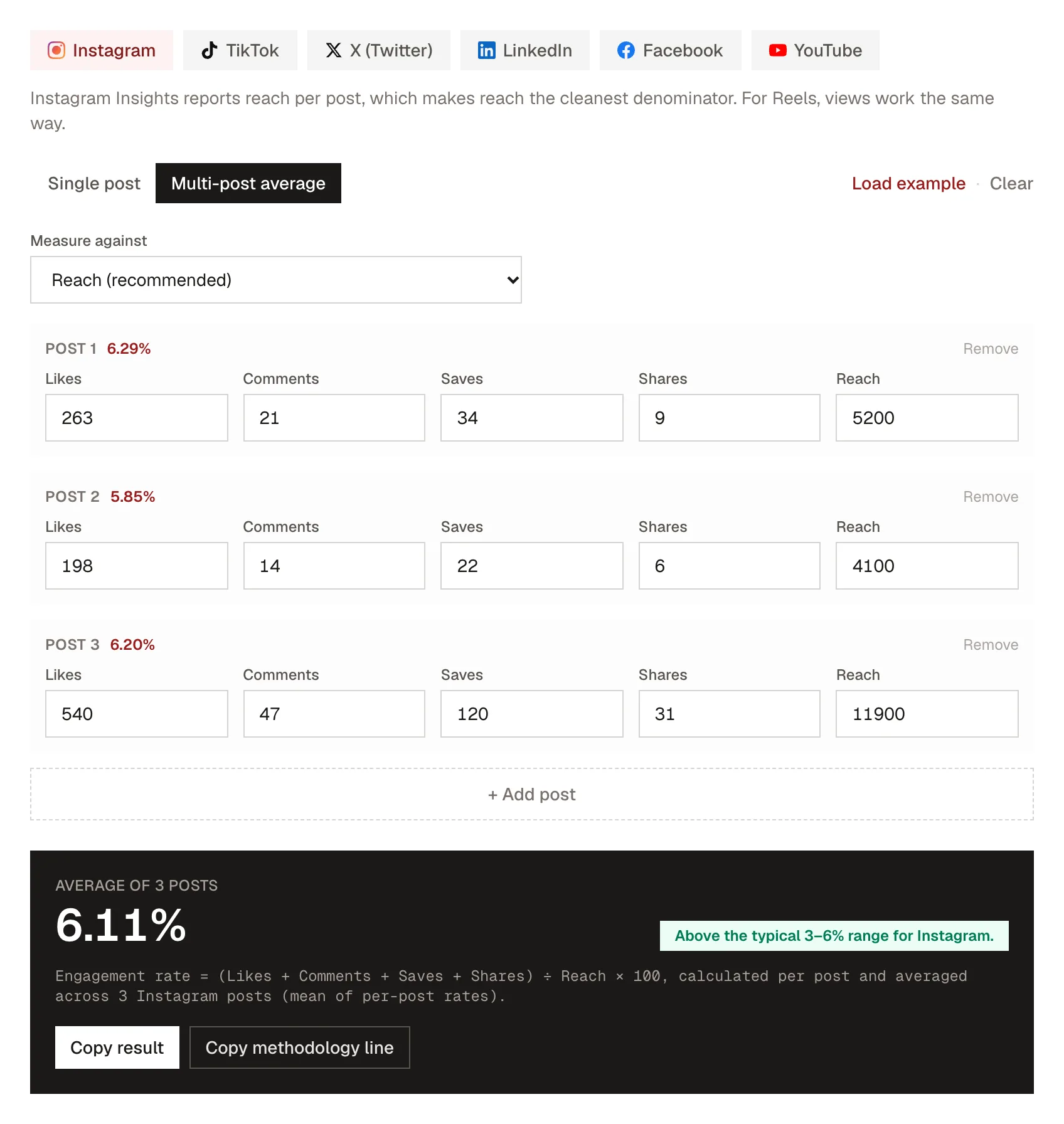
Calculate it in 30 seconds
A worked example. A post earns 1,200 likes, 80 comments, 60 shares, and 110 saves. That's 1,450 engagements. It reached 18,000 accounts, so its rate by reach is 1,450 ÷ 18,000 = 8.1%. The account has 40,000 followers, so its rate by followers is 1,450 ÷ 40,000 = 3.6%.
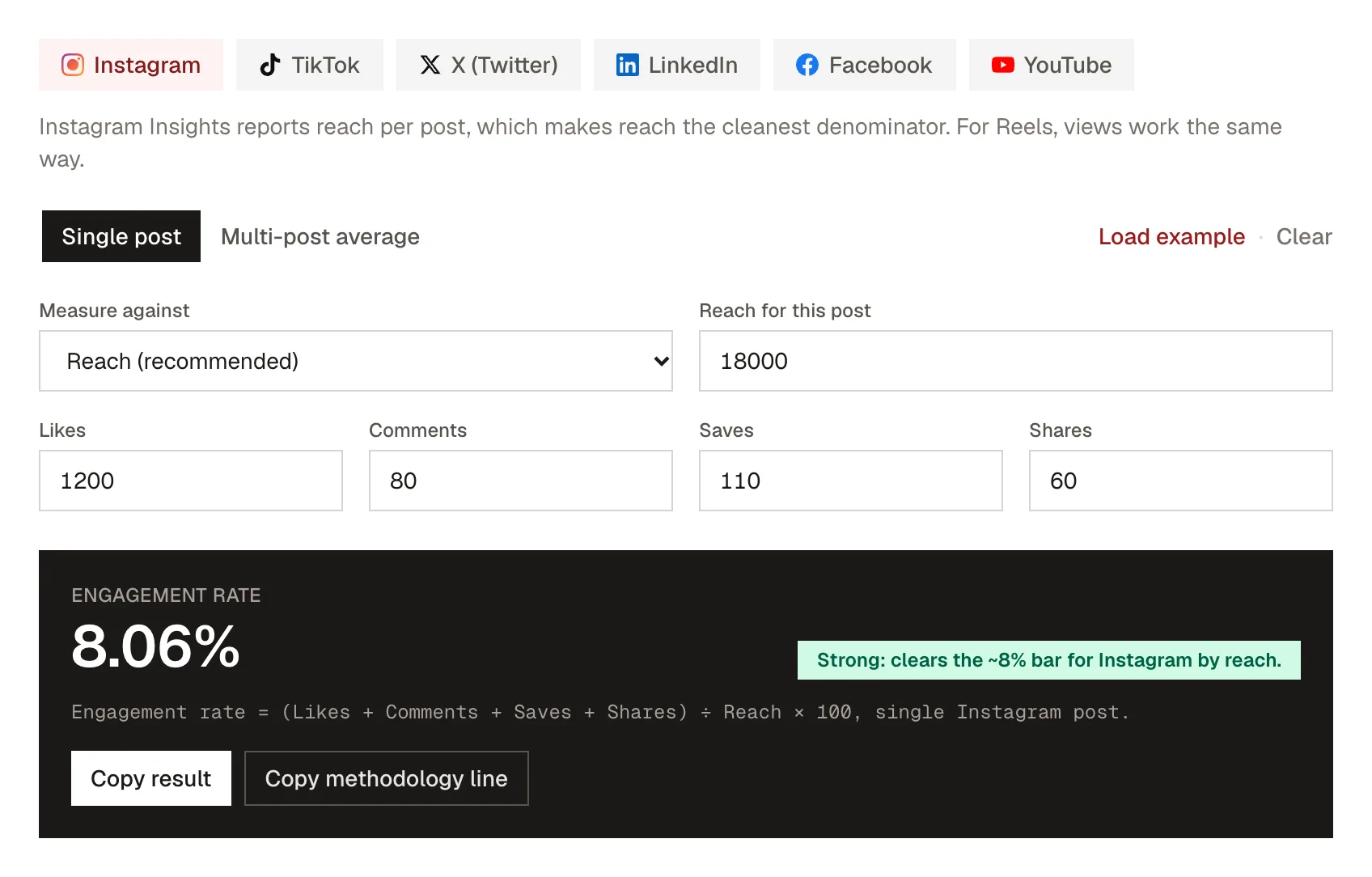
Same post. Two numbers, both arithmetically correct, more than double apart. Only one of them is honest: the one you compare to last month using the same base. That's the whole discipline: the formula is easy, the consistency is the work, and the number is only worth reporting once you can say exactly what it's a rate of.
Frequently asked questions
How do you calculate engagement rate on social media?
Add up a post's interactions (likes, comments, shares, saves) and divide by an audience number, then multiply by 100. The audience number is the catch: divide by reach to measure the content, or by followers for a consistent baseline. Just use the same denominator every time.
Should engagement rate use followers or reach?
Use reach when the platform gives it to you, because it measures how the people who actually saw the post responded rather than your whole follower list. Use followers when reach isn't available; it's less true but consistent. What matters most is picking one and never switching.
What is a good engagement rate?
There's no universal number. It depends on the denominator, the platform, and your account size, and smaller accounts naturally post higher rates. Ignore the conflicting industry averages (they use different formulas and samples) and benchmark against your own trailing 90-day median instead.
Do saves and shares count as engagement?
Yes, and they're the most meaningful kind: saving or sharing takes more intent than a like, so they signal that the content genuinely landed. Some teams weight them more heavily or report them separately for exactly that reason. Just be explicit about what your numerator includes.